It is the 1990s, and two point clouds sit in thirty-dimensional space, perfectly separable by a hyperplane — but infinitely many hyperplanes separate them, and all score zero errors on the data you have. Zero training error is not the goal; the goal is the future. Find the classifier that best guarantees low error on examples not yet seen, which means reasoning about the margin — the width of the buffer between the classes — rather than merely fitting the training points. The generalization guarantee is a theorem, not an empirical hope. Get it wrong and you ship a boundary that aces the test set and fails in the wild, while looking perfect on paper — fitting the past is trivial; the margin buys the future.
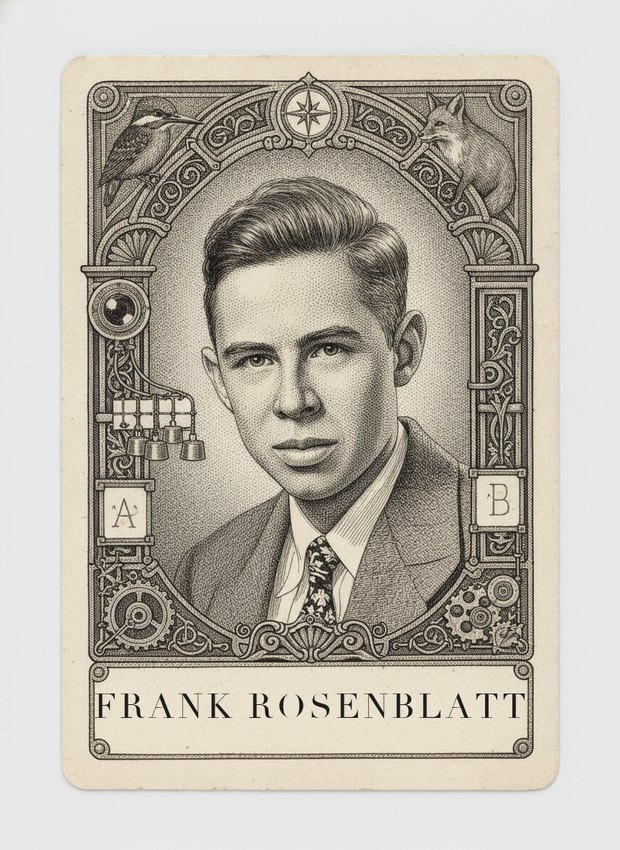
Chose The random-wired network — wrong. The convergence mistake-bound was the one that fit.
Rosenblatt built the perceptron in the late 1950s: an algorithm that provably finds some separating hyperplane whenever one exists, with the Novikoff-style convergence guarantee depending on the margin of the best separator. That makes him the pedagogical anchor here — the margin already appears in his era's mathematics, as the quantity controlling how fast learning converges. What he lacks is the 1990s move: his perceptron stops at any consistent hyperplane, not the widest one, and he had no uniform-convergence theory to say which of the infinitely many zero-error boundaries generalizes. He worked with analog hardware and psychological framing, not quadratic programming. So he can produce a separator and even gesture at why margin matters, but the theorem the problem demands — margin-based generalization — was built three decades after his death in 1971.
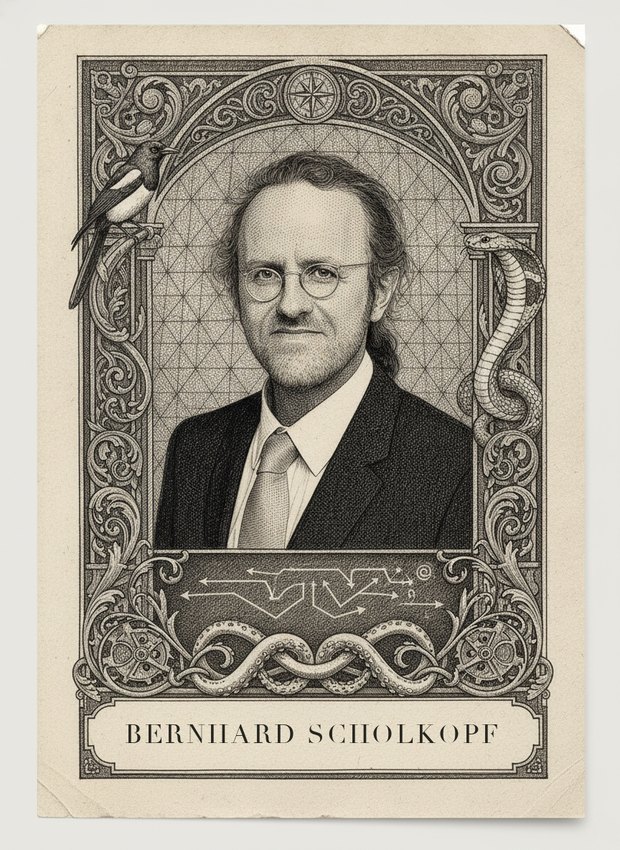
Scholkopf did his doctoral work in the mid-1990s with Vapnik's circle and became the leading builder of the kernel-methods edifice: support vector machines, the kernel trick as a general representer of similarity, kernel PCA in 1998, and the standard monograph with Smola in 2002. For two separable clouds in thirty dimensions he would compute the maximal-margin hyperplane exactly as the field did, and he understands both the optimization (dual quadratic program, support vectors) and the statistical justification (margin-based capacity control). His distinctive contribution — showing that the same maximal-margin machinery lifts to feature spaces via kernels — is more than this linearly separable problem strictly needs, which is the only reason he sits below Vapnik and Chervonenkis: he industrialized and generalized the answer rather than originating its theorem.
Battle #79 · 8/10/2026, 11:36:32 AM · this result is deterministic: the same two personas on this problem always resolve the same way.