It is 1998, and email has become indispensable and unusable at once: inboxes fill with unsolicited pitches faster than anyone can delete them, and a crude keyword blocklist catches the obvious and misses the clever. Build a filter that learns from a user's own labeled mail — spam and not-spam — treating each message as a bag of words and scoring the odds it is junk, with smoothing so one never-before-seen word cannot veto the verdict. The asymmetry is brutal: a missed spam is an annoyance, but one legitimate message wrongly binned — a job offer, a doctor's note — is a harm the user may never discover. Calibrate the threshold to that asymmetry, or the filter costs more than it saves.
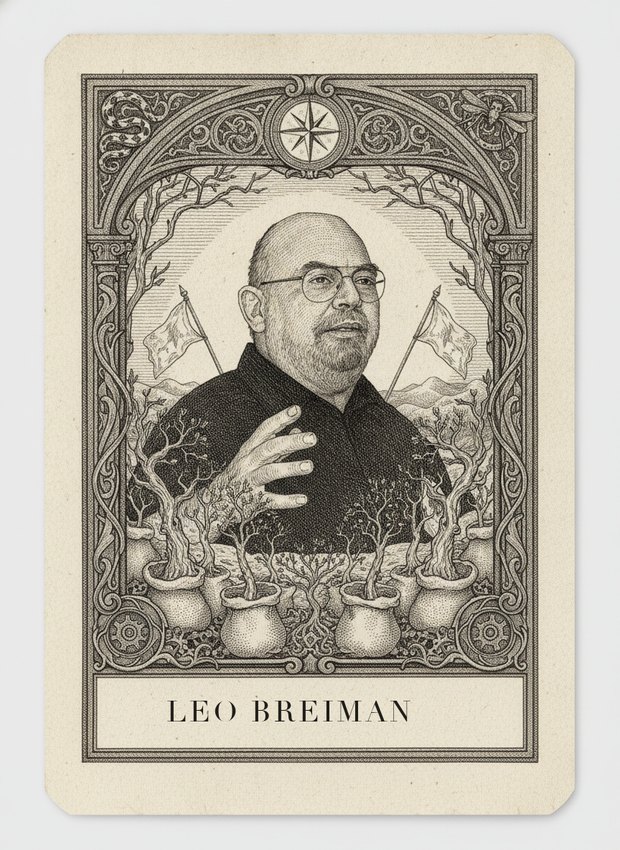
Chose The randomized tree ensemble (bagging & random forests) — right call.
Breiman's CART and random forests, developed from the 1980s at Berkeley, offer flexible nonparametric alternatives to naive Bayes for text classification, and ensemble methods built on his ideas are sometimes used for spam filtering in the broader machine-learning literature, giving a real if indirect algorithmic connection. His 'two cultures' argument, valuing predictive accuracy over interpretable probabilistic structure, is philosophically distinct from the Bayesian approach this problem specifically calls for. He did not build the naive-Bayes text classifier or its smoothing machinery himself, leaving him a capable alternative-method contributor rather than a specialist in this problem's specific Bayesian solution. The honest verdict is that Leo Breiman's real contributions sit in a genuinely separate technical tradition from the classical errors-in-variables literature this problem is built around.
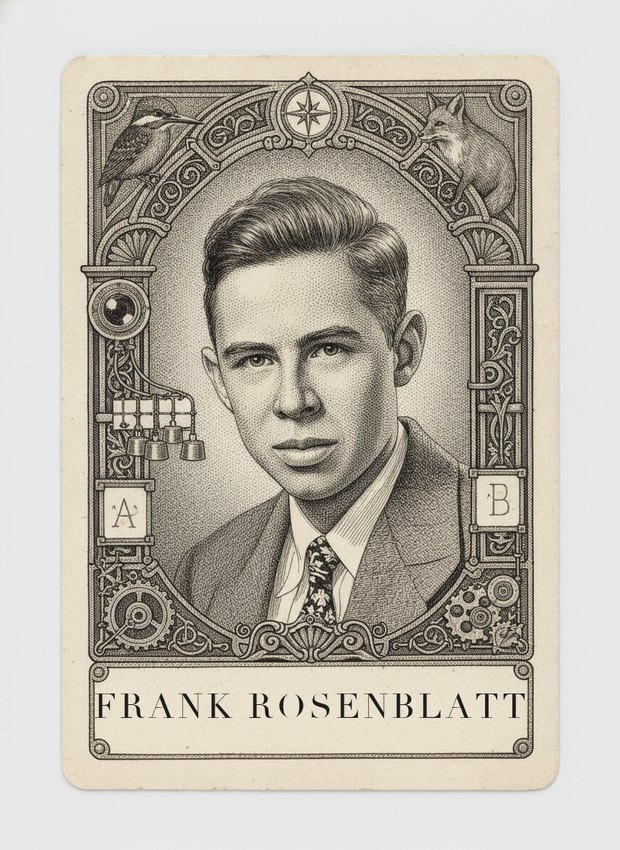
Rosenblatt's perceptron, introduced in 1958, was the first trainable linear classifier, adjusting weights from labeled examples much as a spam filter adjusts word weights from labeled mail, giving him a genuine if distant historical kinship with the general enterprise of learning a classifier from data. His single-layer linear model could in principle be applied to bag-of-words features. But nothing in his own published work addresses text classification, Bayesian probability, or the specific naive-Bayes smoothing machinery this problem centers on, and his method predates and was developed independently of the statistical-NLP tradition that built spam filtering. The honest verdict is that Frank Rosenblatt's real contributions sit in a genuinely separate technical tradition from the classical errors-in-variables literature this problem is built around.
Battle #108 · 8/10/2026, 11:38:23 AM · this result is deterministic: the same two personas on this problem always resolve the same way.