classification
The spam in the inbox
It is 1998, and email has become indispensable and unusable at once: inboxes fill with unsolicited pitches faster than anyone can delete them, and a crude keyword blocklist catches the obvious and misses the clever. Build a filter that learns from a user's own labeled mail — spam and not-spam — treating each message as a bag of words and scoring the odds it is junk, with smoothing so one never-before-seen word cannot veto the verdict. The asymmetry is brutal: a missed spam is an annoyance, but one legitimate message wrongly binned — a job offer, a doctor's note — is a harm the user may never discover. Calibrate the threshold to that asymmetry, or the filter costs more than it saves.
Who this problem belongs to
The two figures whose methods fit it best, out of 71 in contention.
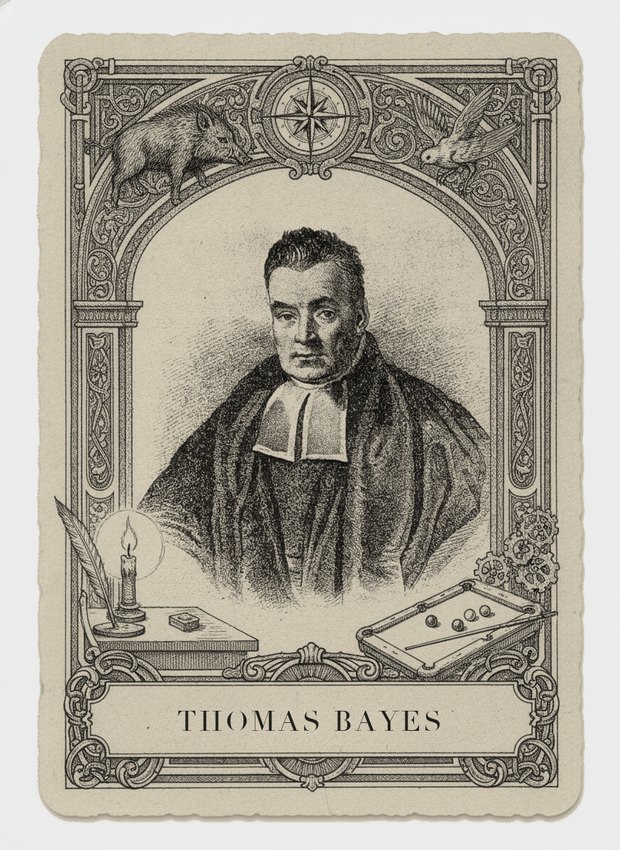
Bayes's theorem, published posthumously in 1763, is the literal mathematical engine of this problem: computing the probability a message is spam given the words it contains by inverting the probability of those words given spam versus not-spam, weighted by a prior rate of junk mail. The naive-Bayes classifier this problem describes is named for exactly this inversion, treating each word as evidence updating a prior belief. He never saw a computer or an email, and the specific 'bag of words' independence assumption and smoothing machinery came two centuries later, but the theorem bears his name because it is the foundational move underneath everything this filter does, an origin no one else on this roster can claim as directly.
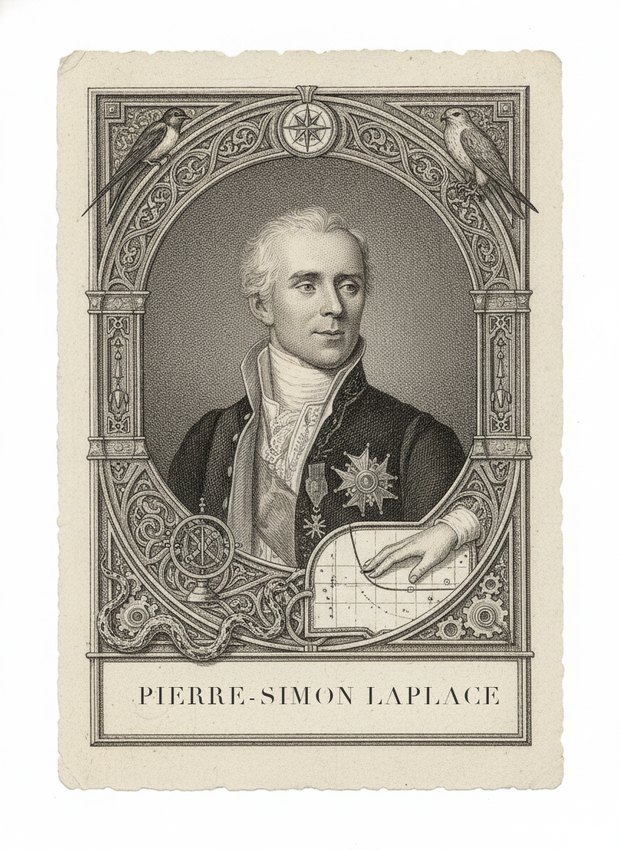
Laplace independently rediscovered and greatly extended Bayes's rule in the 1770s and 1780s, and critically, Laplace's rule of succession, his solution to assigning positive probability to an event never yet observed by adding a small pseudo-count, is precisely the smoothing this problem demands so that one never-before-seen word cannot veto the verdict entirely. What is called Laplace smoothing in every modern naive-Bayes implementation is his direct mathematical contribution, not a later add-on. He built both halves of this problem's core machinery, Bayesian updating and the smoothing that prevents zero-probability catastrophe, making him arguably even more load-bearing to this specific classifier than Bayes himself, short only of the applied text-classification setting.
Fought here
In the mind map
The same ideas, as concepts rather than history — in John's ML knowledge map.
71 figures are scored on this problem. Draw it in a battle to see where you land.