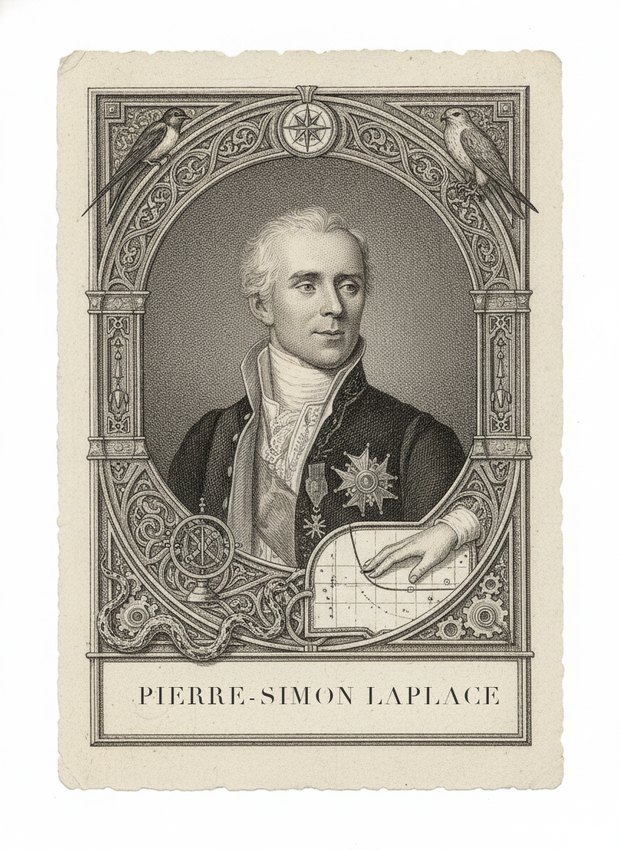
Pierre-Simon Laplace
Bayesian inference in practice; central limit theorem; celestial mechanics
Strongest on
In the mind map
The same ideas, as concepts rather than history — in John's ML knowledge map.
Life and career
Pierre-Simon Laplace was born in 1749 in Normandy, to a family of modest means in the cider-and-farming country around Beaumont-en-Auge. He was headed for the church, studied at Caen, and discovered mathematics there instead. At around nineteen he went to Paris with a letter of introduction to Jean le Rond d'Alembert, who — the story goes — was unimpressed by the letter and impressed by the mathematics Laplace produced on demand. He was placed at the École Militaire teaching cadets, and within a few years was producing memoirs at a rate that made him impossible to ignore. He was elected to the Académie des Sciences in 1773, at twenty-four.
The next fifty years are among the most productive careers in the history of science, conducted through one of the most violent stretches of European political history. Laplace worked through the Ancien Régime, the Revolution, the Terror, the Directory, Napoleon's empire, and the Bourbon Restoration, and he survived all of it — not without cost to his reputation for character. He served on the commission that established the metric system. He was Napoleon's Minister of the Interior for about six weeks in 1799, a tenure that ended when Napoleon concluded he was hopeless at administration; the emperor's remark that Laplace brought "the spirit of the infinitely small" into government is one of the more famous professional dismissals on record. He was nonetheless made a count of the empire, then voted for Napoleon's deposition in 1814 and was made a marquis under Louis XVIII. He examined the young Napoleon at the artillery school; he also, less admirably, was known for adjusting the dedications of successive editions of his books to suit whoever was currently in power.
His scientific life had two great pillars. The first was celestial mechanics: the five-volume *Traité de mécanique céleste* (1799–1825), which took Newton's law of gravitation and worked out, in punishing analytical detail, the perturbations of the planets on one another. His demonstration that the observed secular drifts in the orbits of Jupiter and Saturn were periodic rather than cumulative — that the solar system is stable, with no need of the divine correction Newton had invoked — is the context for the exchange with Napoleon in which Laplace is said to have replied that he had no need of that hypothesis. The second pillar was probability: the *Théorie analytique des probabilités* (1812) and its non-technical companion, the *Essai philosophique sur les probabilités* (1814), which remains one of the best introductions ever written to what probability is *for*.
It is in the *Essai* that he states the famous image of an intelligence that, knowing all forces and all positions at one instant, could compute the entire past and future of the universe — the being later writers called Laplace's demon. The point of the image is usually missed: Laplace introduces it in order to say that we are *not* that intelligence, and that probability is the discipline by which finite minds reason in the gap. He died in Paris in 1827.
Key contributions
Laplace is where Bayes's seed became a working research program. Independently of the posthumous English essay, he formulated inverse probability in memoirs of the 1770s and then spent decades applying it to real data — astronomical observations, birth records, jury verdicts, life tables. If you want a single figure to name as the first practicing Bayesian data analyst, it is him.
Four contributions matter most for a modern reader. First, the **rule of succession**: given a uniform prior on an unknown probability, k successes in n trials give a predictive probability of (k+1)/(n+2) for the next trial. This is the ancestor of every additive-smoothing scheme you have ever used — Laplace smoothing in a naive Bayes classifier or an n-gram language model is this formula, unchanged. Laplace introduced it partly through the deliberately provocative sunrise problem, to make vivid the point that a well-founded inference must assign nonzero probability to an event that has never yet failed to occur.
Second, the **central limit theorem** in an early and general form. Laplace proved that sums of large numbers of independent random quantities tend toward the normal distribution largely irrespective of the distribution of the individual terms. This is the theoretical justification for the ubiquity of the bell curve, for the normal error model in least squares, and for essentially all large-sample frequentist inference. Where Gauss argued that least squares is right *if* errors are normal, Laplace supplied a reason to expect errors to be normal in the first place.
Third, **Laplace approximation and the machinery of asymptotics**. To evaluate the intractable integrals his posteriors demanded, he developed the method now taught as the Laplace approximation: expand the log-integrand around its maximum and treat it as locally Gaussian. In modern terms, this is the second-order Taylor argument behind the Bernstein–von Mises theorem, behind variational and INLA-style approximate inference, and behind the Gaussian sandwich intuition for posterior uncertainty. Related tools — generating functions, and the integral transform that bears his name — came out of the same effort to make hard probability calculations tractable.
Fourth, **estimation applied at scale to messy real data**. He estimated the population of France from a sample of parish birth records with an explicit uncertainty statement, a genuine ancestor of survey sampling. He took up the excess of male over female births across large birth registries and treated it as a formal posterior question about whether the underlying rate differs from one half — a Bayesian hypothesis assessment done in the eighteenth century on hundreds of thousands of records. He worked on error distributions, on comparing estimators, and on what would later be recognized as least-absolute-deviation fitting.
Laplace's determinism is worth taking seriously as a methodological stance, not just a slogan. His probability is *epistemic*: the world is a clockwork, and randomness is a name for our ignorance of initial conditions. This is a coherent and productive position, and it is also precisely the assumption that twentieth-century physics, computational complexity, and machine learning would each, in different ways, undermine.
In battle
Laplace is the strongest of the pre-modern probabilists in this game, and his profile shows why: mean 40.1, median 34, twelve problems at 80 or above and sixteen at 70 or above. He carries a broader competent range than Bayes does — his weakness count (31 problems at 20 or below) is lower — because he brought asymptotics, computation, and applied practice to a subject Bayes left as a principle.
His dominant region is inference from data with structure. "The one-in-a-million event" is his single best problem at 98, and it is literally his: the rule of succession, invented to answer that exact question. "Are boys more likely than girls?" (98) is his own sex-ratio analysis. "The doctor's update" (94), "The spam in the inbox" (91), and "The inbox under siege" (91) are Bayesian updating and naive Bayes classification, where he scores just under Bayes on the pure-theorem problems and above him on anything requiring the calculation to actually be carried out. "Who wrote the disputed papers?" (92) is the Federalist authorship study. Two problems separate him from Bayes decisively: "The match in the small database" (93) and "Count the fish you cannot see" (92) — forensic match probability and capture-recapture population estimation. Both demand estimating an unobserved population quantity from a partial sample with a defensible uncertainty statement, which is exactly the census work he did on French parish records. His category profile confirms the shape: NLP 91.5, small-sample 71.8 across fifteen problems, regression 54.4, classification 49.5, causality 48.4.
His losses cluster into three kinds, and each is diagnostic. **Perception and modern pattern recognition**: "Find every face" (8). Laplace has the normal error model but nothing resembling feature learning, cascades, or the sheer data volume these methods require. **Discrete and combinatorial structure**: "Learning on the molecule graph" (8) — his mathematics is continuous analysis, and graph-structured learning is a register he simply does not operate in, which shows in his networks average of 21.0. **Adversarial, engineered, and systems problems**: "Beat the world champion" (5), "The machine that overdosed" (5), "Optimize across the datacenter" (4), and his floor case "Ship it to a hundred contributors" (3). Game-playing search, safety-critical software engineering, distributed optimization, and open-source collaboration infrastructure are all questions about *artifacts and agents*, not about inference from observation. His games average is 7.5 and his systems average 4.0 — the two lowest numbers on his sheet.
There is a deeper reason his adversarial scores are so poor, and it is philosophical rather than chronological. Laplace's whole framework treats the world as a deterministic mechanism observed through noise. Give him orbits, birth rates, measurement error, or a fixed unknown parameter and he is close to unbeatable. Give him an opponent who is choosing strategies against him, or a system whose behavior depends on how it was built rather than on what generated it, and the demon has nothing to compute. Play Laplace on estimation, smoothing, population inference, and any problem where the answer is a posterior with an honest uncertainty attached. Avoid him wherever the difficulty is combinatorial, adversarial, or engineered.