small-sample
Count the fish you cannot see
It is the 1930s, and a fisheries board must know how many trout live in a lake it can never drain — so you net a batch, mark and release them, then net again days later and count how many bear a mark. From that small overlap you must estimate an entire hidden population and quantify how far off you might be, reasoning from a ratio built on a handful of recaptures. Get it wrong and quotas are set for a stock that isn't there, collapsing the fishery, or set so timidly that a healthy resource goes unused. When the recapture count is single digits, the estimate swings wildly and honesty about that swing is the whole task.
Who this problem belongs to
The two figures whose methods fit it best, out of 38 in contention.
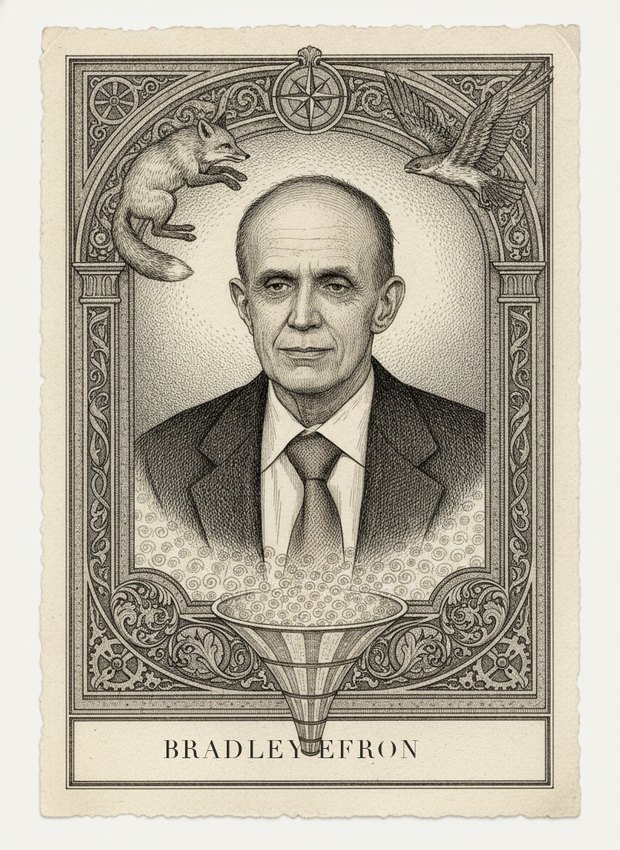
Efron's bootstrap, introduced in his 1979 Annals of Statistics paper, is the single most direct modern answer to exactly what this problem demands: quantifying how far off a small-sample estimator might be when the sampling distribution has no clean closed form. Applied to Lincoln-Petersen recapture data, resampling the marked and captured fish reproduces the variance and skew of the population estimate without relying on fragile normal-approximation formulas that break down at single-digit recapture counts — the exact regime the problem specifies as most dangerous. His empirical Bayes work with Carl Morris further supplies principled shrinkage for combining sparse counts across strata or years. Efron built his career at Stanford specifically on making small-sample uncertainty computationally honest rather than analytically approximate, which is the whole task description in one sentence. He is essentially the modern patron saint of this problem.
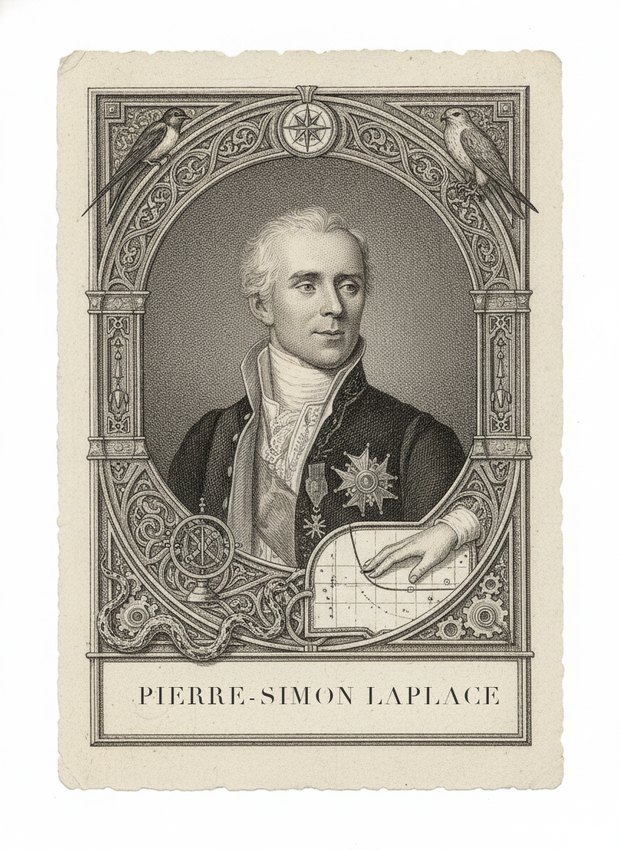
Laplace is the direct historical ancestor of this exact problem type: in his 1783-1786 work estimating the population of France, he used a ratio method strikingly similar to mark-recapture — comparing a known count of registered births in select districts to a separately obtained ratio of births to total population, then scaling up to the whole country, and he explicitly reasoned about the uncertainty of that extrapolation using probabilistic bounds. His broader program treating probability as 'good sense reduced to calculation,' laid out in Théorie analytique des probabilités (1812), gave the field its earliest rigorous framework for inferring an unseen total from a small observed sample plus a ratio, essentially inventing ratio-estimation demography before modern sampling theory existed. He also pioneered inverse probability (Bayesian) reasoning about parameters from data, directly applicable to expressing honest uncertainty about the trout population.
In the mind map
The same ideas, as concepts rather than history — in John's ML knowledge map.
38 figures are scored on this problem. Draw it in a battle to see where you land.