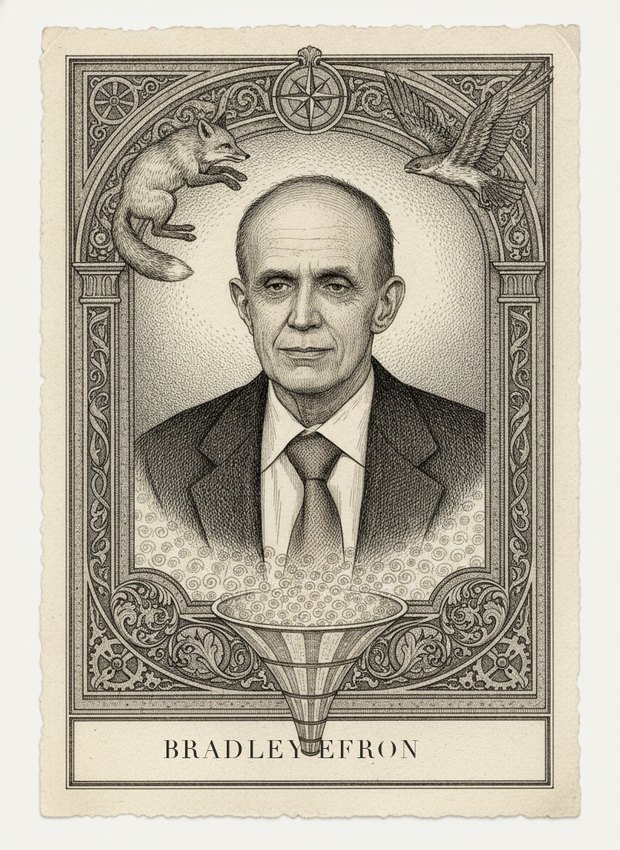
Bradley Efron
The bootstrap; empirical Bayes
Strongest on
In the mind map
The same ideas, as concepts rather than history — in John's ML knowledge map.
Life and career
Bradley Efron was born in 1938 in St. Paul, Minnesota, to Russian Jewish immigrant parents, and arrived at Caltech as an undergraduate intending to be a mathematician. He took his bachelor's degree in mathematics in 1960 and then went to Stanford for graduate work in statistics, completing his PhD in 1964 under Rupert Miller. He has been at Stanford ever since — as professor of statistics and of biostatistics, as department chair, and eventually as Max H. Stein Professor — making his career one of the least geographically eventful and most intellectually consequential in modern statistics.
His early work was theoretical and elegant: on the geometry of statistical inference, on curved exponential families and the role of statistical curvature in second-order efficiency, on the relationship between Fisher information and the observed information. This is the work of someone deeply at home in classical mathematical statistics. It is worth knowing about, because it explains why the bootstrap, when it arrived, was not a hack proposed by someone who could not do the theory. Efron could do the theory. He proposed resampling because he understood exactly where the theory ran out.
The bootstrap paper — "Bootstrap Methods: Another Look at the Jackknife," *Annals of Statistics*, 1979 — is one of the most cited papers in the history of the field. The idea is so simple that its reception involved a certain amount of disbelief, and the name (from "pulling yourself up by your own bootstraps") is a self-aware joke about how implausible it sounds. Efron spent the following decade establishing when it works, when it fails, and how to correct its intervals, culminating in *An Introduction to the Bootstrap* (1993, with Robert Tibshirani), the book that taught the method to a generation of applied researchers.
Efron's second act was large-scale inference. As microarrays and then genomics made it routine to test tens of thousands of hypotheses at once, he returned to empirical Bayes — an idea from Robbins and from Stein's paradox that had been admired more than used — and showed it was the natural framework for the new data. *Large-Scale Inference* (2010) and *Computer Age Statistical Inference* (2016, with Hastie) consolidated this.
The through-line of his career is a methodological argument: the computer is not a convenience appended to statistical theory, it is a legitimate substitute for analytic derivation. Where a previous generation asked "what is the asymptotic distribution of this statistic?", Efron's answer is often "simulate it." He has received the MacArthur Fellowship, the National Medal of Science, the Guy Medal in Gold of the Royal Statistical Society, and the International Prize in Statistics.
Key contributions
**The bootstrap.** You have a sample x₁,…,xₙ from unknown F, and a statistic θ̂ = s(x). You want its sampling distribution and no formula exists. The bootstrap replaces F by the empirical distribution F̂ that puts mass 1/n on each observed point, and then simply *does what the definition says*: draw B resamples of size n with replacement from the data, recompute θ̂* on each, and use the empirical distribution of the θ̂* values as the estimated sampling distribution. Standard errors, bias estimates, and confidence intervals all follow. The conceptual content is a plug-in principle — estimate the functional of F you care about by the same functional of F̂ — plus the observation that Monte Carlo can evaluate that functional when algebra cannot.
The refinements are where the real work is. The naive percentile interval is known to under-cover when the statistic is biased or its variance depends on θ. Efron developed the bias-corrected and accelerated (BCa) interval, which adjusts the percentile endpoints using a bias-correction constant and an acceleration constant estimated by jackknifing, and achieves second-order accuracy. He also developed the ABC approximation for computing these analytically. Equally important is knowing where the bootstrap breaks: for statistics that are not smooth functionals of F (the sample maximum is the standard counterexample), for heavily dependent data unless you resample blocks, and near parameter-space boundaries.
**Empirical Bayes and shrinkage.** Efron and Carl Morris, in a celebrated series of 1970s papers, took the James–Stein estimator — which had been a paradox, a technical curiosity showing that the sample mean is inadmissible in three or more dimensions — and reframed it as empirical Bayes. If θᵢ ~ N(μ, τ²) and you observe zᵢ ~ N(θᵢ, 1), then the Bayes estimator shrinks zᵢ toward μ by a factor depending on τ². You do not know τ², but with many parallel problems you can *estimate it from the data*. Shrinkage stops being a paradox and becomes obvious: the ensemble of estimation problems tells you how much to trust each individual one. Their baseball-batting-average example remains the canonical illustration.
**Large-scale inference and local FDR.** When 20,000 genes are tested simultaneously, Bonferroni is hopeless and the Benjamini–Hochberg FDR procedure is the standard answer. Efron's contribution was to give FDR an empirical Bayes interpretation and then to push it further with the *local* false discovery rate: model the observed z-scores as a two-groups mixture, f(z) = π₀f₀(z) + (1 − π₀)f₁(z), and report fdr(z) = π₀f₀(z)/f(z), the posterior probability that a case with score z is null. The striking practical move is his *empirical null*: rather than assuming f₀ is standard normal, estimate it from the bulk of the data, because correlation across tests, unmodeled covariates, and imperfect normalization routinely make the theoretical null wrong — usually in the direction of manufacturing discoveries.
**Other work.** Efron introduced the least angle regression algorithm with Hastie, Johnstone, and Tibshirani (2004), which computes the entire lasso path efficiently and illuminated why the lasso behaves as it does. His earlier work on the Cox proportional hazards model produced the Efron approximation for tied event times, still the default in most survival software.
In battle
Efron's computed profile makes him one of the most reliably strong personas in the game: mean 51.6 over 100 problems, median 51, **20 dominant scores at 80 or above**, and only thirteen problems at 20 or below. Unlike the sharp specialists — Akaike, Wahba — he wins broadly, because uncertainty quantification is a component of an enormous number of statistical problems rather than a niche.
His peak is **P004 — The bootstrap when theory fails** (97), set in 1979, the year of the paper. The judge calls it his biography: a ratio of two medians from a small paired sample is exactly the class of awkward functional with no tractable asymptotic theory, and the problem's demand for a defense of interval coverage is answered by his own bias-corrected and BCa work. Alongside it, **P124 — Twenty thousand tests at once** (97) is his large-scale-inference program, **P108 — Estimating many means at once** (92) is Efron–Morris empirical Bayes exactly, and **P061 — The hierarchy of hospitals** (93) is the hierarchical-shrinkage problem where partial pooling is the right answer and he built the machinery to justify it. **P012 — One test or twenty?** (92) is multiplicity, **P103 — Count the fish you cannot see** (96) is capture-recapture with an awkward estimator whose uncertainty resists formulas, and **P109 — The match in the small database** (91) rewards careful small-sample reasoning about base rates. **P097 — Does your pipeline reproduce?** (92) is validation, his temperament in one question.
His category profile explains why he is such a good general draft pick: high-dimensional (78.2), small-sample (71.9), testing (69.9), classification (62.5), and regression (51.8), with causality at a respectable 47.7 — he has no do-calculus, but he understands sampling and design well enough not to embarrass himself there.
The losses are sharp and share a common structure: every one of them is a problem where there is no sampling distribution to estimate. **P198 — Program chess before the computer exists** (8) is Shannon's 1949 design essay — hand-built evaluation functions and game-tree search, a deterministic engineering artifact predating his career by three decades. **P163 — The fastest-growing function** (8) is computability. **P081 — Train across a thousand GPUs** (8) and his systems category average of 8 reflect that distributed-training engineering has nothing to do with resampling. **P088 — Attention replaces recurrence** (8) is neural architecture design, and **P243 — Name what you've never trained on** (9) is zero-shot generalization — a modern deep learning capability question with no estimator whose variance he can bootstrap. **P078 — Agreement among the unreliable** (8) is a crowd/consensus problem where the difficulty is modeling annotator behavior rather than quantifying sampling noise.
Practical strategy: play Efron on anything that says "how confident are you?", anything involving many simultaneous estimates or tests, and anything where the sample is small and the statistic is ugly. Note the one trap worth flagging to students — the bootstrap assumes exchangeable draws, so problems with strong dependence or with tiny n are precisely where his own method's assumptions fail, which is why his own battle identity concedes that he loses when samples are too small or too dependent to resample honestly.