small-sample
The bootstrap when theory fails
It is 1979, and computers have finally become fast enough to do statistics no textbook table can. You need a confidence interval for an awkward quantity — the ratio of two medians from twenty-five paired observations — and no closed-form sampling distribution exists, nor will one ever be derived in time. The classical toolkit, built for tractable formulas, simply has no page for this. Resample the data itself, let the computer manufacture the distribution the theory withheld, and defend that the interval means what you claim. Get it wrong and a generation learns to trust intervals that don't cover, or to distrust a method that actually works. The machine is the new pencil; use it honestly.
Who this problem belongs to
The two figures whose methods fit it best, out of 51 in contention.
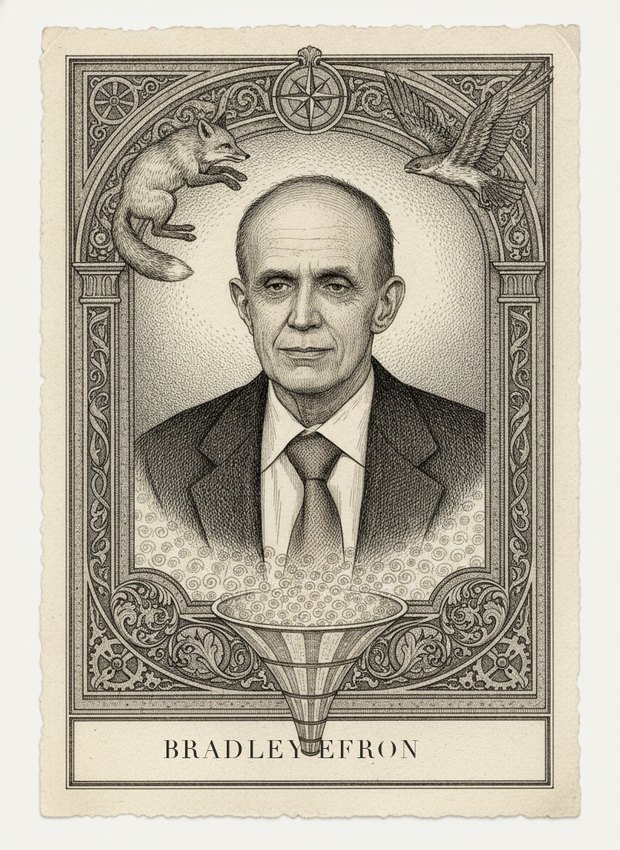
This problem is Efron's biography. His 1979 Annals of Statistics paper 'Bootstrap Methods: Another Look at the Jackknife' — the very year the problem is set — introduced exactly this move: resample the observed data with replacement, recompute the statistic, and let the empirical spread stand in for the sampling distribution no theory could supply. The ratio of two medians from a small paired sample is the flagship class of awkward functionals the method was built for, and his subsequent work on percentile, bias-corrected, and BCa intervals addresses the coverage defense the problem demands, since he knew the naive percentile interval under-covers. His empirical Bayes background gave him the taste for letting data estimate what theory withheld, and Stanford gave him the computers. No one else on Earth is more this problem.
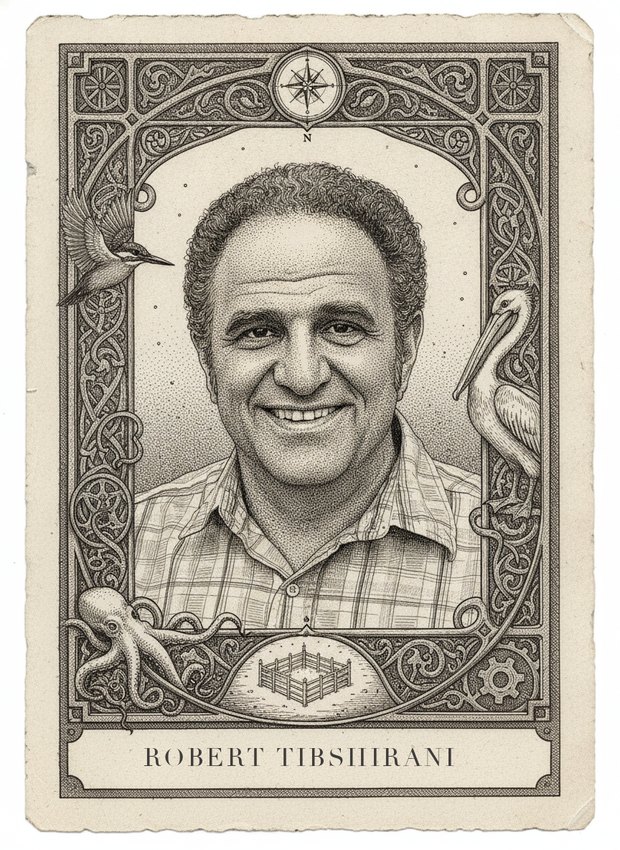
The problem's win line names him, and the record justifies it: Tibshirani co-authored An Introduction to the Bootstrap (1993) with Efron — the book that taught a generation exactly this craft, including worked treatment of awkward functionals like ratios and medians, the percentile-versus-BCa coverage question, and the honest accounting of when B resamples can be trusted at small n. As Efron's student and Stanford colleague, he was formed inside the method's home laboratory, and his own research kept resampling load-bearing: bootstrap and cross-validation for the lasso, standard errors where closed forms were hopeless. Twenty-five paired observations and a ratio of two medians is virtually an exercise from his book, and 'defend that the interval means what you claim' is its recurring theme. He scores under only Efron, the inventor whose look he extended.
In the mind map
The same ideas, as concepts rather than history — in John's ML knowledge map.
51 figures are scored on this problem. Draw it in a battle to see where you land.