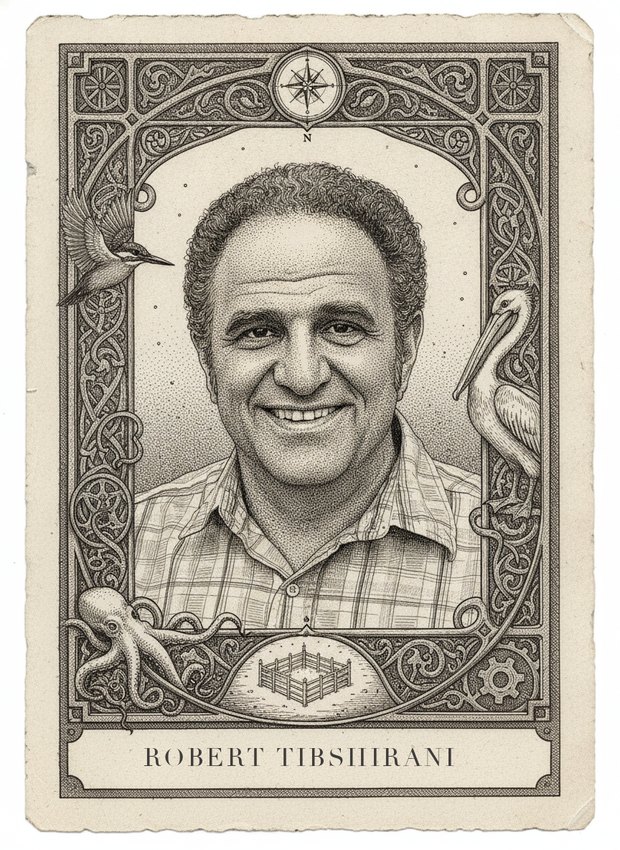
Robert Tibshirani
The lasso; sparsity in regression
Strongest on
In the mind map
The same ideas, as concepts rather than history — in John's ML knowledge map.
Life and career
Robert Tibshirani was born in 1956 in Niagara Falls, Ontario, and took his undergraduate degree in statistics at the University of Waterloo — a program built around co-op placements, which meant he spent chunks of his education doing statistics for actual employers before he had finished learning it. After a master's at the University of Toronto he went to Stanford for his PhD, finishing in 1981 under Bradley Efron. The timing could hardly have been better: Efron had published the bootstrap two years earlier and the department was in the middle of working out what it meant. Tibshirani absorbed both the technical content and, more importantly, the disposition — that a statistical method is worth having if it solves a real problem, and that computation is a legitimate substitute for analysis.
He returned to Canada, joining the University of Toronto in 1985, where he spent over a decade. This is where the two collaborations that define his career took root. With Trevor Hastie, whom he had known at Stanford, he developed generalized additive models, publishing the framework in the mid-1980s and the book in 1990. With Efron he wrote *An Introduction to the Bootstrap* (1993), the text that made resampling accessible to people who were never going to read the *Annals*.
And in 1996 he published, in the *Journal of the Royal Statistical Society*, "Regression Shrinkage and Selection via the Lasso." It is a short paper. It is also one of the most consequential statistical papers of the last half-century, and it arrived at exactly the moment when biology started producing datasets with twenty thousand columns and two hundred rows. He received the COPSS Presidents' Award, the profession's highest honor for a statistician under forty, that same year.
He moved to Stanford in 1998, holding appointments in statistics and in biomedical data science, and the applied half of his career has been substantially medical: microarray and later sequencing data, cancer classification, clinical prediction. That matters for understanding his methods. The lasso is not an aesthetic preference for parsimony; it comes from a setting where a biologist genuinely needs a list of twenty genes to take back to the bench, and where a model naming all twenty thousand is useless.
His later work turned to a problem his own method created. If you use the data to select variables and then compute a p-value for the selected ones, that p-value is a lie — the selection has already used up the evidence. Post-selection and selective inference, developed with Jonathan Taylor, Richard Lockhart, and his son Ryan Tibshirani (himself a prominent statistician), is the attempt to give honest inference after adaptive model selection. More recently he has worked on conformal prediction, which produces distribution-free prediction intervals with finite-sample coverage guarantees. He has been elected to the National Academy of Sciences.
Key contributions
**The lasso.** Minimize the residual sum of squares subject to Σ|β_j| ≤ t, or equivalently
min_β ‖y − Xβ‖² + λΣ|β_j|.
The consequence that makes it revolutionary is geometric. The L1 constraint region is a cross-polytope — a diamond in two dimensions — and it has *corners* on the coordinate axes. The elliptical contours of the residual sum of squares, expanding outward, generically first touch that region at a corner, and a corner is a point where some coefficients are exactly zero. Ridge regression's constraint region is a sphere, which has no corners, so ridge shrinks everything and zeroes nothing. The lasso therefore performs *simultaneous shrinkage and variable selection* in one convex optimization — which is the crucial word, because best-subset selection does the same thing combinatorially and is NP-hard.
The lasso also opened a research program that occupied a generation. Its solution path is piecewise linear in λ, computable by LARS (Efron, Hastie, Johnstone, Tibshirani 2004) or by pathwise coordinate descent (`glmnet`, Friedman, Hastie, Tibshirani 2010). Its variable-selection consistency requires an irrepresentable condition on the design; its prediction consistency requires much less. The penalty generalizes: the **fused lasso** penalizes differences between adjacent coefficients for ordered features, the **group lasso** selects whole groups, the elastic net adds a ridge term to handle correlated predictors, and the **graphical lasso** (with Friedman and Hastie, 2008) applies L1 to the entries of an inverse covariance matrix, estimating a sparse Gaussian graphical model. The lasso penalty is also the convex relaxation at the heart of compressed sensing.
**Bootstrap methods.** With Efron, the book, and independently a body of work on bootstrap confidence intervals and on using resampling to estimate prediction error. This gives him a genuine claim on uncertainty quantification distinct from his sparsity work.
**Genomics methodology.** SAM (significance analysis of microarrays), with Tusher and Chu, was for years the standard tool for finding differentially expressed genes, combining a moderated test statistic with permutation-based FDR estimation. Nearest shrunken centroids (PAM) classifies samples into cancer subtypes while shrinking class centroids toward the overall centroid, producing a classifier that uses only a small number of genes — the lasso instinct applied to discriminant analysis. The **gap statistic**, with Walther and Hastie, gives a principled way to choose the number of clusters by comparing the within-cluster dispersion to that expected under a reference null distribution.
**Post-selection inference.** The covariance test statistic and the broader selective-inference framework condition the inferential distribution on the *selection event* — the set of outcomes that would have led to selecting this model — and derive exact conditional distributions (truncated Gaussians, for polyhedral selection rules like the lasso). This is the honest answer to "which of my selected genes are real?", and it is technically much harder than the selection itself.
**Generalized additive models and the textbooks.** With Hastie, GAMs and backfitting; with Hastie and Friedman, *The Elements of Statistical Learning*; with James, Witten, and Hastie, *An Introduction to Statistical Learning*; with Hastie and Wainwright, *Statistical Learning with Sparsity*.
In battle
Tibshirani's computed profile is that of a strong specialist with an unusually wide specialty: mean 37.1 across 100 problems, **eleven dominant scores**, and thirty-six problems at 20 or below. The specialty is sparsity, and sparsity turns out to touch a surprising number of the game's statistical problems.
He shares his top score across two problems. **P018 — p = 20,000, n = 200** (98) is the lasso's founding use case, and the judge notes that his post-selection inference work attacks the harder half — saying which selected genes are real rather than artifacts of selection. **P182 — The corner that sparsity loves** (98) is the L1 geometry itself, described above; nobody owns that corner more completely. **P283 — Five hundred stocks, one year of days** (93) is graphical lasso territory, and **P134 — When the predictors move together** (86) is the correlated-design problem the elastic net addresses. **P124 — Twenty thousand tests at once** (85) is multiple testing in genomics, where SAM and permutation FDR are his. **P094 — Reconstruct from too few measurements** (85) is compressed sensing, where the L1 relaxation being solved is his penalty even though the recovery theorems are Donoho's and Candès's. **P004 — The bootstrap when theory fails** (90) reflects his Efron lineage and the book. And **P281 — Inference after the search** (88) is selective inference, a problem class where very few people on this roster have anything rigorous to say.
His categories: small-sample 75, testing 68.5, high-dimensional 63.5 across eleven problems, regression 53.5, classification 47.7 across seventeen. That is a broad, strong supervised-learning footprint.
The losses are almost all algorithmic or adversarial. He scores 6 on **P199 — Prune the game tree, provably** and 6 on **P194 — Prune the adversary's replies** — alpha-beta pruning and its node-count analysis, deterministic combinatorial theorems from 1975 with no data in them. **P183 — Cool it slowly** (6) is simulated annealing, **P161 — How many bits must cross the wire** (7) is communication complexity, **P252 — The document that links anywhere** (8) is hypertext system design, and **P243 — Name what you've never trained on** (7) is zero-shot generalization in the modern deep learning sense.
The weakness worth naming explicitly to students is the one in his own battle identity: **the lasso assumes sparsity**. When the truth is dense — when everything matters a little, as it plausibly does in polygenic traits and in many economic systems — L1 selection is not merely suboptimal, it is actively misleading, returning a confident short list that is an artifact of the penalty rather than a property of the world. Ridge, or a dense shrinkage estimator, wins there. Drafting Tibshirani onto a dense-signal problem is the single most instructive mistake a player can make with him.