regression
p = 20,000, n = 200
It is the genomic era, and a microarray hands you twenty thousand gene-expression measurements on just two hundred patients — vastly more predictors than people, a regime where classical regression simply dissolves, fitting the noise perfectly and generalizing not at all. Somewhere in those twenty thousand genes, a handful actually drive the disease. Find that handful, and — harder — say honestly how confident you are that each is signal and not one of the countless noise genes that will, by sheer number, mimic a real effect. Get it wrong and biologists chase phantom genes for years, or a real drug target is buried under false positives. In the p ≫ n world, sparsity and honest selection are the only things standing between you and self-deception.
Who this problem belongs to
The two figures whose methods fit it best, out of 64 in contention.
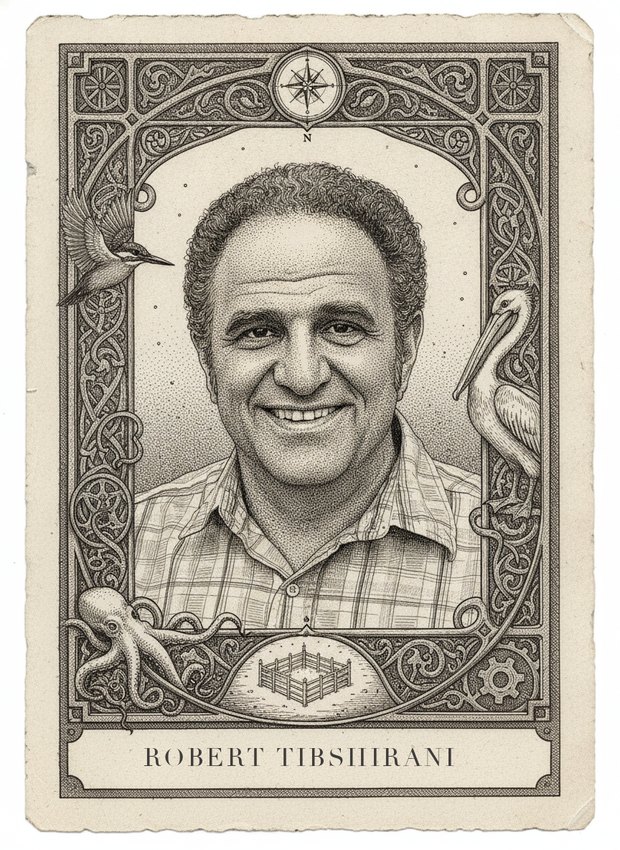
Tibshirani's 1996 lasso is the canonical answer to this exact problem: an L1 penalty on a linear model that simultaneously shrinks coefficients and sets most of them exactly to zero, so out of twenty thousand genes it returns a sparse handful. He built the p >> n machinery deliberately for genomic and biomedical data, later co-authoring the coordinate-descent glmnet software that made lasso and elastic-net regressions on microarray matrices routine on a laptop. His work on significance testing for the lasso and the 'covariance test' directly attacks the harder half of the problem — honest post-selection inference, saying which selected genes are real rather than artifacts of selection. Few historical toolkits map onto a problem so perfectly; this is the tool the problem was written around.

Candes co-founded compressed sensing, the theory establishing that a sparse signal in twenty-thousand dimensions can be recovered exactly from a couple hundred measurements via L1 minimization, provided a restricted-isometry condition holds. That is precisely the p >> n regression regime here. He proved when sparse recovery succeeds and quantified error, giving the field its guarantees rather than heuristics. Crucially he also built the honest-selection half: the knockoff filter (with Barber) controls the false-discovery rate among selected variables in exactly the genomic setting the problem describes, so a biologist chasing gene lists gets a calibrated error rate. Between recovery theory and FDR-controlled selection, Candes covers both the 'find the handful' and 'say how confident' demands about as completely as any single researcher in the batch.
Fought here
In the mind map
The same ideas, as concepts rather than history — in John's ML knowledge map.
64 figures are scored on this problem. Draw it in a battle to see where you land.