It is the genomic era, and a microarray hands you twenty thousand gene-expression measurements on just two hundred patients — vastly more predictors than people, a regime where classical regression simply dissolves, fitting the noise perfectly and generalizing not at all. Somewhere in those twenty thousand genes, a handful actually drive the disease. Find that handful, and — harder — say honestly how confident you are that each is signal and not one of the countless noise genes that will, by sheer number, mimic a real effect. Get it wrong and biologists chase phantom genes for years, or a real drug target is buried under false positives. In the p ≫ n world, sparsity and honest selection are the only things standing between you and self-deception.

Chose The randomized tree ensemble (bagging & random forests) — right call.
Breiman's random forests became a standard microarray tool: they handle p >> n gracefully, are resistant to noise features, and produce variable-importance scores that rank which of twenty thousand genes matter, effectively doing embedded selection. His 'two cultures' essay argued precisely that algorithmic predictive models outperform classical regression when p is huge and structure is unknown — the problem's thesis. Random forests give strong prediction and a defensible importance ranking, but they are weaker on the second demand: calibrated significance for each gene, since importance scores lack a clean false-discovery interpretation without added machinery. So Breiman is a genuinely applicable, historically-used tool for the 'find the handful' side, scoring solidly above midpoint, but below the sparse-regression specialists who also deliver honest per-gene inference.
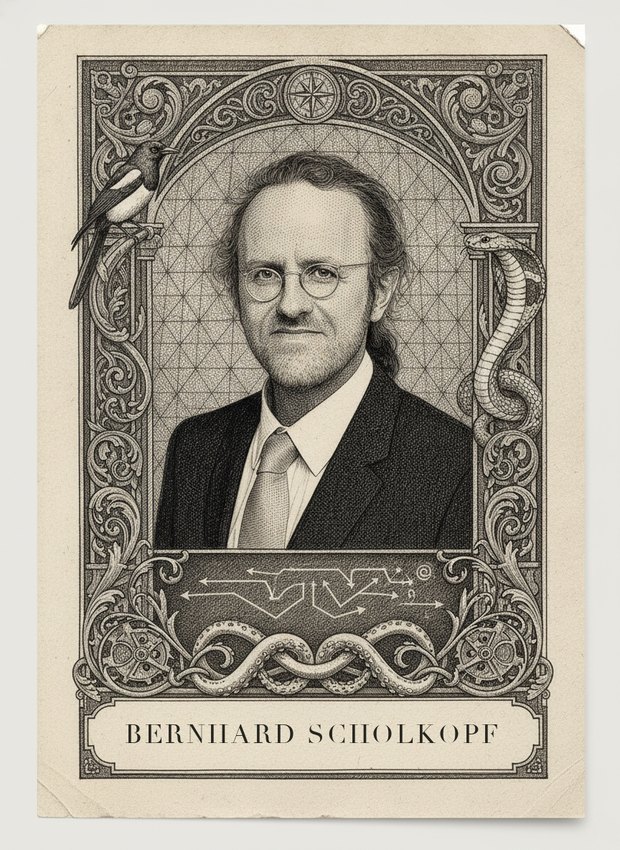
Scholkopf systematized kernel methods and regularization theory — support vector machines with L2 penalties handle p >> n naturally by working in feature space and controlling capacity via margins, and SVMs were in fact widely applied to microarray classification. His representer-theorem and regularization framing directly address overfitting when features vastly outnumber samples. His later causal-inference work bears on distinguishing driver genes from correlated passengers, a real concern in the problem. He scores above midpoint because kernel/regularization machinery genuinely applies, but below the sparsity specialists: standard kernel methods give dense, not sparse, solutions, so they classify well but do not natively return a short interpretable gene list with per-gene significance. The 'find the handful and say how confident' demand is not the SVM's home turf, tempering the score.
Battle #159 · 8/10/2026, 11:41:08 AM · this result is deterministic: the same two personas on this problem always resolve the same way.