causality
The hierarchy of hospitals
It is 1999, and hospital report cards have arrived: newspapers publish mortality league tables, patients choose surgeons by them, and administrators live in fear of them. You have mortality rates across 300 hospitals with wildly different volumes — a rural hospital with twelve cardiac cases sits in the same table as an urban center with four thousand. Rank them without crowning small-sample flukes: raw rates make the tiny hospitals both the best and worst in the nation by pure noise. Partial pooling — shrinking each hospital's estimate toward the ensemble in proportion to its ignorance — is the principled answer, and it must be defended to journalists who will call it fudging. Rank naively and a good small hospital is destroyed by three unlucky deaths.
Who this problem belongs to
The two figures whose methods fit it best, out of 58 in contention.
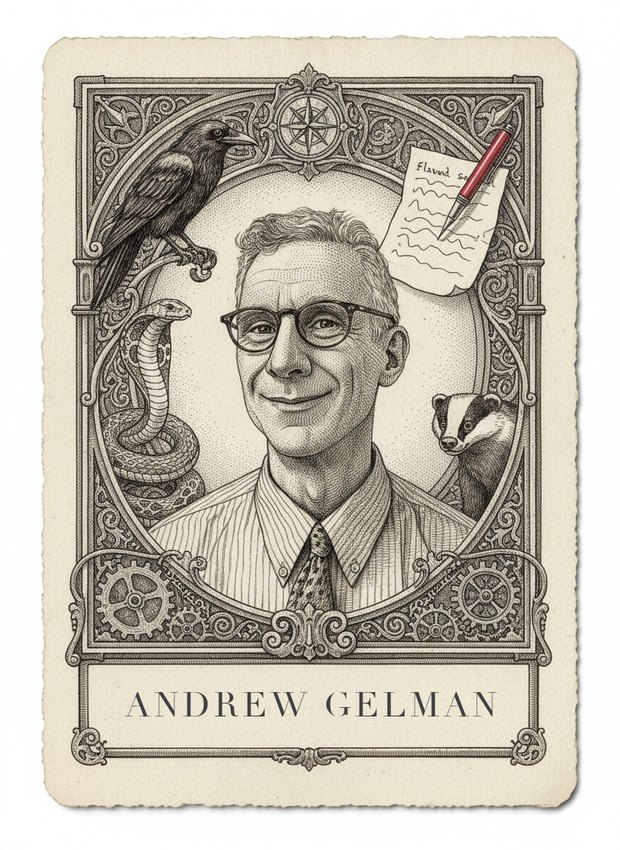
This is Gelman's home problem, stated in his own decade. Through the 1990s he built exactly this machinery: Bayesian Data Analysis (1995) codified hierarchical models with partial pooling as the default treatment of grouped data, and his applied work — the eight-schools example, radon levels by county, small-area estimation — is structurally identical to 300 hospitals of varying volume. He can write the binomial-normal hierarchy, estimate the between-hospital variance, shrink each hospital in proportion to its ignorance, and, crucially, propagate ranking uncertainty — his later writing warns explicitly that ranks are far noisier than the estimates beneath them. He is also the field's most practiced public explainer of why shrinkage is not fudging, the journalist-facing half of the problem. Method, era, and communication all align; top of the batch.
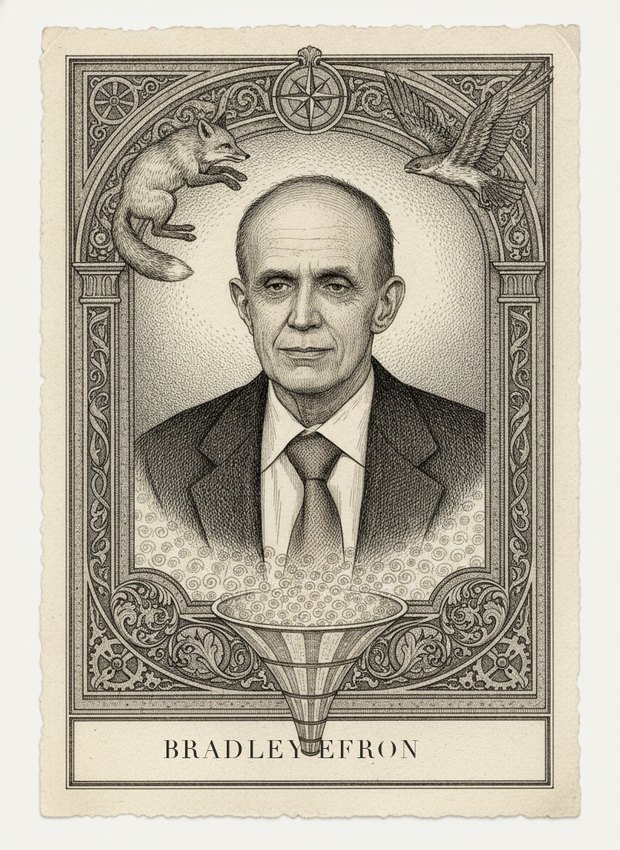
Efron owns half of this problem outright. His 1975-1977 papers with Carl Morris — Stein's estimation rule and its competitors, and the Scientific American piece on Stein's paradox — used exactly this structure: shrink each unit's raw rate (batting averages, toxoplasmosis rates by city) toward the ensemble mean in proportion to its variance, and they defended shrinkage to lay readers, the journalist-facing clause of the problem. Empirical Bayes, which he championed as the frequentist's honest route into pooling, lets the 300 hospitals estimate their own prior. His bootstrap (1979) then delivers ranking uncertainty without distributional leaps. By 1999 all of this is mature, tested methodology he has taught for two decades. He cedes only the full Bayesian multilevel workflow to Gelman; otherwise this is his signature move.
Fought here
In the mind map
The same ideas, as concepts rather than history — in John's ML knowledge map.
58 figures are scored on this problem. Draw it in a battle to see where you land.