small-sample
The one-in-a-million event
It is the turn of the nineteenth century, and a natural philosopher is asked the oldest hard question in probability: what odds do you give an event that has never once occurred? You have watched ten thousand trials and counted zero successes — yet 'impossible' is plainly the wrong answer, because unseen is not the same as never. Estimate the probability of the never-yet-observed and defend the reasoning that lets you assign a positive number to nothing. The choice of prior is the whole argument. Get it wrong and every downstream forecast that rests on rare events — floods, failures, unseen words in a language — inherits either false certainty or paralysing doubt. Smoothing from nothing is a philosophical commitment, not a trick.
Who this problem belongs to
The two figures whose methods fit it best, out of 41 in contention.
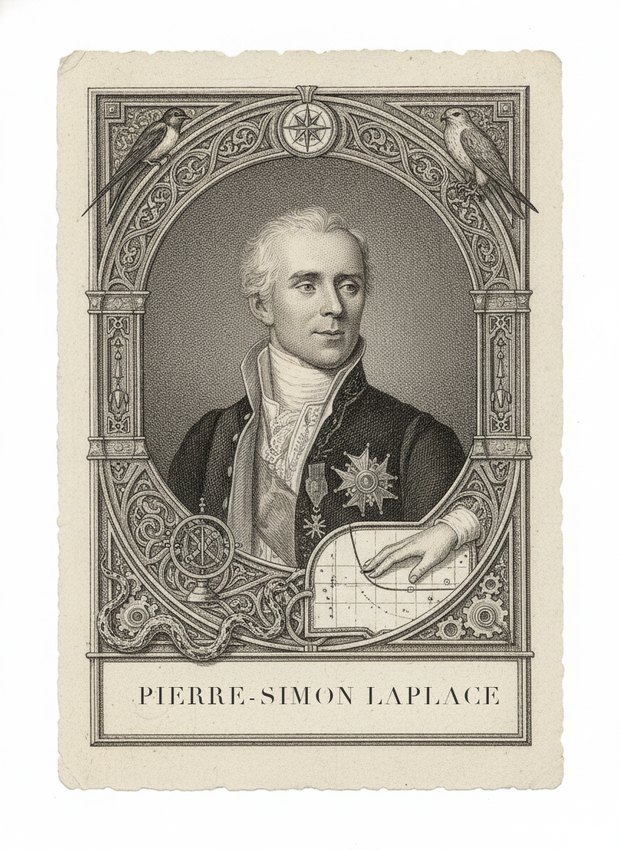
This problem is Laplace's own. His 1774 memoir on the probability of causes, elaborated in the Essai philosophique sur les probabilites (1814), derives the rule of succession: with a uniform prior on an unknown chance, n trials and k successes give a predictive probability of (k+1)/(n+2) — for zero successes in ten thousand trials, roughly one in ten thousand and two, positive but tiny. He posed the sunrise problem precisely to dramatize assigning nonzero probability to the never-yet-failed. Crucially, he did not just compute; he defended the uniform prior as a principled expression of ignorance and understood its choice was the philosophical crux. He also worked celestial and demographic data where rare events mattered practically. Every later smoothing scheme is a footnote to this calculation. He wins on home turf.
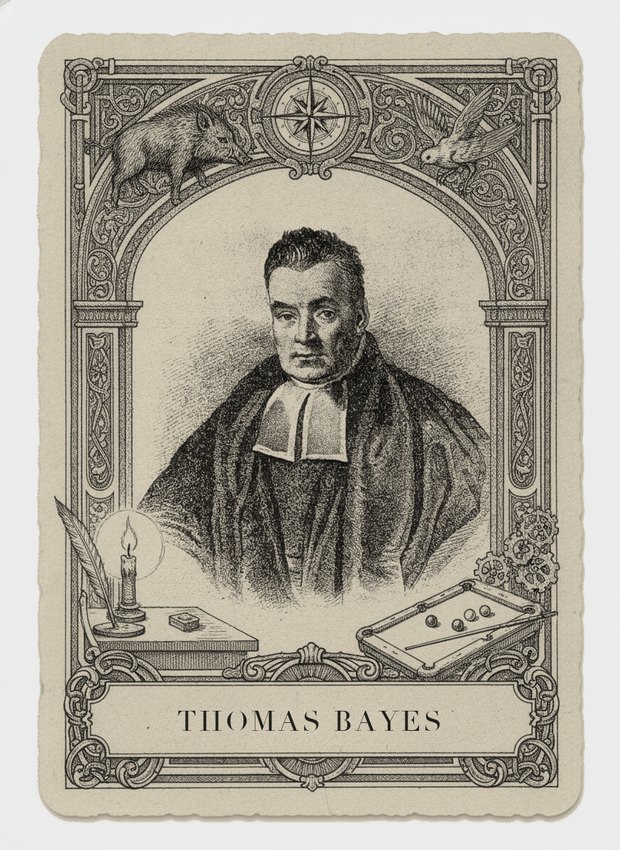
Bayes's posthumous 1763 essay solves the core mathematical problem here: inferring an unknown chance from observed trials. His billiard-table construction gives a uniform prior over the unknown probability and derives the full posterior — which, applied to zero successes in ten thousand trials, concentrates near zero but assigns positive predictive mass, exactly the required answer. What Bayes supplies that few others can is the justification: probability as a coherent degree of belief updated by evidence, so 'unseen is not never' becomes a theorem rather than a slogan. His limitation relative to Laplace is scope and polish — he never published, never generalized to prediction of the next trial explicitly (the rule of succession is Laplace's step), and never confronted prior sensitivity across applications. Still, the machinery this problem demands is his invention.
In the mind map
The same ideas, as concepts rather than history — in John's ML knowledge map.
41 figures are scored on this problem. Draw it in a battle to see where you land.