small-sample
The match in the small database
It is the mid-1990s, and a forensic laboratory has found a DNA profile shared between a crime scene and a suspect — but the frequency of that profile in the population is estimated from a reference database of only a few hundred people, and the courtroom will treat your number as decisive. From that small sample you must estimate how rare the profile truly is, with an interval wide enough to be honest about sampling error and the population subgroups the database underrepresents. Get it wrong and a coincidence is presented to a jury as a one-in-a-billion certainty, or a real match is discounted — when a number this consequential rests on a few hundred samples, overconfidence is a miscarriage of justice.
Who this problem belongs to
The two figures whose methods fit it best, out of 45 in contention.
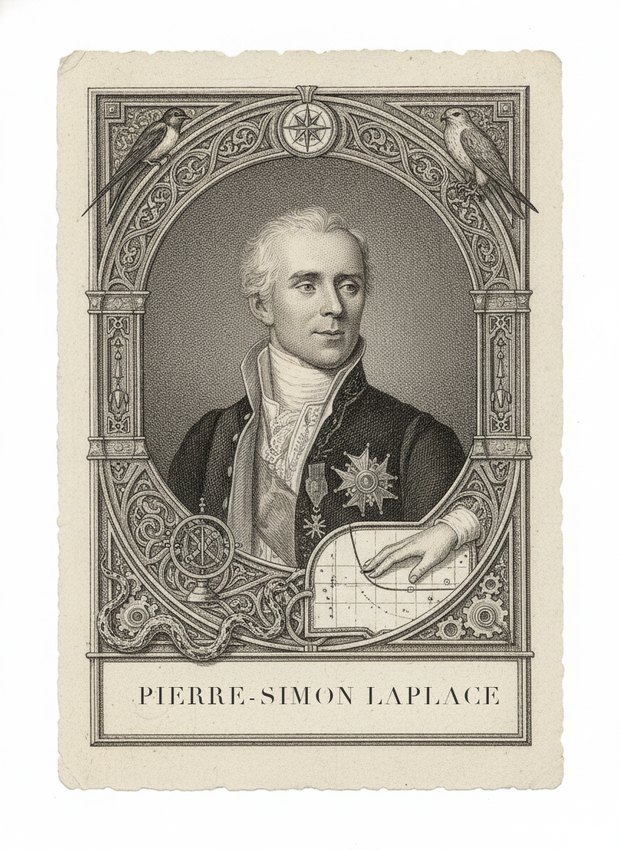
Laplace built the rule of succession to answer this shape of question: given a small number of observed trials, what probability should be assigned to an event, and how confident can you be in that number? His 1780s work on the sex ratio at birth already wrestled with thin registers from small towns, refusing to let a handful of counts either invent or bury an effect, attaching an interval built from an explicit prior rather than a bare point estimate. A 1990s forensic database of a few hundred profiles is the same problem in modern clothes: a rare-event frequency estimated from limited data, presented to a jury that will not tolerate false confidence. Laplace's insistence on an explicit prior and honest uncertainty around a small-sample proportion is exactly the discipline the courtroom needs and naive point estimates omit.
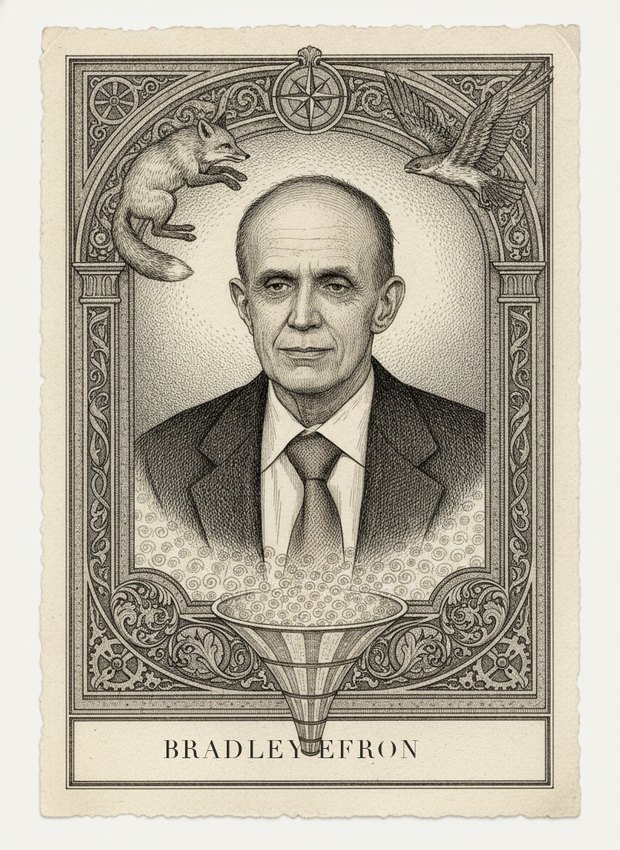
Efron's bootstrap is the direct methodological ancestor of how modern forensic statisticians handle exactly this problem: resampling a small reference database to build an honest, non-parametric confidence interval around a rare-frequency estimate rather than trusting a fragile asymptotic formula. His 1979 paper was motivated by cases where the sample is too small and the target statistic too irregular for classical theory to apply cleanly, which describes a few-hundred-person DNA database estimating a one-in-millions frequency almost exactly. The National Research Council's 1990s reports on forensic DNA statistics leaned on resampling-style thinking to caution against the overconfident point estimates crime labs were producing for juries. Efron's empirical Bayes work also speaks directly to borrowing strength across population subgroups the database underrepresents, rather than treating each subgroup's estimate as if it stood alone.
In the mind map
The same ideas, as concepts rather than history — in John's ML knowledge map.
45 figures are scored on this problem. Draw it in a battle to see where you land.