nlp
Who wrote the disputed papers?
It is 1962, and two statisticians have taken up a question historians have argued for 150 years: twelve of the Federalist Papers are claimed by both Hamilton and Madison, and the rhetoric is too polished to betray its author. The tell is humbler — the little words. "While" versus "whilst," the rates of "upon" and "enough": function words an author cannot consciously control. Build the attribution: model each author's word-rate signatures from the undisputed papers, handle the tiny-sample uncertainty honestly, and combine the evidence across words into an odds statement a historian can weigh. Get it wrong and statistical stylometry is stillborn as a party trick; get it right and quantitative evidence enters scholarship — and eventually courtrooms, where attribution decides forgery, plagiarism, and threat cases.
Who this problem belongs to
The two figures whose methods fit it best, out of 57 in contention.
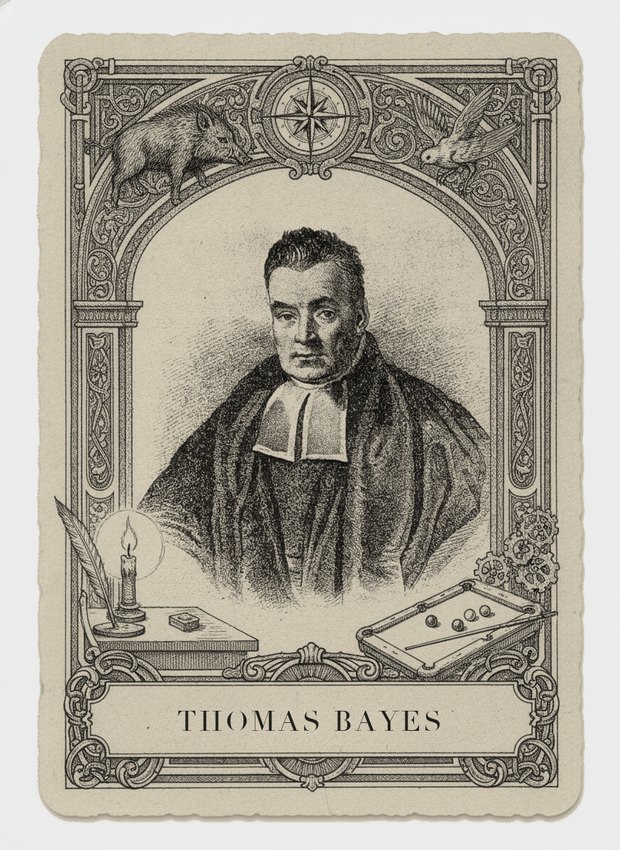
This problem is, almost literally, Frederick Mosteller and David Wallace's 1963-64 study of the disputed Federalist Papers, which used Bayes' theorem exactly as this problem specifies: combine each word's likelihood ratio under 'Hamilton' versus 'Madison' authorship with a prior, updating belief across many independent function-word counts into a final odds statement a historian could weigh. Bayes' 1763 posthumous paper, the inversion of conditional probability, is the precise mathematical engine the historical study ran, word by word, across twelve disputed papers. He worked with billiard-table thought experiments and had no notion of text, authorship, or twelve-word tell-tales like 'whilst' versus 'while,' but the combination rule for turning many weak pieces of evidence into one odds statement is entirely his invention, two centuries early. This is the actual theorem the actual historical study used.
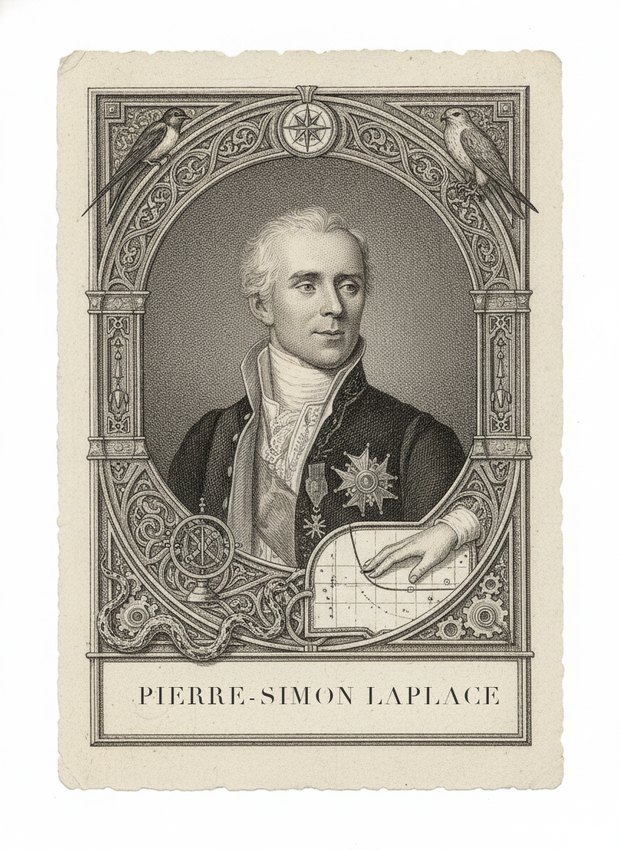
Laplace did more than anyone to turn Bayes' inversion into a working calculus for real evidence, and the specific machinery Mosteller and Wallace needed in 1963 — combining many small, individually weak pieces of evidence (word rates) into a single posterior odds statement, while handling the genuine risk that any one word's count is small and noisy — is directly his contribution from the Essai philosophique sur les probabilités of 1814. His methods for inverse probability applied to real observational data, developed for astronomical and demographic problems, are structurally the same combination-of-evidence apparatus this problem's attribution study depends on. Laplace worked in celestial mechanics and error theory, never conceiving of authorship attribution or function-word statistics specifically. But the calculus that lets many small odds multiply into one defensible historical judgment is a direct descendant of his work on combining evidence.
Fought here
In the mind map
The same ideas, as concepts rather than history — in John's ML knowledge map.
57 figures are scored on this problem. Draw it in a battle to see where you land.