small-sample
Are boys more likely than girls?
It is the 1780s in Paris, and Laplace is turning the newly compiled parish registers to a question older than statistics: is a newborn genuinely more likely to be a boy, or is the observed excess of male births just the wobble of chance? The records are large in some towns and thin in others, and for the thin ones a few births must not be allowed to shout. Estimate the probability of a male birth, attach a credible interval built from a prior stated out loud, and say whether the excess is real. Get it wrong and a fact about human populations is either invented from noise or missed entirely — and the method for judging becomes a template for a century of demography.
Who this problem belongs to
The two figures whose methods fit it best, out of 38 in contention.
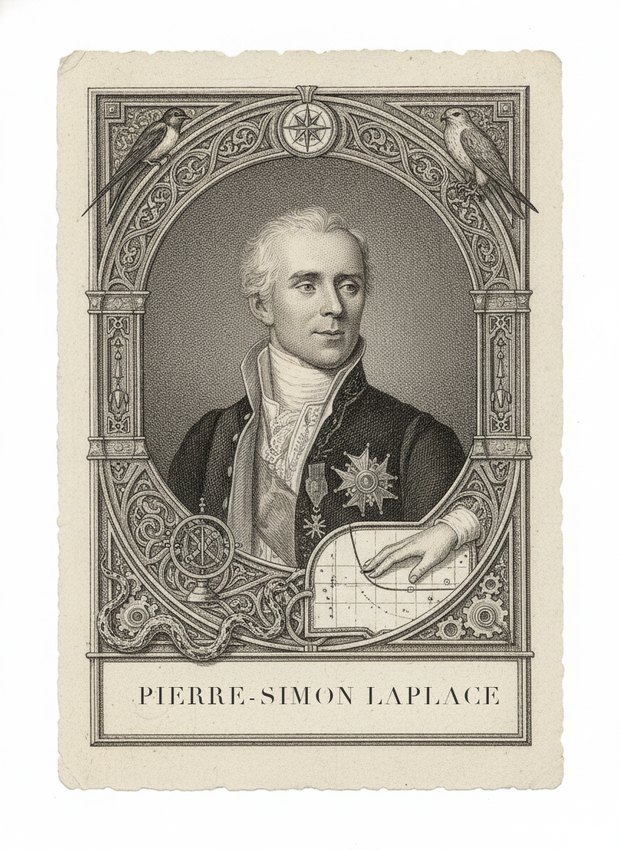
This problem is not an analogy for Laplace; it is his own research program. Beginning with 'Memoire sur la probabilite des causes par les evenements' (1774) and continuing through his sex-ratio studies using parish registers ('Sur les naissances, les mariages et les morts,' developed through the 1780s-1810s and folded into Theorie analytique des probabilites, 1812), he treated the excess of male births as exactly this question: estimate a binomial parameter by inverse probability, state a uniform prior over p explicitly, integrate to a posterior, and report whether p exceeds one half even when a town's register is thin. He derived asymptotic approximations for the small-n honesty this problem demands. No other historical figure did this exact inference, with this exact data, this literally. The score is not 100 only because some register-quality caveats are being asked of a modernized notation.
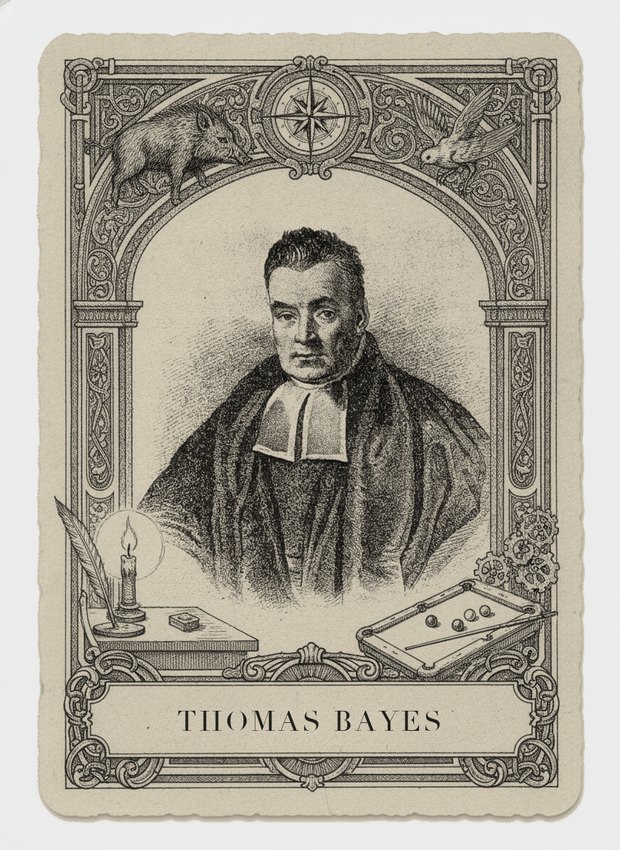
Bayes supplies the theorem this problem is built on, but not the demographic application: his 1763 essay, 'An Essay towards solving a Problem in the Doctrine of Chances,' published posthumously by Richard Price through the Royal Society, is the first rigorous treatment of inverse probability, reasoning from observed successes and failures in Bernoulli trials back to a distribution over the unknown probability of success, using a billiard-table thought experiment as the generative analogy for a uniform prior. That is precisely the logical skeleton required here: binomial likelihood, explicit prior, posterior interval. What Bayes lacked was Laplace's later machinery for closed-form integration, asymptotic approximation for large or small samples, and any interest in actual birth registers. He is the theorem's author, not this problem's practitioner, so the score sits just below Laplace's own operational mastery of it.
In the mind map
The same ideas, as concepts rather than history — in John's ML knowledge map.
38 figures are scored on this problem. Draw it in a battle to see where you land.