causality
The doctor's update
It is 1982, and mass screening programs are expanding across American medicine: cheap tests, rare diseases, and physicians who — surveys keep showing — cannot correctly interpret their own results. A test with 95% sensitivity and a 1% base-rate disease returns positive. Compute the honest posterior, by hand, and explain precisely why intuition fails: why the overwhelming majority of positives are false, and why the base rate dominates the test's advertised accuracy. This is arithmetic a clergyman worked out in the 1750s, yet the patient in front of you is about to be told she probably has cancer when she probably does not. Get the update wrong and the cost is unnecessary surgery, terror, and a screening policy that harms the healthy at scale.
Who this problem belongs to
The two figures whose methods fit it best, out of 59 in contention.
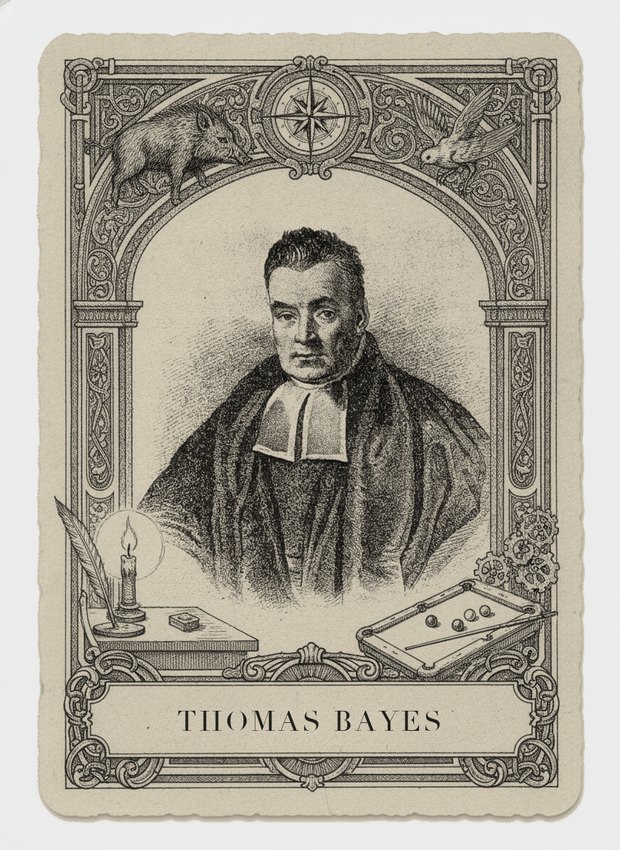
The problem statement calls him out by name: arithmetic a clergyman worked out in the 1750s. Bayes's posthumous Essay (1763) posed and solved exactly this — given an observed outcome, what probability should be assigned to the underlying cause — inaugurating inverse probability with the theorem that bears his name. The doctor's update is that theorem with numbers plugged in: prior 0.01, sensitivity 0.95, normalize against the false-positive mass, and the posterior lands far below one half. His era gap is total — no screening programs, no sensitivity-specificity vocabulary, no psychology literature; his essay reasoned from a billiard-table thought experiment with a uniform prior, and he published nothing in his lifetime, leaving Richard Price to explain the work, so the patient-communication half rests on thin evidence. But a problem that is literally his theorem, applied honestly, crowns one name.
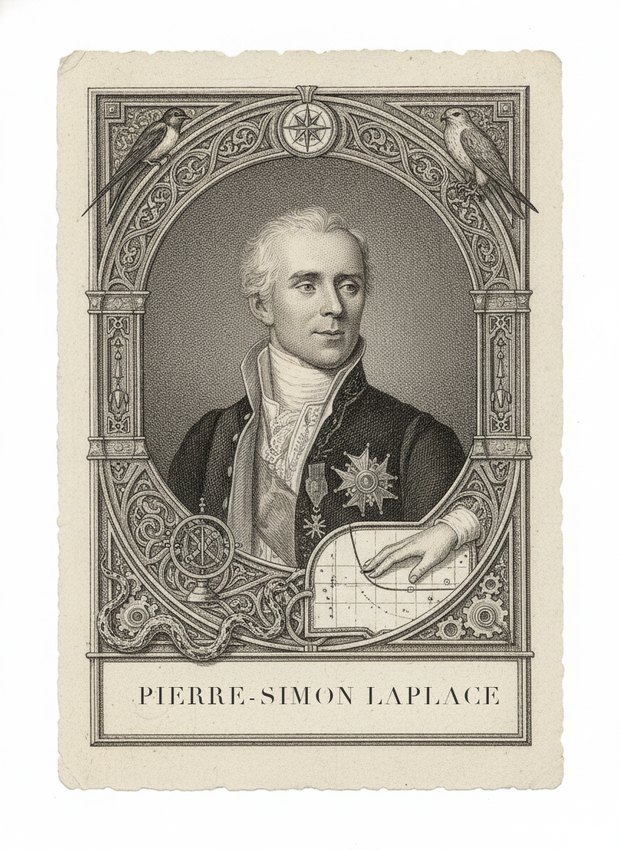
Laplace is the problem's answer key made flesh. He independently formulated the theorem of inverse probability in 1774 and then spent decades actually using it: computing posterior probabilities for demographic ratios, for the mass of Saturn, for the credibility of testimony and jury verdicts — hand Bayesian inference as a working scientific practice, exactly what the clinic demands. His Essai philosophique sur les probabilites (1814) is, among other things, an extended explanation to educated laypeople of why intuition misjudges chances, making him one of very few carriers with era-authentic credentials on the communication half too. The rule of succession is prior-dominated inference in its purest form. His limitations are purely contextual: no medical-screening institutions, no psychology literature, and uniform priors sometimes applied too freely. Otherwise this is his home game, played for two centuries before the patient arrived.
In the mind map
The same ideas, as concepts rather than history — in John's ML knowledge map.
59 figures are scored on this problem. Draw it in a battle to see where you land.