It is the era when scheduling and assignment problems flood into AI: timetables where no two exams clash, frequency assignments where neighbors must differ, layouts where every constraint must hold at once. Cast the problem abstractly — variables, domains of possible values, and constraints forbidding certain combinations — and search for an assignment satisfying them all. Blind backtracking drowns; the art is to propagate constraints so that fixing one variable prunes the domains of others before you ever guess them, detecting dead ends early and ordering choices to fail fast. Get it wrong and you explore a combinatorial swamp that a little propagation would have killed instantly, or accept a schedule violating a constraint no one checked — constraint satisfaction is the backbone of planning, and propagation makes it tractable.

Chose Reduction to a known-hard problem — right call.
Karp's foundational work on NP-completeness explains precisely why constraint satisfaction problems can explode combinatorially and why blind backtracking is, in the worst case, provably intractable — graph coloring and related CSP variants appear directly among his 1972 list of NP-complete problems, giving him deep authorship of the theoretical hardness this scenario's 'combinatorial swamp' describes. His subsequent algorithmic work on efficient special-case solutions shows comfort with the propagation-versus-brute-force tradeoff this problem asks students to master. But the specific engineering of arc consistency and constraint-propagation algorithms used in practical CSP solvers is a distinct, more applied lineage developed by others, so his relevance is deep complexity-theoretic grounding rather than the applied propagation machinery itself.
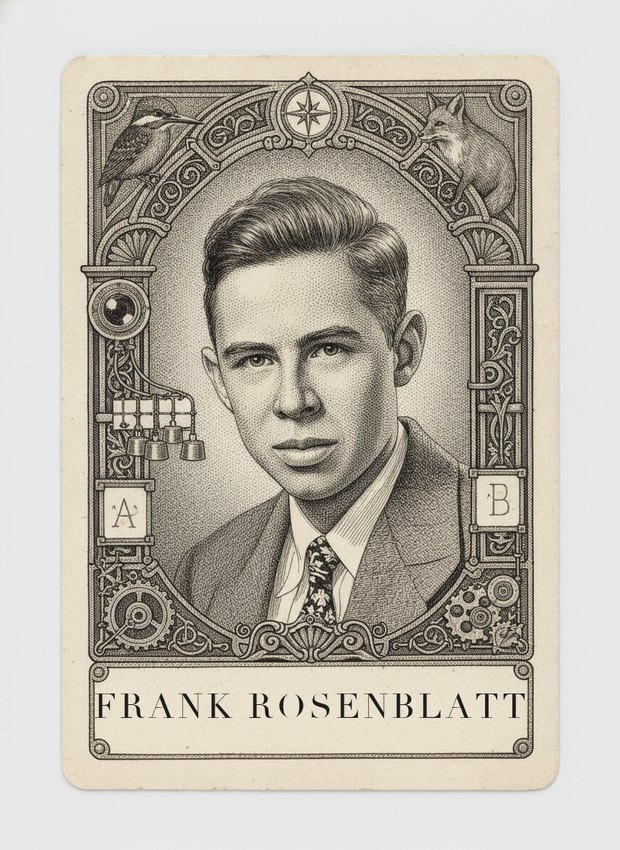
Rosenblatt's perceptron is a trainable linear classifier operating via weighted sums and thresholds, a fundamentally different computational model from the discrete, exact, symbolic constraint-propagation search that CSP solving requires for scheduling and layout problems. There is no meaningful bridge between perceptron learning and arc consistency, forward checking, or backtracking search with propagation. Nothing in Rosenblatt's published work addresses constraint satisfaction, timetabling, or frequency assignment problems. His relevance is limited to general foundational-neural-network historical importance rather than any directly applicable technique for this discrete symbolic-search problem. His perceptron's binary threshold units share only superficial resemblance with a CSP's boolean-like domain values; nothing in his learning rule addresses exact propagation. His historical importance as a pioneer remains real, even if disconnected from this problem's actual content.
Battle #105 · 8/10/2026, 11:38:11 AM · this result is deterministic: the same two personas on this problem always resolve the same way.