It is 1978 at the National Weather Service, and an underappreciated discipline has quietly emerged: forecasters have issued probability-of-precipitation numbers for a decade, and someone must finally ask whether the numbers mean anything. Audit them: when the forecast says seventy percent, does it rain seven times in ten? Build the calibration analysis, score the forecasts with a rule that rewards honesty — where hedging toward fifty percent costs points and both overconfidence and timidity are punished — and separate calibration from resolution, since a forecaster who always recites the climatological base rate is calibrated and useless. Get it wrong and probability numbers become decoration; get it right and weather forecasting becomes the rare institution whose stated uncertainties are true — the existence proof every other forecasting field needs.

Hopfield's energy-based neural networks model memory and pattern completion through physical, statistical-mechanics analogies, an elegant body of work that nonetheless has no direct connection to probabilistic forecast calibration, proper scoring rules, or institutional weather verification. His Nobel-winning physics background does give him general comfort with statistical formalism, a thin, indirect basis for engaging with the mathematics underlying a scoring rule's convexity properties, but he never applied his methods to forecasting or calibration auditing. His relevance to this specific 1978 National Weather Service problem is essentially incidental, general statistical sophistication from an unrelated subfield of computational neuroscience, rather than any applicable technique. A grad student should treat this as a reminder that Nobel-caliber work in one statistical-physics-adjacent field does not automatically transfer to an unrelated forecast-verification problem.
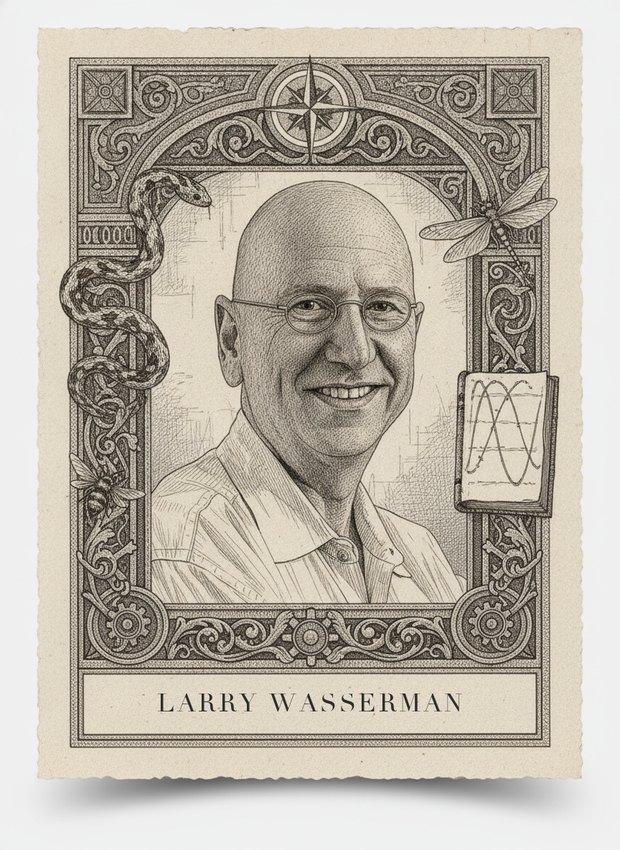
Wasserman's All of Statistics bridges classical inference and modern data science with exactly the register this audit needs: hypothesis testing, calibration, and proper scoring rules are treated as a coherent toolkit rather than separate traditions, and his broader teaching emphasizes that a forecast's stated uncertainty is a testable claim, not decoration. His work sits comfortably alongside the calibration-versus-resolution distinction this problem draws, since decomposing a scoring rule into these components is standard material in the statistics-meets-machine-learning synthesis he represents. He did not personally build or audit weather-forecasting verification systems, and his career is textbook synthesis rather than institutional application, so his score reflects strong methodological fluency rather than direct historical engagement with this exact 1978 problem.
Battle #115 · 8/10/2026, 11:38:40 AM · this result is deterministic: the same two personas on this problem always resolve the same way.