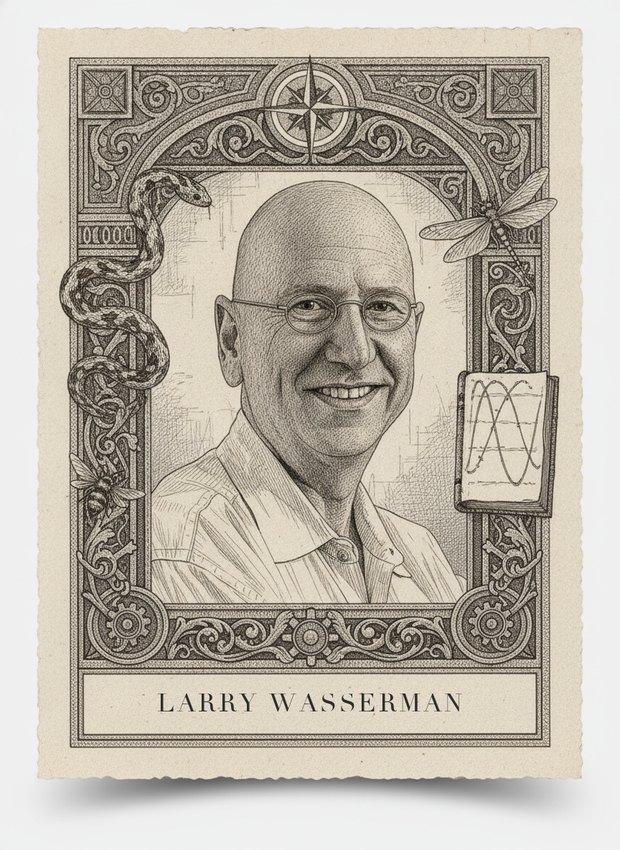
Larry Wasserman
All of Statistics; the statistics-ML bridge
Played by Trent
Strongest on
Battles
One test or twenty? W Leo Breiman
The variable you removed is still there L Leo Breiman
The odds of default L Bernhard Scholkopf
One test or twenty? W Frances Allen
The lady and her teacups W John Hopfield
Thirty percent chance of rain W Noam Chomsky
A thousand categories, one bet W Leo Breiman
Inference after the search W Leo Breiman
The same patients, measured again and again
In the mind map
The same ideas, as concepts rather than history — in John's ML knowledge map.
Life and career
There is a particular kind of academic influence that does not show up in citation counts: the person who taught a whole adjacent field what your field actually says. Larry Wasserman has that kind of influence twice over — once through a slim textbook that sits on more machine learning students' desks than any statistics book has a right to, and once through a decade of unusually blunt public commentary on how statistics is practiced.
Wasserman is Canadian, took his doctorate in statistics at the University of Toronto, and joined Carnegie Mellon, where he has spent essentially his entire career. His appointments span the Department of Statistics and Data Science and the Machine Learning Department — which at CMU is not a courtesy affiliation but a genuine double citizenship, and the fact of it explains most of his output. He arrived at a department with a strong Bayesian and foundational tradition, in a university that was simultaneously inventing machine learning as an academic discipline down the hall, and he spent thirty years working the seam.
Early recognition came fast; he received the COPSS Presidents' Award, the profession's principal honor for an early-career statistician, and has been recognized by the Canadian statistical community as well. But his reputation among younger researchers rests on other things. *All of Statistics: A Concise Course in Statistical Inference* (2004) was written, explicitly, for computer scientists — people who needed to know what a confidence interval is, what the bootstrap does, why the Bayesian and frequentist accounts of a probability differ, and what minimax means, and who did not have three semesters to find out. Its companion, *All of Nonparametric Statistics*, did the same job for smoothing, density estimation, and wavelets. Together they became the standard bridge in a period when the two communities were converging fast and mostly talking past each other.
The second source of his public presence was the blog *Normal Deviate*, which he ran for a couple of intense years in the early 2010s. It was written in a register almost nobody in statistics used at the time: candid, argumentative, willing to say that a fashionable method was oversold or that his own field was defending indefensible practice. He used it to argue about the frequentist-Bayesian divide, about what machine learning had gotten right that statistics had missed, about the emerging replication crisis, and about the misuse of p-values — not as an outsider's complaint but as an insider's, which made it land harder.
His research has kept moving. Having done foundational work in Bayesian robustness and nonparametric inference, he moved into high-dimensional and sparse estimation, then into distribution-free predictive inference, then into topological and geometric data analysis, and into statistical formulations of differential privacy. The connective tissue is a recurring question: *what can you honestly claim*, given assumptions you are actually willing to defend?
Key contributions
**Nonparametric confidence sets, honestly.** Much of Wasserman's technical career concerns a problem that graduate students underestimate. Fitting a smooth curve is easy; putting a confidence band around it that has the coverage you claim is genuinely hard, because the estimator is biased, the bias depends on the unknown smoothness, and the usual variability band ignores it. Wasserman's work — including his long collaboration with Chris Genovese — takes seriously the distinction between a band that covers the *smoothed* function and one that covers the *truth*, and studies when adaptivity to unknown smoothness can and cannot be had for free. The recurring answer is that adaptive estimation is possible but adaptive *inference* often is not, and this asymmetry is one of the most useful facts a practitioner can carry around.
**Distribution-free predictive inference.** With Jing Lei and collaborators, Wasserman developed the modern statistical theory of conformal prediction: procedures that produce a prediction set for a new observation with guaranteed finite-sample marginal coverage, assuming only exchangeability — no model, no asymptotics, no distributional assumption. You take any predictor you like, however baroque, run it as a black box, calibrate its residuals on held-out data, and emit intervals that are valid whether or not the predictor is any good. Their work extended this to regression with split-conformal and jackknife-style variants, characterized the efficiency you give up for that validity, and studied conditional coverage, which is where the guarantees genuinely bite. This body of work is a large part of why conformal methods went from a niche idea to a standard tool for uncertainty quantification around neural networks.
**High-dimensional and nonparametric methods with structure.** With John Lafferty and their students — Ravikumar, Han Liu, and others — he developed methods that keep nonparametric flexibility in high dimensions by imposing structure rather than parametric form: sparse additive models, which fit a sum of smooth univariate functions with most of them shrunk to exactly zero; the nonparanormal, which fits a Gaussian graphical model after unknown monotone transformations of the marginals, so that graph structure is recovered without assuming normality; and the rodeo approach to local, greedy bandwidth selection that adapts to relevant variables.
**Topological data analysis with error bars.** TDA arrived from computational topology as a set of algorithms — persistent homology, persistence diagrams — with essentially no inferential theory. Wasserman, with Chazal, Fasy, Rinaldo, Balakrishnan and others, supplied it: confidence sets for persistence diagrams, bootstrap-based procedures separating topological signal from sampling noise, and rates for estimating geometric and topological features from noisy point clouds. His survey work on the statistical view of TDA is the standard entry point. It is a characteristic contribution: a method arrives with striking pictures and no notion of what a false loop looks like, and he asks how to tell.
**Statistical differential privacy.** With Shuheng Zhou he formulated privacy-preserving data release as a statistical minimax problem: given a privacy budget, what is the best achievable rate of convergence, and what does the privacy constraint cost you in effective sample size? This reframed privacy from an algorithmic property into a question about the fundamental limits of inference under a constraint, and it is the frame the statistics literature has largely adopted.
In battle
Wasserman is a genuine generalist within statistics, and his profile shows it: a mean around 47 with a median of 48, unusually high for the roster, spread evenly rather than concentrated in one spike. He is the figure you play when the problem is a *statistics* problem of almost any kind.
His single best problem is **P125 — The p-value reckoning** at 92, and the game's own explanation is worth reading carefully, because it also explains why he is not first: his public writing on the abuse of p-values, on the gulf between statistical and practical significance, and on taking replication failure seriously was sharp and influential, but Andrew Gelman waged the more sustained public campaign and edges him out. Two candid statisticians, same problem, and the ranking turns on which candor was more central to the actual historical event.
**P005 — Prediction intervals without a model** at 90 is his cleanest win, and it should be: distribution-free predictive coverage under exchangeability alone is the conformal program he helped build. **P020 — The smooth curve, honestly** at 84 is nearly a restatement of his nonparametric confidence-band work, with the word "honestly" doing exactly the work he spent years insisting it should. **P290 — Anonymous, except for everything about you** at 82 is his differential privacy work. **P004 — The bootstrap when theory fails** (78), **P126 — When the bell curve won't hold** (78), **P012 — One test or twenty?** (76), and **P022 — Predict, or explain?** (76) round out a dominant band that reads like a syllabus for *All of Statistics* — which is the point.
His category table is flatter than most: `small-sample` and `fairness` at 61.4, `classification` at 61.0, `high-dim` at 57.5, `testing` at 55.2, `regression` at 50.2, `causality` at 49.5. There is no hole in the middle of statistics. That breadth makes him a reliable, low-variance pick — he will rarely embarrass you and rarely blow the field away outside his top handful.
The weaknesses are all outside statistics entirely, and they are severe. `systems` at 8.5, `computability` at 10.5, `games` at 14.0, `search` at 15.0, `optimization` at 19.0, `perception` at 20.0. He scores 5 on **P244 — The compiler that beats the coder**, 8 on **P198 — Program chess before the computer exists**, 10 on **P164 — Trust without recomputing**, 11 on **P031 — Is there a fast route through every city?**, 12 on **P078 — Agreement among the unreliable**, and 13 on **P049 — Schedule the moonshot**. Compiler internals, game-tree search, cryptographic verification, NP-completeness, distributed consensus, project scheduling: none of these have any purchase on statistical estimation theory, and the game says so bluntly.
There is a subtler weakness worth flagging for players. Wasserman's `experimental-design` sits at only 41.0 despite fifteen problems in the category — noticeably below Murphy's 69.0 and Gelman's 58.9. He is a theorist of inference from data, not a designer of the trials that generate it, and the game separates those two things sharply. Similarly, `rl` at 25.5 puts him well behind anyone with a sequential-decision background.
Play Wasserman when the problem asks *what can we honestly conclude from this data*. Bench him when the problem asks *how do we build the thing*.