regression
The smooth curve, honestly
It is the era when statisticians stop insisting the world is a straight line. You must estimate a dose-response curve with no parametric form assumed — let the data choose the shape — while making two hard decisions honestly: how smooth to make the curve (too wiggly and you fit noise, too stiff and you erase real structure), and how to report uncertainty bands that actually mean something around a curve you did not pre-specify. The smoothing choice is a bias-variance bargain with real consequences. Get it wrong and a regulator reads a dose as safe because your oversmoothed curve flattened a real spike, or panics over wiggles that were only noise — the bands must be honest about a shape you let the data pick.
Who this problem belongs to
The two figures whose methods fit it best, out of 61 in contention.

This problem is Wahba's life work stated as an exam question. From the early 1970s she developed smoothing splines in reproducing kernel Hilbert spaces, proving the fitted curve solves a penalized regression whose penalty is exactly the wiggliness this problem asks her to calibrate. With Craven she gave generalized cross-validation in 1979, the canonical principled answer to how smooth, chosen by the data with proven optimality properties rather than taste. And she answered the second half too: her 1983 Bayesian confidence intervals for spline estimates, derived from the Gaussian-process dual of the spline, are the standard honest-bands construction, with the across-the-function coverage subtleties she and successors like Nychka analyzed explicitly. Every axis named, nonparametric, inference, splines and kernels, is territory she personally built.
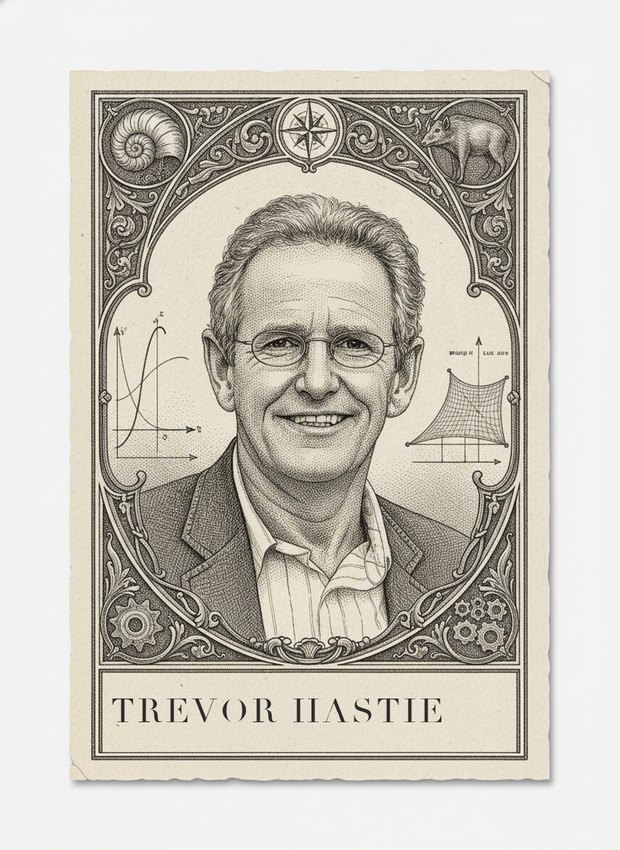
Hastie built the applied canon for this exact problem. Generalized additive models, developed with Tibshirani in the mid-1980s and codified in their 1990 monograph, estimate curves like this dose-response by smoothing splines and local regression, with the smoothing amount chosen by cross-validation or effective degrees of freedom, machinery he not only uses but helped standardize and ship in software the whole field runs. The Elements of Statistical Learning treats the bias-variance bargain, spline bases, and kernel smoothers with definitive clarity, and his applied work confronts pointwise bands for smoothers, including their bias caveats, directly. He sits one step below Wahba only because the deepest band theory, GCV optimality and the Bayesian interval derivation, is her theorem set; as the person you would actually hire to deliver this analysis, he may be first.
Fought here
In the mind map
The same ideas, as concepts rather than history — in John's ML knowledge map.
61 figures are scored on this problem. Draw it in a battle to see where you land.