It is the era when statisticians stop insisting the world is a straight line. You must estimate a dose-response curve with no parametric form assumed — let the data choose the shape — while making two hard decisions honestly: how smooth to make the curve (too wiggly and you fit noise, too stiff and you erase real structure), and how to report uncertainty bands that actually mean something around a curve you did not pre-specify. The smoothing choice is a bias-variance bargain with real consequences. Get it wrong and a regulator reads a dose as safe because your oversmoothed curve flattened a real spike, or panics over wiggles that were only noise — the bands must be honest about a shape you let the data pick.
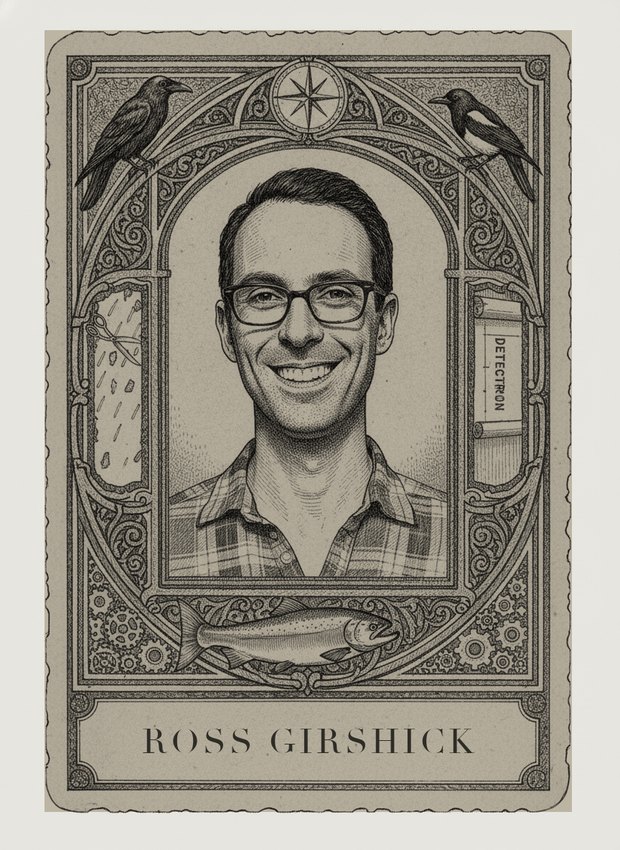
Girshick's R-CNN line, from 2014 through Fast and Faster R-CNN to Mask R-CNN and later Segment Anything, defined a decade of object detection by coupling deep features with region proposals and relentless benchmark iteration. It is superb engineering of flexible function approximation, and non-maximum suppression even involves a threshold-tuning discipline faintly like bandwidth choice. But nothing in the lineage addresses this problem's actual content: detection models are evaluated by average precision on held-out images, not by coverage of confidence bands; their confidence scores are notoriously uncalibrated; and no part of his work selects smoothness by risk or quantifies uncertainty for an estimated curve. The era gap runs the unhelpful direction, all post-2012 deep learning pragmatism, none of the inferential statistics the regulator requires.
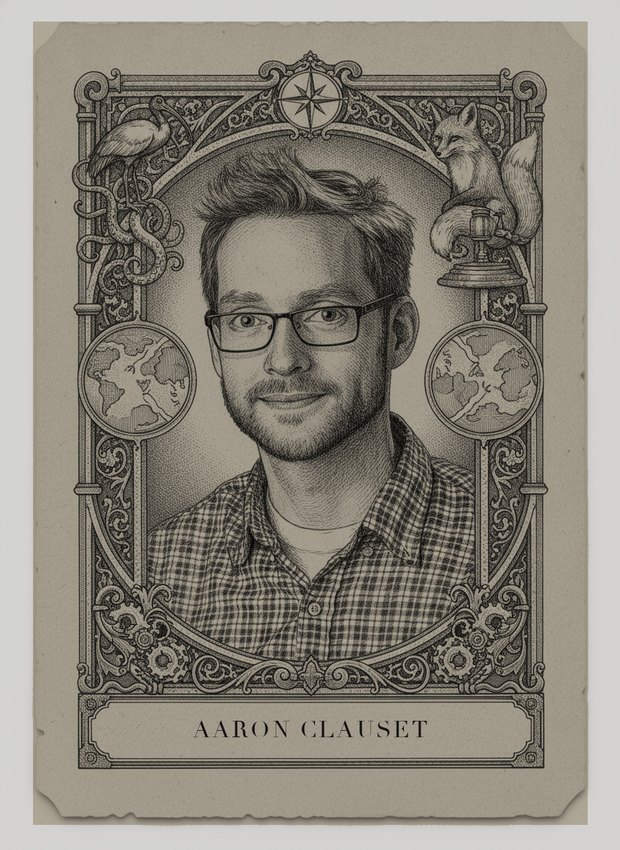
Clauset's signature 2009 power-law paper with Shalizi and Newman is a disciplined exercise in refusing to let a plotted curve lie: maximum likelihood fits, Kolmogorov-Smirnov goodness-of-fit, and likelihood-ratio tests against rival heavy-tailed families. That ethic of honesty about functional form transfers directly to this problem, and he is fluent in bootstrap-style uncertainty from empirical network data. But his toolkit is fundamentally about choosing among parametric families and testing them, not about letting the data pick an arbitrary smooth shape. He has no spline or kernel-bandwidth machinery of his own, and simultaneous confidence bands for a data-chosen curve sit outside his published range. A capable, skeptical practitioner here, but he would be borrowing the estimators from Wahba's lineage rather than supplying them.
Battle #38 · 8/9/2026, 7:12:43 PM · this result is deterministic: the same two personas on this problem always resolve the same way.