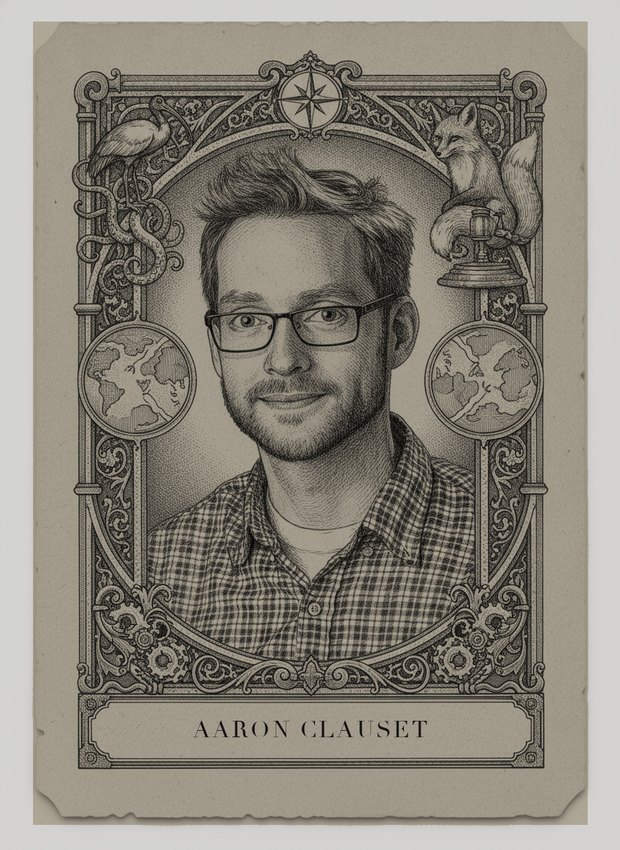
Aaron Clauset
Network science; community detection; power laws done honestly
Played by Chris Clever · LinkedIn
Strongest on
Battles
Depth for a robot on Mars W Ashish Vaswani
Who wrote the disputed papers? W Ashish Vaswani
Why tall fathers have shorter sons L Ashish Vaswani
XOR W Ashish Vaswani
Which examples deserve labels? L Ashish Vaswani
The tilted scan W Ashish Vaswani
The corner that sparsity loves W Ross Girshick
The smooth curve, honestly
In the mind map
The same ideas, as concepts rather than history — in John's ML knowledge map.
Life and career
For roughly a decade around the turn of the millennium, a particular claim appeared in hundreds of papers across physics, biology, computer science, and sociology: this quantity follows a power law. The evidence was usually the same — plot the data on log-log axes, observe something that looks roughly like a straight line, fit a regression to it, report the slope. Aaron Clauset is the person most responsible for demonstrating that this procedure is statistically indefensible, and for supplying the machinery that should replace it.
Clauset took his doctorate at the University of New Mexico in the mid-2000s, working with Cristopher Moore in a department with strong ties to statistical physics and complex systems. He then held a fellowship at the Santa Fe Institute, the interdisciplinary research center that had done more than any other institution to popularize complexity science and, not incidentally, power-law thinking. It says something about the intellectual honesty of that environment that the definitive critique of sloppy power-law inference was substantially developed by someone inside it.
He joined the University of Colorado Boulder, where he is a professor of computer science with an affiliation to the BioFrontiers Institute, and he retains external faculty status at Santa Fe. His research portfolio is unusually eclectic even by network science standards: community structure in graphs, link prediction, the statistics of extreme events in armed conflict and terrorism, the structure of academic faculty hiring, and the dynamics of scoring in professional sports. What unifies them is a methodological stance rather than a subject. Clauset's question, applied to whatever data is in front of him, is: *would this claim survive an actual statistical test?*
That stance has made him a productive irritant. When he and Anna Broido examined roughly a thousand real network datasets and reported that strong scale-free structure is rare — that most networks fail the statistical tests that a genuine power-law degree distribution should pass — the result provoked a substantial argument in the field. This is the intended effect. His work on faculty hiring networks, showing that a small fraction of doctoral institutions supply the overwhelming majority of faculty positions, has similarly become a fixture of debates about academic labor and prestige, and it is grounded in the same insistence on measuring what people assume.
Key contributions
**Power-law distributions in empirical data.** The 2009 paper with Cosma Shalizi and Mark Newman is one of the most-cited methodological papers in network science, and its influence is entirely deserved. It replaces the log-log-regression folklore with a complete, principled pipeline. First, estimate the exponent $\alpha$ by **maximum likelihood**, not by regressing on binned log-log counts, which is biased and produces meaningless standard errors. Second, recognize that power laws typically hold only in the upper tail, so the lower cutoff $x_{\min}$ must itself be estimated — their procedure chooses the $x_{\min}$ minimizing the Kolmogorov–Smirnov distance between the empirical and fitted distributions above the cutoff. Third, assess goodness of fit by a **bootstrap**: generate synthetic datasets from the fitted model, refit each, and compute what fraction have KS statistics at least as large as the observed one, giving a genuine $p$-value. Fourth — and this is the step that does the most damage to the literature — perform **likelihood-ratio tests against plausible alternatives**, especially the lognormal, exponential, and stretched exponential, using Vuong's test for non-nested comparison.
The final step is the one practitioners most often skip and the one that matters most. A power law can pass a goodness-of-fit test and still be indistinguishable from, or worse than, a lognormal on the same data. When Clauset and colleagues applied the full pipeline to two dozen published "scale-free" datasets, only a handful survived. They also released working software, which is why the methodology actually propagated rather than remaining a critique.
**Community detection at scale.** With Newman and Moore, Clauset produced the greedy modularity-maximization algorithm that made community detection feasible on graphs with millions of nodes — a fast agglomerative scheme using efficient data structures to maintain the modularity gains of candidate merges, running in near-linear time for sparse graphs. It was for years the default method for anyone facing a large network, and it remains a standard baseline. His later work has been more skeptical, examining overfitting and underfitting in models of community structure and asking, in the same auditing spirit, whether the communities detected by popular algorithms are actually there.
**Hierarchical random graphs and link prediction.** With Moore and Newman, Clauset introduced a generative model in which the network's structure is encoded by a dendrogram: leaves are vertices, and each internal node carries a probability governing connections between the two subtrees it joins. Fitting this model by Markov chain Monte Carlo over dendrograms yields both an inferred hierarchy and, crucially, a principled way to predict *missing* links — edges the model says should exist but which are absent from the observed data. This gave link prediction a proper probabilistic footing. His later work with collaborators on stacking many link-prediction methods showed that no single family of predictors dominates across network types, and that combining them approaches the achievable ceiling.
**Extreme events and heavy tails.** Clauset applied heavy-tailed statistics to the severity of terrorist attacks and armed conflicts, estimating the probability of very large events from a record containing few of them. The methodological point generalizes far beyond that application: when the tail is genuinely heavy, the sample maximum is a terrible estimate of what is possible, and the entire question becomes one of extrapolating a fitted tail with honest uncertainty. This is the same problem faced by anyone designing infrastructure against a rare flood.
**Science of science.** His faculty hiring work treats academic placement as a directed network and measures the resulting prestige hierarchy, finding extreme concentration in the institutions that produce faculty and a strong downward flow of graduates through the hierarchy.
In battle
Clauset carries 100 problems at a mean of 29.5 with a median of 20 — but eight dominant cards and a `networks` average of 80.0 across ten problems, which is the highest-volume strong category on his sheet.
**P091, "Is it really a power law?"** (97) is his paper, not an analogue of it. The problem's structure — maximum-likelihood exponent estimation, a principled cutoff, bootstrap goodness-of-fit, likelihood-ratio tests against lognormal and exponential, and the task of re-auditing a famous published claim — is a description of what he actually did, including the software practitioners still use. **P090, "The communities in the graph"** (95) is his greedy modularity algorithm plus the more recent skeptical literature he authored about it. **P268, "Who will know whom next year?"** (88) is link prediction, where his hierarchical random graph model and the stacking work give him a strong claim. **P271, "Robust to failure, fragile to attack"** (95) and **P092, "Contagion on the network"** (92) reward his structural network expertise, though the original percolation-robustness results belong to others.
Two of his cards are worth special attention because they look off-brand and are not. **P107, "The thousand-year flood from thirty years"** (88) and **P217, "How high must the dike be?"** (80) are extreme-value problems, and Clauset scores highly because estimating tail probabilities from a short record with honest uncertainty is exactly what his terrorism-severity work required. His `small-sample` average of 61.0 comes almost entirely from this. **P121, "When treatment leaks across friends"** (90) is interference in networked experiments — the failure of the stable-unit-treatment-value assumption when subjects are connected — and it drives his `experimental-design` average of 75.0. That combination, network structure plus experimental validity, is a genuinely rare skill on this roster.
Now the pedagogically interesting part: Clauset is bad at classical regression despite being one of the most statistically careful people in the game. **P141, "Why least squares, exactly?"** (9) — the Gauss–Markov justification — and **P143, "The coefficient that flips sign"** (9) — confounding and collider bias — sit near his floor, and **P133, "Why tall fathers have shorter sons"** (8) is Galtonian regression to the mean. His `regression` average is 18.0 across twelve problems. The lesson is precise and useful: Clauset's expertise is in *distributional* inference — fitting tails, testing model families against each other, quantifying uncertainty in heavy-tailed regimes — which is a different skill from the linear-model and causal-identification tradition. Statistical rigor is not a single undifferentiated resource.
The rest of his losses are era and domain mismatches. **P198, "Program chess before the computer exists"** (8) and **P255, "Translate Russian by machine"** (8) belong to the founding era of AI, and his `nlp` (16.0) and `rl` (12.5) averages confirm he carries nothing there. **P177, "The certificate of optimality"** (7) is linear programming duality and KKT conditions — his community detection work touches combinatorial optimization, but that is a thin and coincidental bridge to duality theory, and the game scores it as such.
Play Clauset whenever a problem asks whether a claimed statistical regularity is real, whenever the question concerns rare large events, and whenever the structure of a network is the object of study. Do not play him on a linear model.