networks
The communities in the graph
It is 2008, and community detection has become a cottage industry with a credibility problem: hundreds of algorithms, each finding "communities" in every network it touches — including in random graphs that have none, because modularity maximization will happily carve structure out of pure noise. Partition a social network into communities without knowing their number in advance, and with statistical guarantees against seeing structure in noise: a generative model of block structure, principled inference over it, and an honest test of whether the detected partition beats the random-graph null. Sociologists, epidemiologists, and security agencies are all consuming these partitions as if they were facts. An algorithm that always finds communities is not a detector; it is a hallucination with a runtime.
Who this problem belongs to
The two figures whose methods fit it best, out of 49 in contention.

Moore's research on phase transitions in inference and the physics of algorithms is directly, substantially relevant to this exact problem: detecting the threshold at which community structure becomes statistically detectable in a stochastic block model, distinguishing genuine signal from noise via principled statistical-physics-derived methods, is close to the core of his published research program. He works in almost exactly this period and shares deep intellectual overlap with Clauset's statistically rigorous approach to network inference, both explicitly concerned with the credibility problem the problem describes. His textbook on computation and his technical fluency with phase-transition analysis in inference problems make him one of the strongest possible carriers for this specific 2008 stochastic-block-model problem.
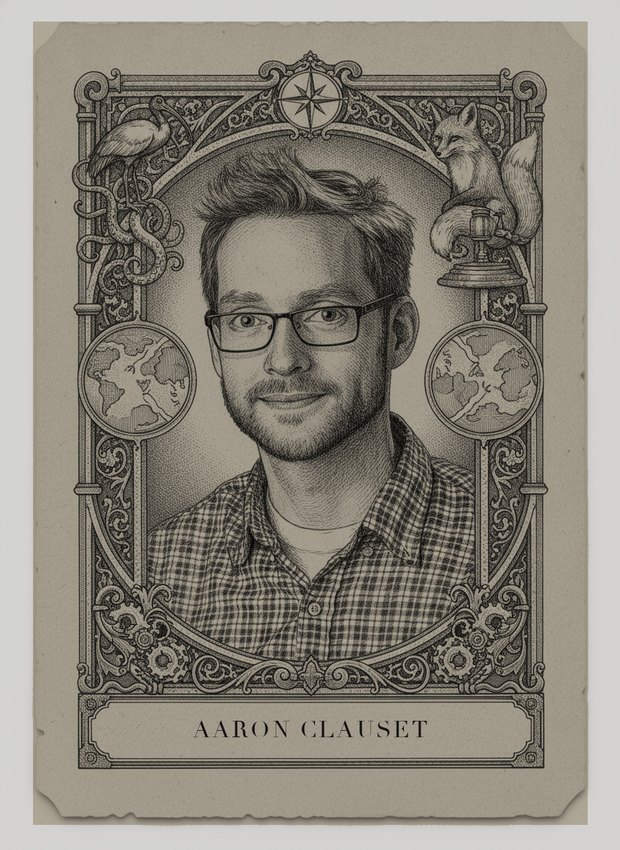
Clauset's career centers precisely on this problem: rigorous, statistically honest community detection, testing whether apparent structure in a network beats a random-graph null rather than accepting modularity maximization's tendency to find communities everywhere, including in networks with none. His published work explicitly critiques exactly the credibility problem the problem describes, hundreds of algorithms each finding structure regardless of whether it is real, and champions generative model-based approaches with principled statistical tests as the correct fix. He works in almost exactly this period and intellectual tradition, closely overlapping with Moore's statistical-physics-inflected approach to inference on graphs. This is not an adjacent contribution, it is close to the actual research program the problem describes, making him one of the strongest possible carriers for this exact 2008 problem.
In the mind map
The same ideas, as concepts rather than history — in John's ML knowledge map.
49 figures are scored on this problem. Draw it in a battle to see where you land.