experimental-design
When treatment leaks across friends
It is the 2010s at a social-media company, and an experiment on a new feature violates the one assumption every A/B test rests on: that one user's treatment does not affect another's outcome. Here it plainly does — a treated user posts more, and their untreated friends see it and respond, so the control group is quietly contaminated through the social graph. Design an experiment that respects this interference: randomize clusters of the network, or model the spillover explicitly, so the measured effect is not diluted or inflated by leakage across friendships. Get it wrong and the feature's true effect is mismeasured at the scale of a billion users, and a change that helps or harms engagement ships on a number the network structure quietly corrupted.
Who this problem belongs to
The two figures whose methods fit it best, out of 37 in contention.
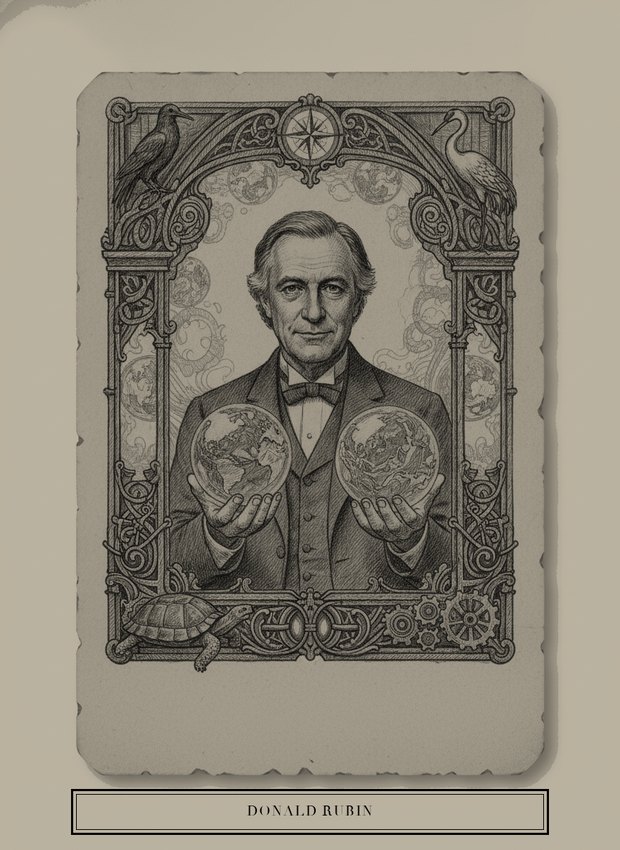
Rubin, at Harvard since 1984, co-developed the potential outcomes framework with Neyman's foundations and, critically, formalized SUTVA, the stable unit treatment value assumption, in his 1980 and 1986 papers, explicitly naming the no-interference condition that this problem violates. He is the person most responsible for giving researchers precise language for exactly this failure mode: one unit's treatment affecting another's potential outcomes. His later work on causal inference, propensity scores, and multiple imputation built the standard machinery that any interference-aware analysis must extend or relax. Designing a cluster-randomized experiment or an explicit spillover model to fix a SUTVA violation is a direct, modern continuation of Rubin's own research program, making him one of the two or three most relevant carriers in this entire batch.
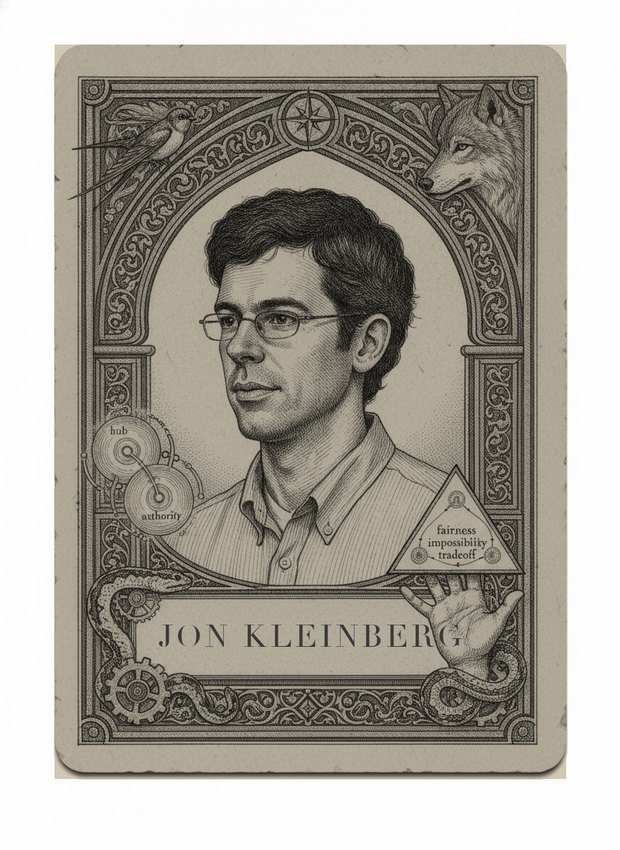
Kleinberg, at Cornell since 1996, built the HITS algorithm, foundational results on small-world navigability building on Milgram's six-degrees experiment, and extensive work on the structure and dynamics of social and information networks, later extending into algorithmic fairness. His entire research program is about formalizing how information and influence propagate through networks exactly like the friendship graph in this problem, making him one of the most directly relevant carriers in the batch. His navigability and network-structure results give precise tools for reasoning about how far a treatment effect might ripple, how many hops of separation matter, and where natural community boundaries sit for cluster randomization. He did not personally write the SUTVA-violation causal-inference papers, but the network science underlying any credible spillover model is substantially his.
In the mind map
The same ideas, as concepts rather than history — in John's ML knowledge map.
37 figures are scored on this problem. Draw it in a battle to see where you land.