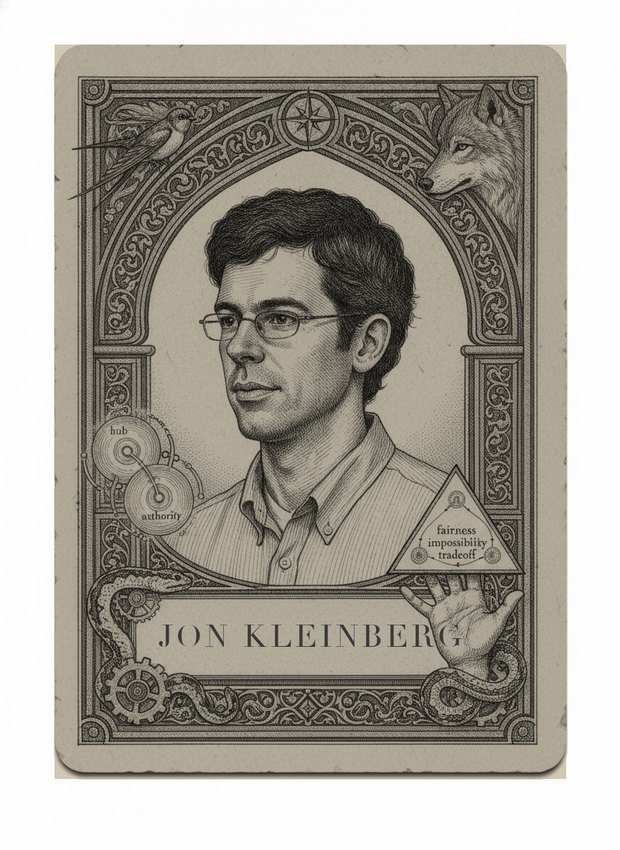
Jon Kleinberg
HITS; small-world navigability; algorithmic fairness
Played by Mary McHale
Strongest on
Battles
In the mind map
The same ideas, as concepts rather than history — in John's ML knowledge map.
Life and career
There is a particular kind of theorist who is drawn not to algorithms for their own sake but to the moment when a mathematical structure turns out to explain something people actually do. Jon Kleinberg has spent thirty years being that theorist, and the result is a body of work that sits at an unusual intersection: rigorous enough for a theory conference, load-bearing enough that it shapes how search engines rank, how public-health agencies place sensors, and how courts think about algorithmic risk scores.
Kleinberg did his undergraduate work at Cornell and his doctorate at MIT in the mid-1990s, then spent a formative stretch at IBM's Almaden Research Center in Silicon Valley. The timing mattered enormously. He arrived in industrial research exactly as the World Wide Web went from curiosity to infrastructure, and while most of the field still treated documents as bags of words, Kleinberg looked at the hyperlink graph and saw a structure carrying information that the text alone did not. The work he did in that window — on ranking, on the geometry of link structure — became foundational to web search.
He returned to Cornell as faculty and has stayed, now as a Tisch University Professor with appointments spanning computer science and information science. Cornell gave him something the pure theory community could not: colleagues in economics, sociology, and law who forced his questions outward. He co-taught and co-wrote *Networks, Crowds, and Markets* with the economist David Easley, a textbook that introduces game theory, network structure, and market design to undergraduates as a single subject rather than three. Earlier, with Éva Tardos, he wrote *Algorithm Design*, which for two decades has been one of the standard texts from which computer science students learn to think about greedy algorithms, dynamic programming, and NP-completeness.
His recognitions include a MacArthur Fellowship in 2005 and the Nevanlinna Prize in 2006, the award given at the International Congress of Mathematicians for mathematical contributions to information science; he is a member of the National Academy of Sciences and the National Academy of Engineering. What is more telling than the awards is the shape of his later career: rather than consolidating around network science, he moved steadily toward questions of fairness, incentives, and human decision-making — turning the same theorist's instinct on problems where the stakes are unambiguously social.
Key contributions
**HITS: hubs and authorities.** Kleinberg's 1999 analysis of authoritative sources in a hyperlinked environment introduced a two-sided notion of importance. A page is a good *authority* if it is pointed to by good hubs; a page is a good *hub* if it points to good authorities. The mutual recursion resolves into the principal singular vectors of the link matrix — authorities are the top eigenvector of $A^\top A$, hubs of $AA^\top$. Developed in parallel with PageRank, HITS is the linear-algebraic sibling of that idea, and the pair together established spectral methods as the natural language of link analysis.
**Small-world navigability.** Milgram's famous experiment established two facts, and the second is the harder one: not only do short paths exist between distant strangers, but ordinary people can *find* them using only local information. Kleinberg's result, published in 2000, showed that this is not automatic. Model the world as a lattice with additional long-range links whose probability of connecting two nodes decays as distance to the power $-r$. He proved that decentralized greedy routing succeeds in polylogarithmic time at exactly one value of the exponent — the one matching the lattice dimension — and provably fails everywhere else. Navigability is a knife-edge property, not a generic consequence of short paths. It is one of the cleanest theorems in network science.
**Influence maximization.** With David Kempe and Éva Tardos, Kleinberg formalized the question of which small seed set of individuals maximizes the eventual spread of an idea through a network under stochastic diffusion models. The key insight is that the expected spread is a *submodular* function of the seed set — diminishing returns — which means the naive greedy algorithm carries a provable $1 - 1/e$ approximation guarantee despite the underlying problem being NP-hard. This single observation launched an entire subfield and generalizes directly to outbreak detection and sensor placement, where the same submodular machinery tells you where to put monitors to catch a contagion early.
**Link prediction and temporal network structure.** With David Liben-Nowell, Kleinberg posed the link prediction problem in its now-canonical form: from a snapshot of a social network, predict which currently-absent edges will appear. The paper's systematic comparison of proximity measures — common neighbors, Adamic–Adar, Katz, rooted PageRank — established the benchmark against which every later method, including modern graph neural networks, is measured. His work on bursts gave a state-machine model for detecting when a stream of documents or messages suddenly intensifies, extracting hierarchical burst structure from time-stamped text.
**Impossibility theorems.** Kleinberg has a taste for proving that you cannot have everything. His clustering impossibility result showed that no clustering function can simultaneously satisfy scale-invariance, richness, and consistency — three axioms each of which looks obviously desirable in isolation. More consequentially, with Sendhil Mullainathan and Manish Raghavan, he showed that natural fairness criteria for risk scores are mutually incompatible: calibration within groups and equal false-positive and false-negative rates across groups cannot all hold unless base rates are identical or prediction is perfect. This result reframed the public debate over algorithmic risk assessment in criminal justice from an argument about which vendor was biased into a statement about what is mathematically available.
In battle
Kleinberg is one of the strongest all-round cards in the game, and the profile explains why: mean 48.2, median 45, with twenty problems scoring 80 or above and a ceiling of 99. He is not a one-trick specialist — he is broadly competent, spectacular in a wide band, and only genuinely weak in a few well-defined places.
His four commanding categories are `systems` (88.5), `experimental-design` (79.0), `fairness` (74.9), and `networks` (74.8), and the dominant problems fall straight out of them. **P089, "Six degrees, provably"** (99) is not an analogy or an adjacent contribution — it is literally his theorem, down to the exponent and the greedy routing argument, and no other figure on the roster can claim authorship of it. **P270, "Choose the first hundred believers"** (99) is influence maximization; **P186, "Where to place the sensors"** (93) is the same submodular greedy machinery pointed at outbreak detection. **P268, "Who will know whom next year?"** (98) is the link prediction problem he defined. **P092, "Contagion on the network"** (96) and **P277, "The graph that knew your name"** (95) sit in the same territory. **P077, "The rank of every page"** (92) is HITS, where he shares the stage with PageRank's authors but loses nothing by the comparison.
**P099, "The score that decides parole"** (99) is worth calling out separately, because it is a different kind of strength. That problem is about the mathematics of fair risk scoring, and Kleinberg's impossibility theorem is the definitive statement on it. It also explains why his `fairness` average is nearly 75 across nine problems — this is a genuine second pillar, not a lucky single card.
His weaknesses are equally coherent. Kleinberg is a discrete mathematician and network scientist; he is not a statistician, not a control theorist, and not a reinforcement learning researcher. His `regression` average is 15.5 and `rl` is 16.5, the two floors of his card. **P138, "The trend with a memory"** (13) — time-series with autocorrelation — asks for an ARIMA-style toolkit he simply does not carry. **P288, "Let the images choose the basis"** (15) is PCA on image data; he is fluent in spectral methods on graphs, but eigenfaces belong to a different lineage. **P064, "The long corridor of sparse reward"** (14) and **P201, "The dice make it learnable"** (12) are pure reinforcement learning, and his relevance there is generic algorithmic proximity rather than any historical contribution. **P074, "Drive through the intersection"** (12) needs perception and control, neither of which is his.
**P215, "The therapy the trial reversed"** (15) is the most pedagogically interesting loss: causal inference from a confounded comparison. Kleinberg has worked on human decisions versus machine predictions, but the specific machinery of confounding and Simpson-style reversals belongs to the causality tradition, and the game correctly declines to credit him for it.
The lesson for a player: if the problem is about structure in a graph, spread through a population, or the impossibility of having all your fairness properties at once, Kleinberg is close to unbeatable. If it is about noise, dynamics, or estimating a parameter, look elsewhere.