networks
Contagion on the network
It is 2006, and pandemic-preparedness planners have absorbed an uncomfortable lesson from SARS: the mass-action equations of classical epidemiology assume everyone mixes with everyone, but real outbreaks run along the wiring of an actual contact network, where a few high-degree individuals do disproportionate damage. Model how a virus — or a rumor, the mathematics is indifferent — spreads on a contact network, and then act on the model: with doses for only 100 nodes, choose which to vaccinate for maximum effect, knowing that targeting hubs, targeting bridges, and targeting at random give wildly different epidemic outcomes. The choice must be justified against the network's structure, not intuition. When the real outbreak comes, this arithmetic is the difference between containment and a pandemic curve.
Who this problem belongs to
The two figures whose methods fit it best, out of 41 in contention.
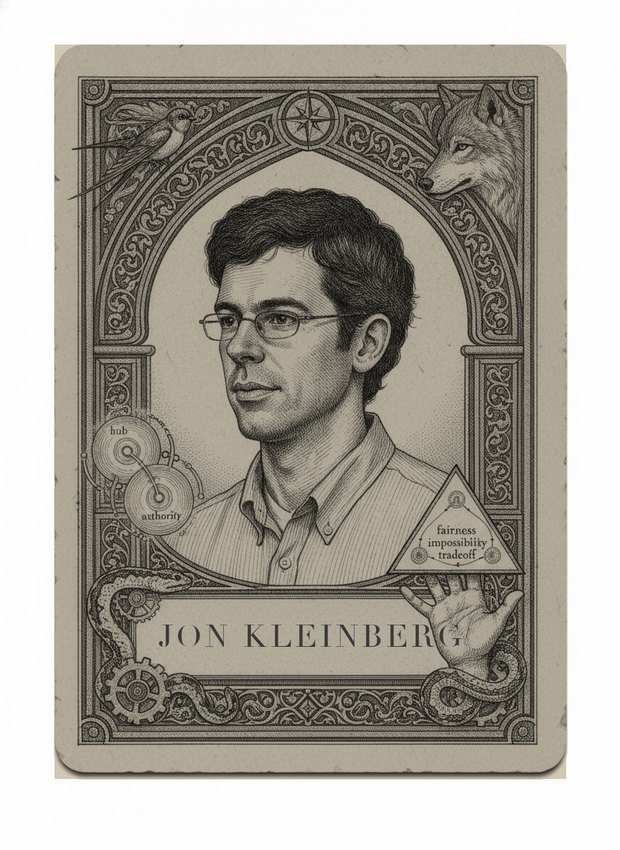
Kleinberg's foundational network-science work on hubs, authorities, and the structural role of highly connected nodes gives him direct, expert-level command of exactly the reasoning this problem demands: why targeting hubs, targeting bridges, and targeting at random produce wildly different outcomes on a real contact network. His research on cascades and diffusion through networks — how influence, information, and by extension contagion propagate along structurally heterogeneous graphs — is close kin to the epidemic-modeling and intervention-targeting problem posed here, set right around his most active period on network dynamics. He is among the strongest possible carriers in this pool for a problem about structure-aware intervention on networks.
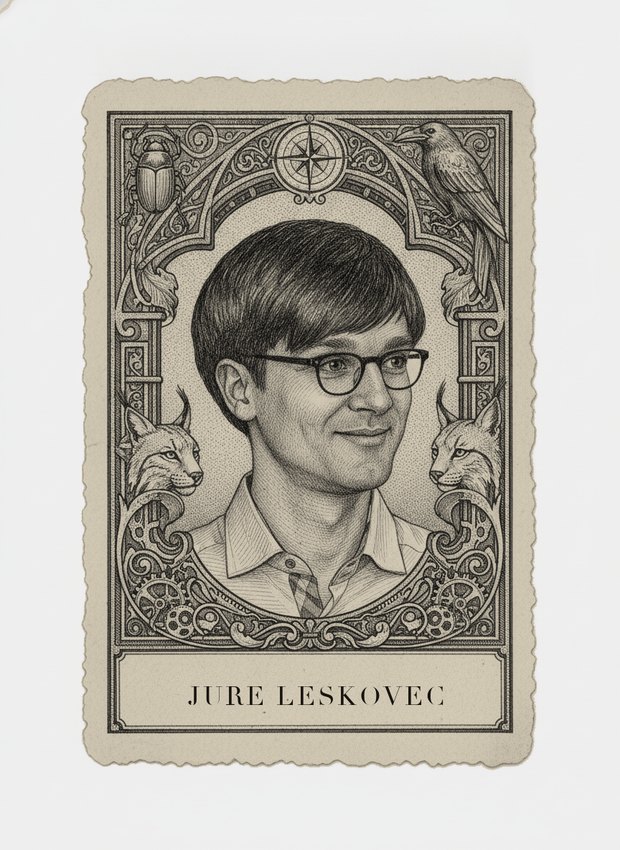
Diffusion on real contact graphs is Leskovec's home ground, and his own work lands a year after this scenario. With Krause, Guestrin, Faloutsos, VanBriesen and Glance he posed exactly this selection problem, choosing a small set of nodes on a network to blunt or detect a spreading process, showed the objective is submodular, and built CELF's lazy evaluation so the greedy solution with its provable guarantee could actually run on graphs of realistic size. Alongside that he measured cascades directly, in the blog-propagation and viral-marketing studies of the same period, which is where his distrust of hub-targeting intuition comes from: observed cascade shapes rarely match what mass-action reasoning predicts. He would state the vaccination choice as constrained submodular maximization, justify it against measured structure, and be honest that the contact network itself is the weakest input.
In the mind map
The same ideas, as concepts rather than history — in John's ML knowledge map.
41 figures are scored on this problem. Draw it in a battle to see where you land.