fairness
The score that decides parole
It is 2016, and investigative journalists have just audited a risk score used in American courtrooms: black defendants who did not reoffend were flagged high-risk at nearly twice the rate of white defendants, while the vendor answers, truthfully, that the score is equally well calibrated across races. Both sides are reading the same confusion matrices. Audit the score properly: define the competing fairness criteria — calibration, equal false-positive rates, equal false-negative rates — and prove the impossibility theorem showing that when base rates differ, no score can satisfy them all. Then do the part mathematics cannot: recommend anyway, explicitly, with the trade-off owned rather than obscured. People are being detained on these numbers today. Refusing to choose is also a choice, made by default, against the defendants.
Who this problem belongs to
The two figures whose methods fit it best, out of 30 in contention.

Kleinberg co-authored the 2016 impossibility theorem this problem asks for almost by name: with Mullainathan and Raghavan, he proved that calibration, equal false-positive rates, and equal false-negative rates cannot all hold simultaneously when base rates differ across groups, formalizing exactly the COMPAS-audit standoff of ProPublica versus Northpointe the problem describes. He built the mathematics that makes 'both sides are reading the same confusion matrices honestly' a provable, not just observed, fact. His algorithmic-fairness work throughout the mid-2010s is precisely this problem, timed to the year it happened. No carrier maps more exactly onto the mathematical half of the task.
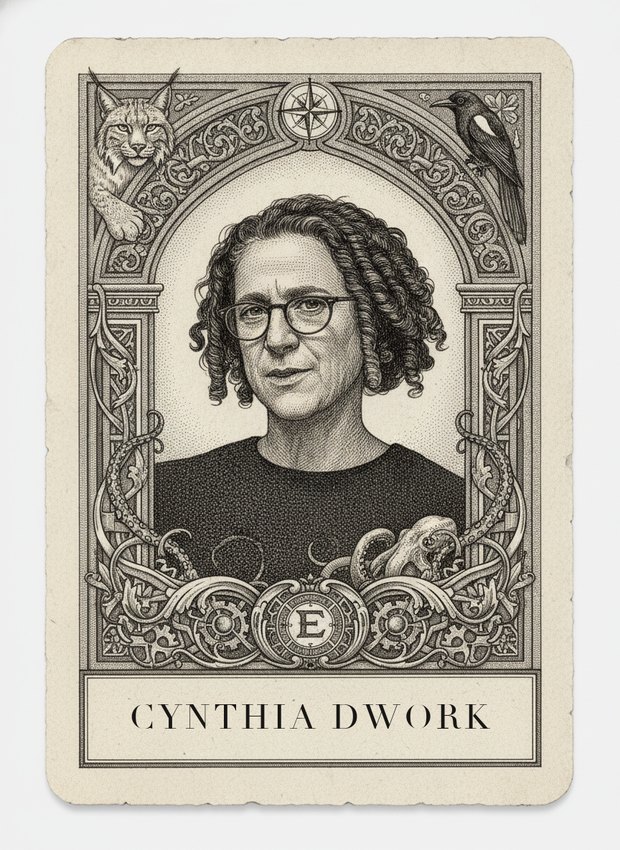
Dwork's differential privacy work established the discipline of formal, provable guarantees about statistical systems, and by the mid-2010s she extended that rigor directly into fairness, co-authoring 'Fairness Through Awareness' (2012) which anticipated the tension between competing fairness definitions this problem's impossibility theorem formalizes. Her instinct — that a fairness claim needs a proof, not a promise — is exactly the register the problem demands. She is slightly behind Kleinberg only because the specific calibration/error-rate impossibility result is his and collaborators' named theorem, while her contribution is the deeper methodological foundation it builds on.
In the mind map
The same ideas, as concepts rather than history — in John's ML knowledge map.
30 figures are scored on this problem. Draw it in a battle to see where you land.