networks
Who will know whom next year?
It is 2003, and social networks have become data: millions of nodes, timestamped edges, and a question with both scientific and commercial teeth — given the network today, which pairs not yet connected will be connected a year from now? Common neighbors, path structure, and community membership all whisper predictions; make them speak precisely. Define the link-prediction problem, compare principled scores against the right null — because on a sparse graph, predicting "no edge" everywhere is deceptively accurate — and say what the achievable accuracy reveals about how much of social life is structurally determined. Get it wrong and recommender engines wire the social graph by folklore; get it right and you must face the second question — what it means that the future of acquaintance is predictable at all.
Who this problem belongs to
The two figures whose methods fit it best, out of 53 in contention.
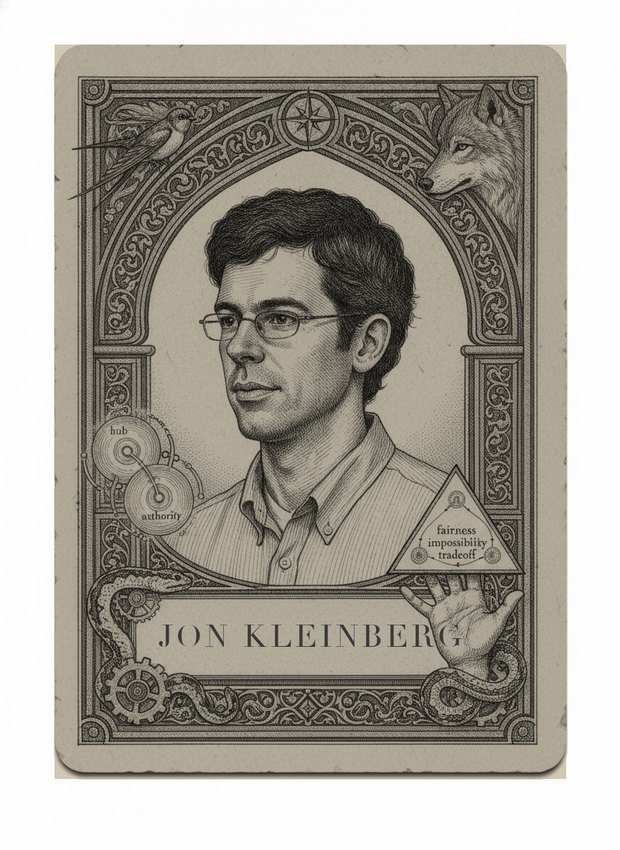
Kleinberg co-authored, with David Liben-Nowell, 'The Link-Prediction Problem for Social Networks' (2003), the paper that formalized this exact problem, given a network's structure today, which absent edges will appear later, and systematically compared common-neighbor, path-based, and community-based scoring functions against each other. His earlier HITS algorithm and his small-world navigability work also established the broader toolkit of treating social and hyperlink structure as a precisely analyzable mathematical object rather than a metaphor. His insistence on comparing predictors against the right null, since sparse graphs make predicting no-edge deceptively accurate, is a direct match for this problem's own framing. No other career on this card maps this specifically onto the problem's exact language and year, which is why his score sits at the maximum.
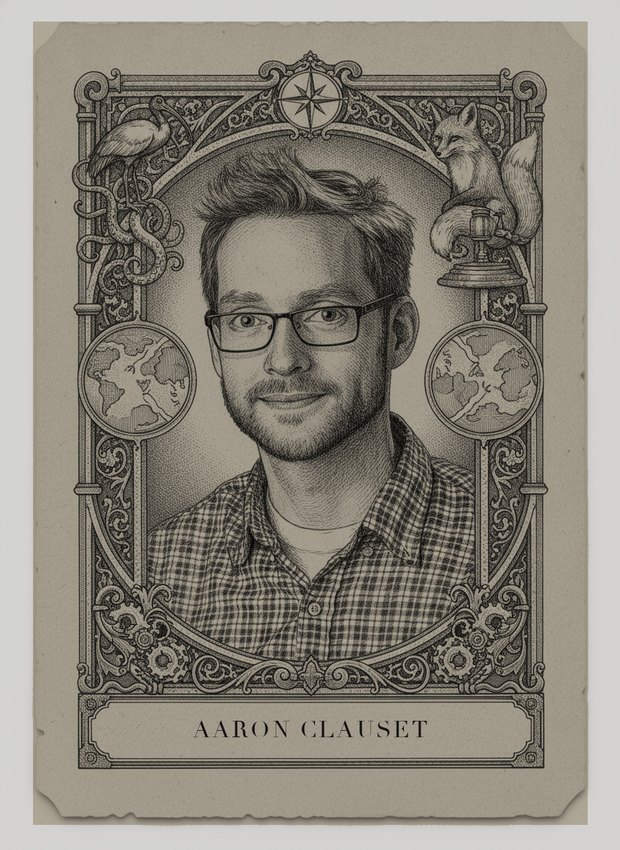
Clauset's network science research, rigorously distinguishing genuine power-law and community structure in real networks from artifacts of noisy measurement or naive null models, gives him deep authority over this problem's central methodological trap: that a sparse social graph makes the trivial 'no edge anywhere' baseline deceptively accurate, so evaluation against the right null is the actual craft. His community-detection work also provides exactly the structural signal, shared community membership, this problem lists as a candidate predictor alongside common neighbors and path structure. His broader honest-statistics approach to network claims matches the problem's demand to say precisely what achievable accuracy reveals about social structure. His score falls just short of Kleinberg's because he was not the link-prediction problem's original formalizer, though his methodology sharpens it considerably.
Fought here
In the mind map
The same ideas, as concepts rather than history — in John's ML knowledge map.
53 figures are scored on this problem. Draw it in a battle to see where you land.