small-sample
The thousand-year flood from thirty years
It is the 1940s, and an engineer designing a dam must specify the flood height expected once in a thousand years — using a river gauge that has recorded only the last thirty. The question is not about the middle of the data but its far tail, exactly where the observations run out, so you must fit the distribution of annual maxima and extrapolate honestly far beyond anything seen. Get the tail model wrong and you either build a wall too low, and a town drowns in a flood the record never warned of, or too high, wasting fortunes against a threat that isn't there. With thirty points asked to speak for a millennium, the choice of tail law is the entire gamble.
Who this problem belongs to
The two figures whose methods fit it best, out of 47 in contention.
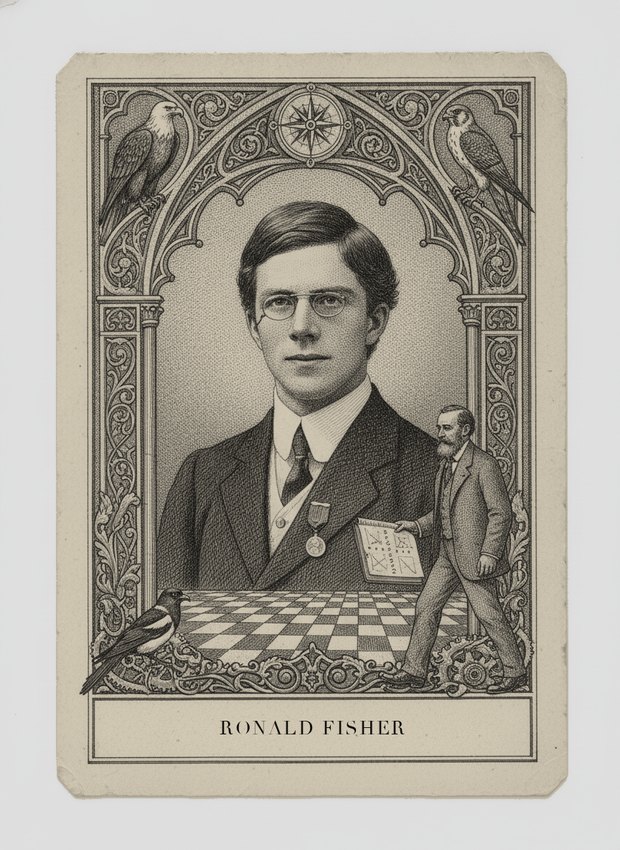
Fisher, working with L.H.C. Tippett in 1928, proved the limiting laws that govern the maximum of many independent observations — the Fisher-Tippett theorem, later completed by Gnedenko, which is the entire mathematical foundation for extrapolating a flood record's tail beyond its longest observed value. Their motivating problem was literally the strength of materials and extreme observations in small samples, the identical structure as thirty years of river gauge maxima. Fisher's broader command of maximum likelihood lets him fit whichever of the three limiting families the data supports and attach honest uncertainty. He is not scored a full 100 only because Gumbel later did more of the specific hydrological popularizing; Fisher supplied the mathematics the engineer must use.

Clauset's research on power laws and heavy-tailed distributions, particularly his widely cited work on rigorously testing whether an empirical distribution's tail really follows a power law rather than merely looking like one on a log-log plot, is a direct modern descendant of exactly this dam-engineer's dilemma. He built statistical tests specifically to stop researchers from confidently extrapolating tails that thirty data points cannot actually support, replacing eyeballed slopes with maximum-likelihood fits and goodness-of-fit bootstrapping. His network-science background adds no direct hydrology, but his methodological core — honest tail inference from limited data, resisting the seduction of a dramatic extrapolation — is precisely what the flood problem demands, making him one of the strongest modern carriers here.
In the mind map
The same ideas, as concepts rather than history — in John's ML knowledge map.
47 figures are scored on this problem. Draw it in a battle to see where you land.