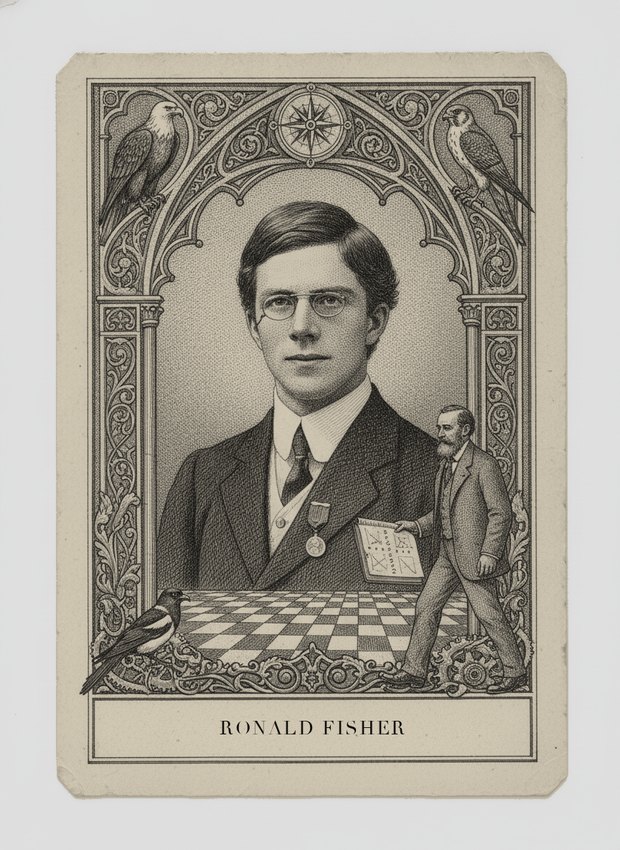
Ronald Fisher
Maximum likelihood, ANOVA, randomized experimental design
Strongest on
In the mind map
The same ideas, as concepts rather than history — in John's ML knowledge map.
Life and career
If you have ever computed a p-value, run an ANOVA, randomized subjects to treatment arms, or written down a likelihood and maximized it, you have used Ronald Aylmer Fisher's machinery. No single person shaped twentieth-century quantitative practice more, and few are harder to write about honestly.
He was born in London in 1890, one of twins whose brother was stillborn. His eyesight was so poor that he was forbidden to work by electric light and was taught mathematics largely without paper — a tutor would explain geometry aloud and Fisher would work it in his head. Colleagues later remarked on his extraordinary geometric intuition and on his habit of stating results without the derivations others needed; both plausibly trace to this. He won a scholarship to Cambridge in 1909, read mathematics and physics, and encountered Mendelian genetics and the biometric-Mendelian controversy that would define his research life. His eyesight kept him out of the First World War; he taught school, unhappily and badly, and farmed.
In 1919 he took a post at Rothamsted Experimental Station, an agricultural research institute north of London, hired to make sense of decades of accumulated field-trial records. It was a strange, ideal appointment. Rothamsted gave him messy real data, small samples, an urgent practical question — does this fertilizer work on this soil — and near-total freedom. In fourteen years there he produced most of the apparatus of modern statistics. *Statistical Methods for Research Workers* (1925) put it in the hands of practicing scientists and went through many editions; *The Design of Experiments* (1935) did the same for randomization, blocking, and factorial layouts. *The Genetical Theory of Natural Selection* (1930) was one of the three founding texts of the modern evolutionary synthesis, reconciling Darwinian gradualism with Mendelian particulate inheritance by showing that continuous variation arises from many small-effect loci.
He became Galton Professor of Eugenics at UCL in 1933 — succeeding Karl Pearson, with whom he had feuded viciously for over a decade, the two men having conducted a running war through their respective journals since Fisher's corrections to Pearson's chi-squared degrees of freedom. He moved to the Balfour Chair of Genetics at Cambridge in 1943, worked on blood-group genetics and the Rhesus system, was knighted in 1952, and spent his last years in Adelaide, dying there in 1962.
Two matters of legacy have to be stated plainly. Fisher was a committed eugenicist throughout his life, and the final chapters of *The Genetical Theory of Natural Selection* argue for differential fertility policy on hereditary grounds; he held the Galton chair in eugenics and served in eugenics organizations, and this was not incidental to his statistics but continuous with the biometric research program that funded and motivated it. And from the 1950s he publicly and persistently disputed the inference that smoking causes lung cancer, arguing that the correlation might reflect a common genetic cause or reverse causation, and doing so while holding consulting relationships with the tobacco industry. His methodological objection — that observational association does not establish causation without a design to support it — was his own doctrine applied consistently, and it was, in this instance, catastrophically wrong. Both facts belong in any account of him, and neither cancels the mathematics.
Key contributions
**Maximum likelihood and the theory of estimation.** Fisher gave the likelihood function its status as *the* object of inference and defined the criteria by which estimators should be judged: consistency, efficiency, and sufficiency. The concept of a **sufficient statistic** — one that carries all information in the sample about a parameter, so the conditional distribution of the data given it is parameter-free — is his, and it is the organizing idea behind exponential families, the Rao–Blackwell theorem, and much of modern estimation theory. **Fisher information**, the expected curvature of the log-likelihood, quantifies how much a sample tells you about a parameter, and the Cramér–Rao bound establishes it as the floor on the variance of any unbiased estimator. Maximum likelihood estimators achieve that floor asymptotically. This entire vocabulary — likelihood, MLE, information, efficiency, sufficiency — is Fisher's coinage and Fisher's framework, and it is the backbone of statistical machine learning.
**Analysis of variance.** ANOVA decomposes total variability in an outcome into components attributable to identified sources plus residual, and tests each via the F ratio of mean squares — the F distribution being named for Fisher. This turned the analysis of multi-factor experiments from an art into a procedure, and it is the same decomposition that underlies mixed models, variance components, and every partition-of-sums-of-squares argument in the linear model.
**Experimental design.** This may be his deepest contribution. Fisher argued that inference is only as good as the design that produced the data, and gave three principles that remain the foundation of the field. **Randomization**: assigning treatments by a chance mechanism guarantees, without any assumption, that unmeasured confounders are balanced in distribution — and, crucially, it supplies the reference distribution against which the observed effect is judged. **Replication** provides an estimate of error against which to measure the effect. **Blocking** removes known nuisance variation before it can obscure the signal, yielding randomized blocks and Latin squares. He also introduced **factorial designs**, showing that varying several factors simultaneously is not only cheaper than one-at-a-time experimentation but is the *only* way to detect interactions, and developed confounding schemes and fractional replication when full factorials became infeasible.
**The randomization test and exact inference.** The Lady Tasting Tea is the founding example: a colleague claimed she could tell whether milk was poured before or after the tea. Fisher's response was to design an experiment — eight cups, four of each, presented in random order — and to compute the exact null distribution by enumerating all C(8,4) = 70 ways of choosing four cups. No normal approximation, no asymptotics: the probability of a perfect sort by pure guessing is 1/70. This is permutation inference, and it is the philosophical root of the bootstrap and of every modern exact/nonparametric procedure. Fisher's exact test for 2×2 tables comes from the same reasoning.
**Significance testing and p-values.** Fisher formalized the null hypothesis, the test statistic, and the p-value as a measure of evidence against the null, and popularized (while explicitly disclaiming as a rigid rule) the 0.05 convention. His conception differed sharply from Neyman and Egon Pearson's decision-theoretic framework of fixed error rates, and the two camps fought over it for decades; the hybrid taught in most courses today is a mangled amalgam neither would have endorsed.
**Population genetics and multivariate methods.** He proved the fundamental theorem of natural selection, developed the diffusion approach to allele frequencies, and introduced **linear discriminant analysis** — using, as his example, measurements on three species of iris, a dataset that has been the field's default toy problem ever since.
In battle
Fisher is the strongest carrier on this section of the roster and one of the strongest overall: mean 57.1, median 59, twenty-nine problems at 80 or above, thirty-eight at 70 or above, and only eighteen weak. He is not a specialist. He is a general-purpose statistical heavyweight who happens to have several problems he owns outright.
The perfect scores tell you where he lives. "The lady and her teacups" (100) is his own randomization test, and the profile notes his insistence on exact enumeration over asymptotics is precisely what the problem demands. "Three species of iris" (100) is his own discriminant analysis on his own dataset. "The recombination fraction from a small cross" (99) is genetic linkage estimation by maximum likelihood — his statistics and his genetics at once. "The eight field plots" (98) is Rothamsted agricultural trial design; "Design the trial before the data" (98) is the design-before-analysis doctrine; "The factor you can't keep changing" (98) is factorial and fractional-factorial design; "Two proportions, tiny cells" (98) is Fisher's exact test; "The thousand-year flood from thirty years" (96) is extreme-value estimation, where the Fisher–Tippett theorem classifies the limiting distributions of maxima. His category averages are the broadest strong profile in the early-statistics cohort: small-sample 77.6, testing 76.9, experimental-design 76.2, classification 65.0, information 65.0, high-dimensional 56.5, regression 56.2.
His causality average of 49.7 across fifteen problems is the most interesting number on his sheet, and a student should read it as a portrait rather than a deficiency. Fisher is *unbeatable* on causal problems where you control the assignment — randomize and the inference is airtight — and mediocre on causal problems where you cannot, because his considered position was that observational association simply does not license causal claims. That position is what he defended, wrongly and damagingly, on smoking. The game scores both halves.
His losses are uniformly computational, algorithmic, or perceptual, and they are steep. "Small tools, loosely joined" (5) is his floor — Unix pipeline and operating-system design, with no bridge whatsoever to experimental statistics. "Name what you've never trained on" (6) is zero-shot learning; "Will it ever halt?" (6) is computability; "Index the entire web" (8) is large-scale information retrieval; "Segment anything" (8) is modern image segmentation; "Is there a fast route through every city?" (8) is combinatorial complexity. His systems average is 6.5, perception 7.0, computability 7.0, search 13.5, optimization 15.0.
Play Fisher on anything involving a designed experiment, a likelihood, a small sample, a significance test, or a variance decomposition, and expect him to win. Play him on machines, algorithms, scale, or observational causal inference and he falls off fast. The most pedagogically valuable battle to watch is Fisher against a modern causal-inference figure on an observational problem: he has the sharper tools and the wrong doctrine, and the game scores that honestly.