experimental-design
Design the trial before the data
It is the 1920s, and you will get exactly twenty-four experimental units to interrogate four factors suspected of interacting — and once the season or the batch is spent, there is no going back for more. The temptation is to vary one factor at a time; the waste in that is enormous, and the interactions it hides may be the whole story. Design the experiment that extracts the most information from twenty-four runs: justify your blocking against nuisance variation and your randomization against bias you cannot see. Every unit is precious. Get the design wrong and no cleverness in the later analysis can rescue what the data never contained — you will have burned a year to learn less than half of what those units could have told you.
Who this problem belongs to
The two figures whose methods fit it best, out of 46 in contention.
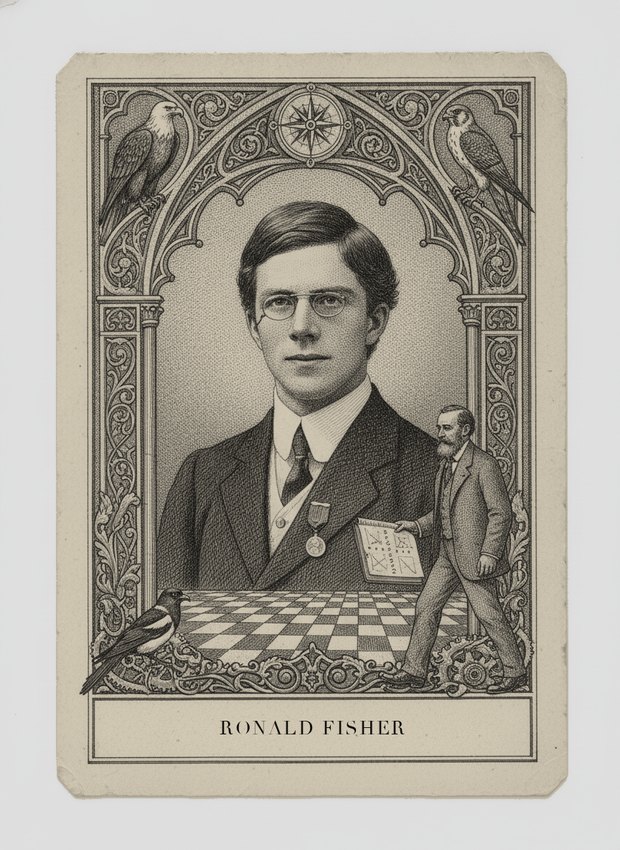
This is Fisher's home ground in the most literal sense. At Rothamsted from 1919 he faced exactly this constraint — one season's plots, no second chances — and invented the modern answer. Randomization justifies the analysis, blocking absorbs soil and batch gradients, and the factorial principle makes every one of twenty-four runs inform every effect: vary all four factors together so main effects and interactions are estimated simultaneously rather than wasting units on one-factor-at-a-time comparisons, whose inefficiency he attacked explicitly. His 1926 paper on the arrangement of field experiments and The Design of Experiments (1935) codified confounding higher-order interactions with block effects — precisely what a two-level design in blocks of eight demands. He is the only person in this batch who both lived the constraint and built the machinery, in the exact decade the problem specifies.
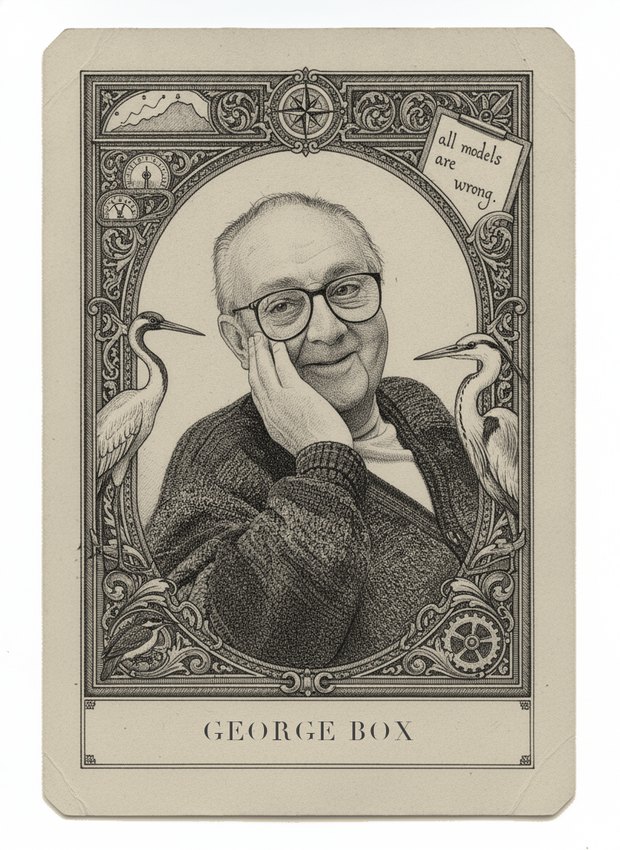
Box learned experimentation at ICI in the 1940s and 1950s under precisely this economics: chemical runs cost real money, batches drift, and interactions between factors are usually the story. Response-surface methodology (Box and Wilson, 1951), fractional factorial designs, fold-over augmentation, and blocking against time trends are direct machinery for four factors in twenty-four units. Statistics for Experimenters, written with the Hunters, is essentially a field manual for this problem, full of worked two-level factorials with confounded blocks. His signature instinct — treat experimentation as sequential, spend part of the budget learning where to spend the rest — would shape how he split the twenty-four runs. He postdates the 1920s setting, but his toolkit is Fisher's program refined for industry; only Fisher himself is more native here.
In the mind map
The same ideas, as concepts rather than history — in John's ML knowledge map.
46 figures are scored on this problem. Draw it in a battle to see where you land.