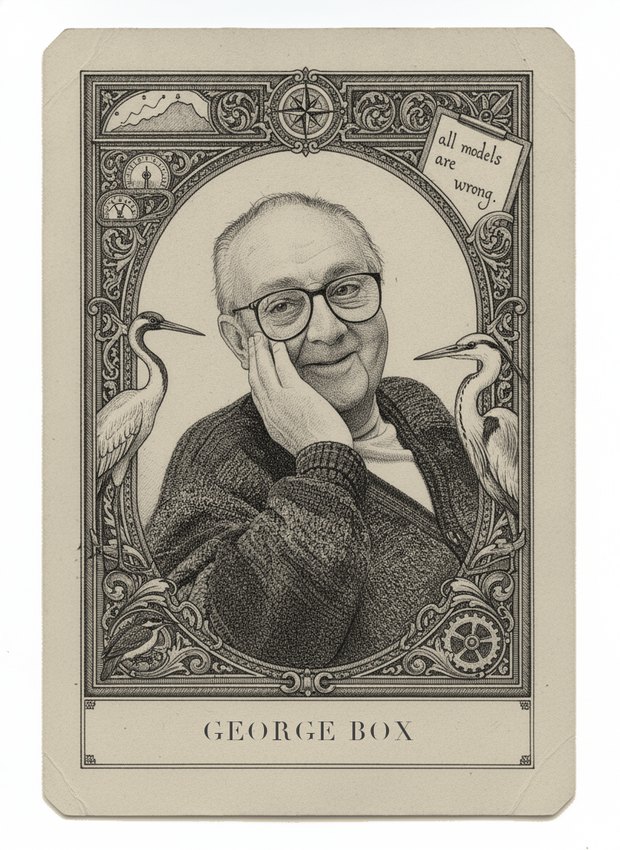
George Box
'All models are wrong'; time series; response surfaces; Bayes in quality control
Strongest on
In the mind map
The same ideas, as concepts rather than history — in John's ML knowledge map.
Life and career
George Edward Pelham Box came to statistics the way a lot of the best applied statisticians of his generation did: by being handed a real problem and no one to solve it. Born in Gravesend, Kent, in 1919, he was studying chemistry when the Second World War interrupted, and he served in the British Army during the war doing experimental work connected to the defense against chemical weapons. The experiments produced messy, variable data, and Box — with no formal training in the subject — taught himself enough statistics to analyze them. The story he told about that period, that he asked for a statistician and was told there wasn't one so he had better become one himself, is the origin myth of a career spent insisting that statistics is something you do *in the middle of* an investigation, not something you apply to a finished dataset.
After the war he took a degree in mathematics and statistics at University College London, studying in the orbit of Egon Pearson, and completed a doctorate there. He then joined Imperial Chemical Industries, where he spent most of the 1950s as an industrial statistician. ICI is where the characteristic Box worldview was forged. A chemical plant is not a place where you get to collect one enormous clean sample and fit one model. It is a place where every experimental run consumes raw material and machine time, where the factors interact, where the process drifts, and where the practical question is never "what is the true model?" but "which knob should I turn next, and by how much?"
He moved to the United States in the later 1950s, spending time at Princeton, and in 1960 founded the Department of Statistics at the University of Wisconsin–Madison, where he remained for the rest of his career and built one of the most influential applied statistics groups in the world. Wisconsin under Box became a place where students were expected to work on live industrial problems, and where the Monday-night beer-and-statistics sessions at his home became famous — a running seminar in which practitioners brought real data and the group argued about it.
Box's personal life intersected with statistics history in a way that is hard to ignore: he married Joan Fisher, daughter of R. A. Fisher, and she later wrote a biography of her father. Box thus stood, personally as well as intellectually, between the Fisherian design-of-experiments tradition and the Bayesian revival of the second half of the twentieth century — and, unusually for his era, he refused to treat those as warring camps. He collaborated with George Tiao on Bayesian inference in statistical analysis, worked extensively with Gwilym Jenkins on time series, and later in his career turned toward quality improvement and the statistical side of what became the industrial quality movement, engaging seriously with Japanese quality methods and with W. Edwards Deming's ideas.
He was president of the American Statistical Association and of the Institute of Mathematical Statistics, and he continued writing and teaching into his nineties. He died in Madison in 2013. His memoir, published near the end of his life, carried the title *An Accidental Statistician*, which is about as accurate a self-description as the field has produced.
Key contributions
Box's technical legacy comes in four large pieces, and they all share a common shape: sequential, model-guided, deliberately approximate.
**Response surface methodology.** The 1951 paper with K. B. Wilson, "On the Experimental Attainment of Optimum Conditions," is the founding document of a whole branch of applied optimization. The setting: a process output (yield, purity, strength) depends on continuous inputs (temperature, pressure, concentration) through an unknown, noisy function, and each evaluation is expensive. Box and Wilson's answer is a two-phase strategy. Far from the optimum, fit a first-order (linear, plus interactions) model in a small local design — a fractional factorial with center points — and use its gradient to define a *steepest ascent* path; take a sequence of cheap runs along that path until improvement stops. When curvature is detected (which the center points let you test), switch to a second-order design — the central composite design is Box and Wilson's, the Box–Behnken design came later with Donald Behnken — fit a quadratic surface, and use its canonical analysis to locate and characterize the stationary point: is it a maximum, a saddle, a ridge? Modern readers should recognize this as derivative-free stochastic optimization with a surrogate model and a trust region, invented for chemical plants two decades before anyone said "surrogate."
**Box–Jenkins time series.** With Gwilym Jenkins, in *Time Series Analysis: Forecasting and Control* (1970), Box gave the ARIMA framework its canonical operational form. The technical content — autoregressive and moving-average operators, differencing to handle nonstationarity, seasonal multiplicative structure (the "airline model") — matters less than the *methodology* they wrapped around it: the identification–estimation–diagnostic-checking loop. You look at the sample autocorrelation and partial autocorrelation functions to guess an order, estimate, then examine the residuals for remaining structure, and iterate. Their transfer-function and intervention models extended this to inputs and to abrupt policy changes. For decades "Box–Jenkins" was simply the name of the discipline of applied forecasting.
**Box–Cox transformations.** The 1964 paper with David Cox proposed treating the transformation of the response as a parameter to be estimated rather than chosen by eye: the family $y^{(\lambda)} = (y^\lambda - 1)/\lambda$ (with the log as the limit at $\lambda \to 0$), with $\lambda$ estimated by maximum likelihood alongside the regression coefficients. It is a small idea with an outsized effect, because it made "should I log this?" a question with a likelihood-based answer and a confidence interval.
**Robustness, evolutionary operation, and the philosophy.** Box did foundational work on the robustness of standard procedures to violations of their assumptions — an early, careful demonstration that some tests (notably variance tests) are far more fragile to nonnormality than others. He invented Evolutionary Operation (EVOP), a scheme for running tiny designed experiments continuously on a *production* process so that improvement happens without ever taking the plant offline. And he articulated the aphorism that every statistician now knows: all models are wrong, but some are useful. It is not a shrug. It is a research program — it says the object of inference is not the true model but the useful approximation, and it licenses the whole iterative, diagnostic, learn-as-you-go style that runs through everything above.
In battle
Box is a specialist, and the game's score matrix makes that unusually legible. Across 102 problems his mean score is 44 with a median of 40, but the distribution is bimodal: eleven problems where he is dominant (80+) and eighteen where he is nearly irrelevant (≤20). He is not a generalist who is decent everywhere. He is a scalpel.
His home category is **experimental design** (65.4 average, his best by a wide margin), followed by **testing** (52.9) and **small-sample** work (47.6). Play him where the data does not exist yet and someone has to decide how to generate it. His single strongest cell is **P112 — Climb the yield surface** at 98, and the matrix's own explanation is blunt about why: this is not adjacent expertise, it is literally the ICI problem that produced response surface methodology. **P138 — The trend with a memory** (98) is Box–Jenkins by another name. **P045 — Tune the un-differentiable** (96) is the response-surface machinery applied to black-box optimization, and it is a good demonstration that Box's method predates and anticipates a lot of what gets called Bayesian optimization today. **P007 — Design the trial before the data** (92) and **P114 — Eleven factors, twelve runs** (92, 88) are pure fractional-factorial and screening-design territory — Plackett–Burman-scale problems where the whole art is extracting main effects from a run budget that looks impossibly small. **P118 — The factor you can't keep changing** (92) is split-plot design, a structure that arises constantly in industry when one factor is expensive to reset, and Box wrote about it directly. **P021 — Which of five models?** (90) and **P008 — A/B test with a twist** (85) round out the pattern: model discrimination and comparative experimentation with a diagnostic loop.
The losses are equally coherent, and they are all the same loss. Box scores 6.0 in **computability**, 10.0 in **search**, 17.0 in **systems**, and 28.0 in **information**. He collapses on **P031 — Is there a fast route through every city?** (5), **P201 — The dice make it learnable** (5), **P161 — How many bits must cross the wire** (7), **P077 — The rank of every page** (8), **P194 — Prune the adversary's replies** (8), and **P167 — How few bits for a good-enough picture** (10). The through-line: Box's entire toolkit assumes a continuous response measured with noise, a small budget of physical runs, and a human deciding what to try next. Combinatorial complexity, information-theoretic limits, adversarial search, graph spectra, and self-play credit assignment are not weak spots in his method — they are outside its domain of definition. He has no machinery for discrete structure and none for computational cost as a first-class object. Even his mid-range categories tell the story: **causality** at 35.8 is surprisingly soft for someone so deep in experimental design, because the game's causality problems lean on observational identification (potential outcomes, do-calculus, instruments) rather than on randomization, and randomization is the only causal instrument Box really needs.
Practical read: bring Box to any problem phrased as *design the experiment*, *find the operating conditions*, *forecast this series*, or *transform and diagnose this regression*, and he will beat almost anyone. Bring him to anything phrased as *how fast*, *how many bits*, or *what's the optimal policy*, and he has nothing to say — and the matrix, correctly, gives him nothing.