regression
The trend with a memory
It is 1970, and a forecaster fitting a regression to a monthly economic series is quietly violating the assumption underneath ordinary least squares: the errors are not independent, they are autocorrelated — this month's shock bleeds into next month's — so the standard errors are wrong and the significance tests lie. Model the series properly: capture the dependence with autoregressive and moving-average terms, difference away trends until the series is stationary, and only then trust the inference. Get it wrong and you report a predictor as significant on the strength of correlation that is really just the series' own inertia, and the forecast intervals are far too tight — a whole tradition of naive time-series regression drew false conclusions from ignoring the memory in the noise.
Who this problem belongs to
The two figures whose methods fit it best, out of 56 in contention.
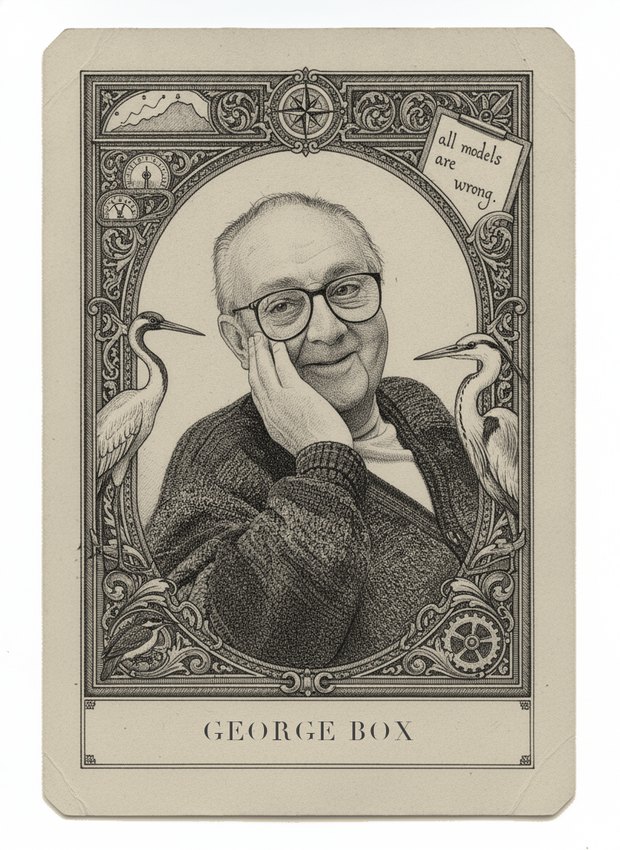
This problem is Box's own biography. With Gwilym Jenkins he published Time Series Analysis: Forecasting and Control in 1970, the exact year this problem is set, codifying the identify-estimate-diagnose cycle for autoregressive integrated moving-average models. Differencing a nonstationary series until it settles, choosing AR and MA orders from the autocorrelation and partial-autocorrelation functions, then checking residuals for leftover structure — that sequence is literally the Box-Jenkins method, developed at ICI and Wisconsin from real production and economic series. He understood better than anyone that ignoring serial correlation in regression residuals manufactures spurious significance, which is precisely the trap this economic forecaster has fallen into. No one else on this roster owns the method by name; Box did not adapt time-series thinking to this problem, he built the toolkit the problem is describing.
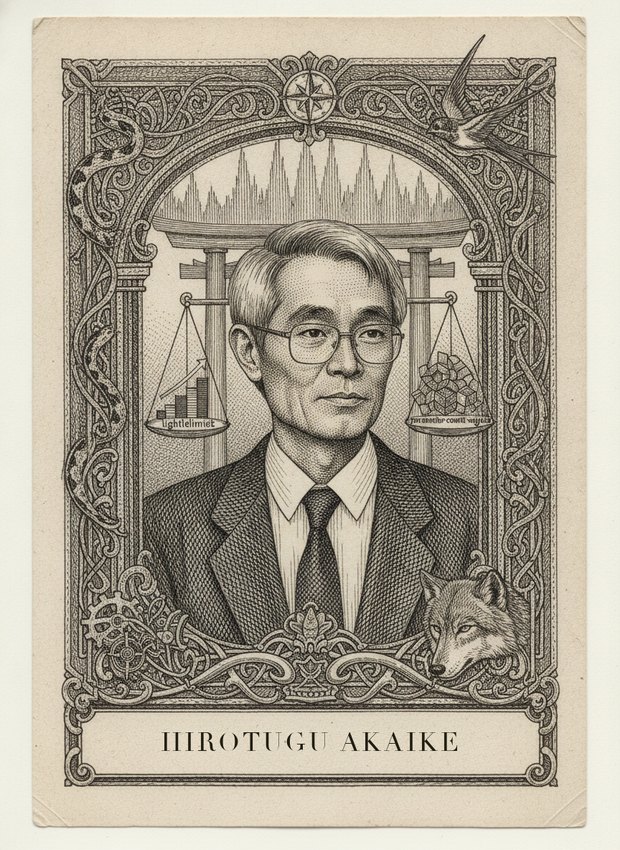
Akaike's 1974 information criterion answers the question this problem sidesteps but any honest forecaster must ask: how many AR and MA terms, exactly, and how do you stop guessing? Working at Japan's Institute of Statistical Mathematics through the 1970s, he reframed model selection as minimizing expected prediction error rather than chasing significance tests, giving Box-Jenkins practitioners a principled way to pick orders instead of eyeballing correlograms. His state-space reformulation of ARMA models, developed alongside this work, also connects directly to Kalman filtering for time series. He is not the originator of ARIMA differencing or stationarity diagnosis, which belong to Box and Jenkins, but no one improved the practice of fitting these models more than he did, and the criterion bearing his name is still the default order-selection tool today.
Fought here
In the mind map
The same ideas, as concepts rather than history — in John's ML knowledge map.
56 figures are scored on this problem. Draw it in a battle to see where you land.