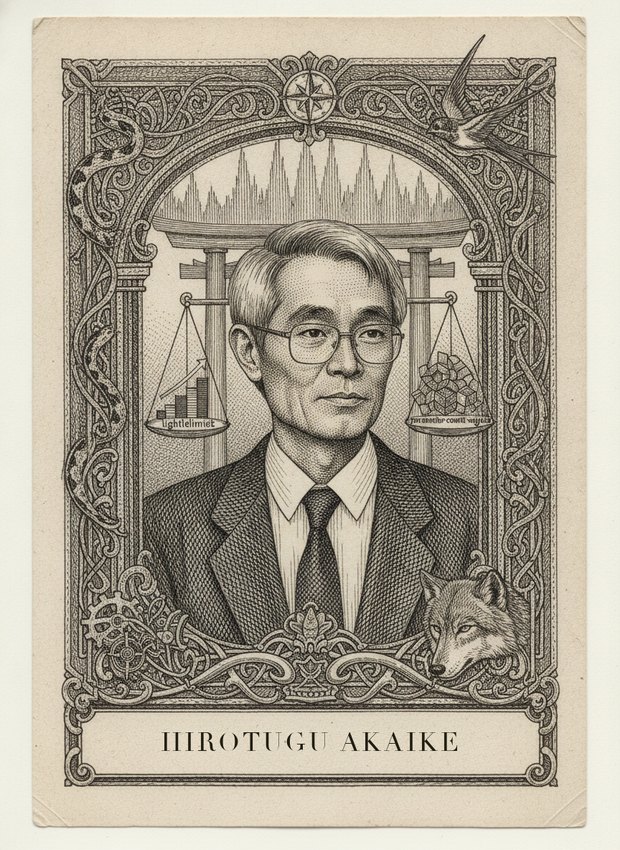
Hirotugu Akaike
AIC; information criteria for model selection
Strongest on
In the mind map
The same ideas, as concepts rather than history — in John's ML knowledge map.
Life and career
Hirotugu Akaike was born in 1927 in Fujinomiya, in Shizuoka Prefecture, and came of age in a Japan that was rebuilding its scientific institutions from the ground up. He studied mathematics at the University of Tokyo, and in 1952 joined the Institute of Statistical Mathematics (ISM) in Tokyo, the national research institute that would be his professional home for essentially his entire career. He rose through it steadily and eventually served as its Director General. Unlike many of the figures on this roster, Akaike did not build his reputation by moving between elite universities on two continents; he built it by staying in one place and taking seriously the problems that were actually brought to him.
That last point matters more than it sounds. ISM in the 1950s and 1960s functioned partly as a service institute for Japanese science and industry. Akaike worked on real time series: vibration and seismic records, ship-steering dynamics, cement-kiln control, thermal power plant operation. He was, for long stretches, an applied engineer's statistician. This is the origin of the sensibility that runs through all his work — a deep suspicion of the idea that there exists a "true model" waiting to be discovered, and a corresponding conviction that the honest goal of statistical modeling is *prediction of future data*, not identification of truth.
The frequentist orthodoxy of the era treated model selection as a hypothesis-testing problem: nest your models, run a likelihood ratio test, pick a significance level by convention. Akaike found this unsatisfying in practice, because the significance level was arbitrary and the framework said nothing when models were not nested. Working on autoregressive order selection for spectral estimation, he confronted the problem in its most irritating concrete form: each additional AR lag fits the observed history better, and yet forecasts get worse. Something other than fit had to be measured.
His answer arrived in two stages: the Final Prediction Error criterion (FPE) in 1969, and then, in a 1971 symposium paper published in 1973, the information criterion that carries his name. The 1973 paper — "Information theory and an extension of the maximum likelihood principle" — is one of those rare papers whose central formula fits on one line and whose consequences reorganized an entire practice. By the 1980s AIC was standard equipment in econometrics, ecology, signal processing, psychometrics, and biostatistics, often used by people who had never read the derivation.
Akaike continued working on time series and Bayesian modeling for decades afterward, developing state-space methods, the Bayesian criterion ABIC, and software tools (the TIMSAC packages) that put his methods in practitioners' hands. He received the Kyoto Prize in 2006, one of the highest honors available to a scientist working outside the Nobel categories. He died in 2009. In the citation literature he is among the most-cited statisticians who has ever lived, largely on the strength of a single three-symbol acronym.
Key contributions
**The Akaike Information Criterion.** The derivation is worth understanding rather than memorizing, because everything about AIC's proper use and misuse follows from it. Suppose data are generated by an unknown distribution *g*, and you fit a parametric family *f(·|θ)* by maximum likelihood, obtaining θ̂. You would like to choose the model that minimizes the expected Kullback–Leibler divergence from *g* to *f(·|θ̂)* on *new* data drawn from *g*. The maximized log-likelihood on the *training* data is the natural estimator of the relevant term — but it is biased upward, because θ̂ was tuned on exactly those data. Akaike showed that, asymptotically and under regularity conditions, that bias is equal to *k*, the number of free parameters. Correct for it and you get
AIC = −2 log L(θ̂) + 2k,
to be minimized. The penalty is not a philosophical preference for parsimony; it is a bias correction with a derivation. This is why AIC is not interchangeable with a "penalize complexity because simple is beautiful" heuristic, and why the constant 2 is not adjustable taste.
Several consequences follow directly, and graduate students should internalize them. AIC estimates *predictive* performance, so it is not consistent for model identification when a true finite-dimensional model exists in the candidate set — BIC, with its log(n) penalty, is. Akaike's framework does not assume the true model is among the candidates; the KL target is defined relative to whatever *g* actually is, and the best candidate may simply be the least-wrong approximation. AIC differences between models are meaningful, absolute values are not. And the asymptotic bias correction degrades when *k* is not small relative to *n*, which is what motivated the small-sample correction AICc developed by Sugiura and later popularized by Hurvich and Tsai — a refinement of Akaike's edifice, not a replacement.
**Time series and spectral estimation.** Akaike's route to AIC ran through autoregressive modeling, and his contributions there stand on their own. FPE (1969) gave a criterion for AR order selection derived from one-step-ahead prediction error. He developed multivariate AR methods for feedback-system identification, applying them to problems like cement-rotary-kiln and power-plant control, where determining the direction of influence among coupled channels was the practical question. His later state-space and Bayesian smoothing work, including seasonal adjustment methods, shaped how Japanese official statistics handled trend and seasonality.
**Bayesian modeling and ABIC.** Akaike extended his information-theoretic thinking to hierarchical Bayesian models, proposing ABIC — an information criterion for comparing models with smoothness priors, in which hyperparameters controlling regularization strength are chosen by criterion minimization rather than by hand. The conceptual link to generalized cross-validation and to modern empirical-Bayes hyperparameter selection is direct.
**A stance, not just a formula.** Akaike's larger contribution is the reframing: the entropy-maximization principle as a foundation for statistical inference, and model selection as a decision about predictive accuracy rather than a test of truth. That stance — evaluate models by how well they will do on data you have not seen — is the same instinct that underwrites cross-validation, out-of-sample validation, and the entire modern machine learning evaluation protocol.
In battle
Akaike's computed profile is that of a specialist with an unusually sharp peak. Across roughly a hundred problems he averages about 34, but the shape of the distribution matters more than the mean: four dominant scores, and a long tail of twenty-five problems where he scores 20 or below. He is a scalpel, not a hammer.
His single best showing is **P021 — Which of five models?** at 98, and the judge's reasoning is blunt about why: this is Akaike's own problem, in his own decade, solved with his own formula. Nested candidate models, better fit and worse forecasts, and a demand that the complexity penalty be *justified* rather than chosen by taste — that is the exact situation that produced AIC. He is nearly as strong on **P138 — The trend with a memory** (88), which lands in his native autoregressive time-series territory, and **P171 — The shortest description that predicts** (88), where the information-theoretic framing of model complexity is his natural language even though the minimum-description-length machinery came from others. **P128 — Does the extra parameter earn its keep?** (84) is AIC restated as a question. He carries **P097 — Does your pipeline reproduce?** (70) and **P015 — Does the model fit at all?** (66) on general model-criticism strength.
By category the pattern is consistent: information (59), regression (45), high-dimensional (44), small-sample (42), and testing (42) are his strong suits, because every one of them is fundamentally about deciding how much structure the data can support.
The losses are equally legible and pedagogically useful. He scores 5 on **P200 — Beat the world champion**, and the explanation is unusually clean: Deep Blue was hand-engineered brute-force search plus a grandmaster-tuned evaluation function, a deterministic engineering artifact with no statistical model to select among. Akaike's toolkit compares models against observed data; there is no data-generating process here to approximate. He scores 8 on **P088 — Attention replaces recurrence** — a sequence-modeling problem, superficially adjacent to his time-series work, but the actual content is neural architecture design at a scale and in an idiom he never touched. **P254 — The wall around the data structure** (8) is software abstraction and encapsulation, **P176 — Cut through the interior** (9) and **P177 — The certificate of optimality** (9) are combinatorial and continuous optimization, and **P164 — Trust without recomputing** (9) is verification. His optimization category average of 9 and games average of 11.5 are among the lowest on the roster.
The practical lesson for anyone drafting Akaike: play him against problems whose core question is *which model, and how complex?* Play him into anything algorithmic, combinatorial, adversarial, or architectural and he will be beaten badly by opponents whose entire careers were built there. He is devastating in a narrow lane and nearly inert outside it — which is, in a sense, exactly what a criterion is.