regression
Which of five models?
It is the 1970s, and forecasting has a seductive disease: add parameters and the fit to past data always improves, right up until the model has memorized the noise and predicts the future terribly. You hold five nested time-series models, each fitting the history a little better than the last, and you must choose one to forecast next quarter — on principle, not on which curve hugs the old data most tightly. Penalize complexity in a way you can justify from information theory, not taste. Get it wrong and you ship the overfit model: it dazzled on the backtest and fails the moment real money rides on the forecast — the whole art is trading fit against parsimony before reality, not after, exposes the bloat.
Who this problem belongs to
The two figures whose methods fit it best, out of 59 in contention.
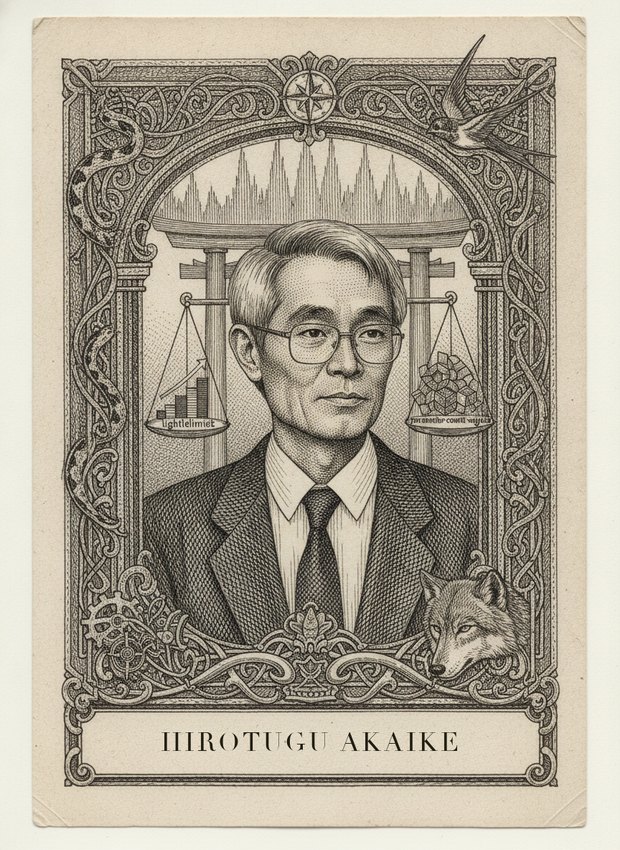
This is Akaike's own problem, in his own decade, solved with his own formula. Working on spectral estimation and autoregressive order selection at Tokyo's Institute of Statistical Mathematics, he faced literally this: nested AR models, each fitting history better, forecasting worse. His 1969 FPE and then the 1973 information criterion derived the answer from first principles — maximized log-likelihood is a biased estimate of expected out-of-sample Kullback-Leibler divergence, and the bias is asymptotically the parameter count, so minimize -2logL + 2k. That is precisely 'penalize complexity in a way you can justify from information theory, not taste.' He applied it to real time series immediately and it reshaped forecasting practice worldwide. The only reason to withhold two points: small-sample corrections (AICc, 1978, Sugiura) and consistency critiques (BIC) came from others, refining edges of his edifice.
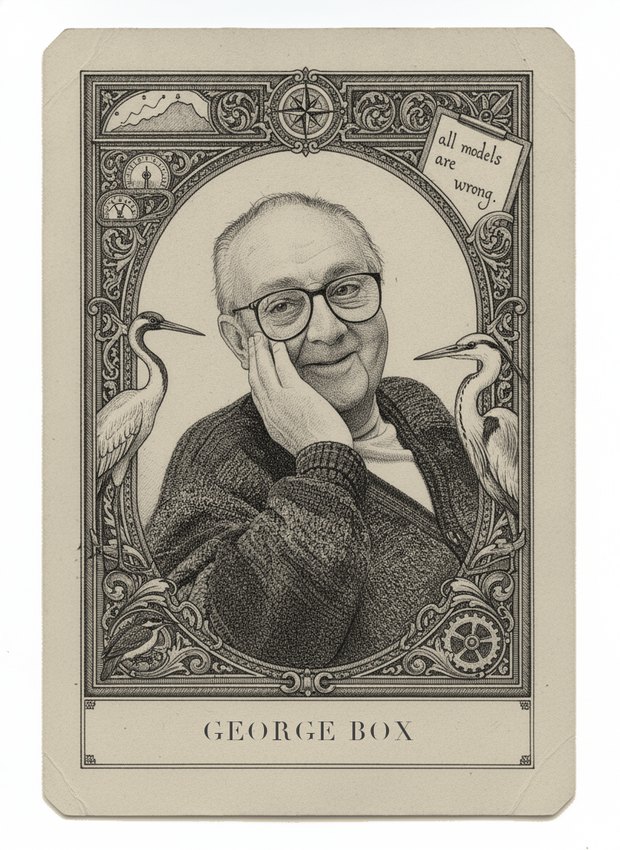
This problem describes Box's day job. The Box-Jenkins methodology (1970, with Gwilym Jenkins) is the canonical 1970s procedure for exactly this: identify candidate ARIMA orders from autocorrelation structure, estimate, then check residuals, iterating toward the most parsimonious model that leaves white-noise residuals. Parsimony was not a slogan for him but an operating principle — 'all models are wrong, but some are useful' is precisely a warning against mistaking in-sample fit for truth. He forecast real series for industry and knew the overfit model's backtest seduction firsthand. His one gap against the problem's letter: his justification is diagnostic craft and scientific judgment rather than a formal information-theoretic derivation — that final step is Akaike's, and Box respected but did not originate it. On this problem in this decade, nearly everyone else is a tourist; Box is the resident.
Fought here
In the mind map
The same ideas, as concepts rather than history — in John's ML knowledge map.
59 figures are scored on this problem. Draw it in a battle to see where you land.