It is 1970, and a forecaster fitting a regression to a monthly economic series is quietly violating the assumption underneath ordinary least squares: the errors are not independent, they are autocorrelated — this month's shock bleeds into next month's — so the standard errors are wrong and the significance tests lie. Model the series properly: capture the dependence with autoregressive and moving-average terms, difference away trends until the series is stationary, and only then trust the inference. Get it wrong and you report a predictor as significant on the strength of correlation that is really just the series' own inertia, and the forecast intervals are far too tight — a whole tradition of naive time-series regression drew false conclusions from ignoring the memory in the noise.

Niyogi's work on manifold learning and Laplacian eigenmaps, along with his learning-theoretic analyses of speech and language, deals with structured but generally not temporally autocorrelated data — his central concern was geometric structure in high-dimensional feature spaces, such as how speech samples cluster on a low-dimensional manifold, rather than serial dependence across sequential observations in a regression. There is a loose analogy between 'structure the naive method ignores' in both problems, but the specific machinery — differencing, ARMA terms, autocorrelation functions — is entirely absent from his research program, which ran from the 1990s until his early death in 2010. He would need to import an unfamiliar statistical framework wholesale rather than extend his own tools to solve this.
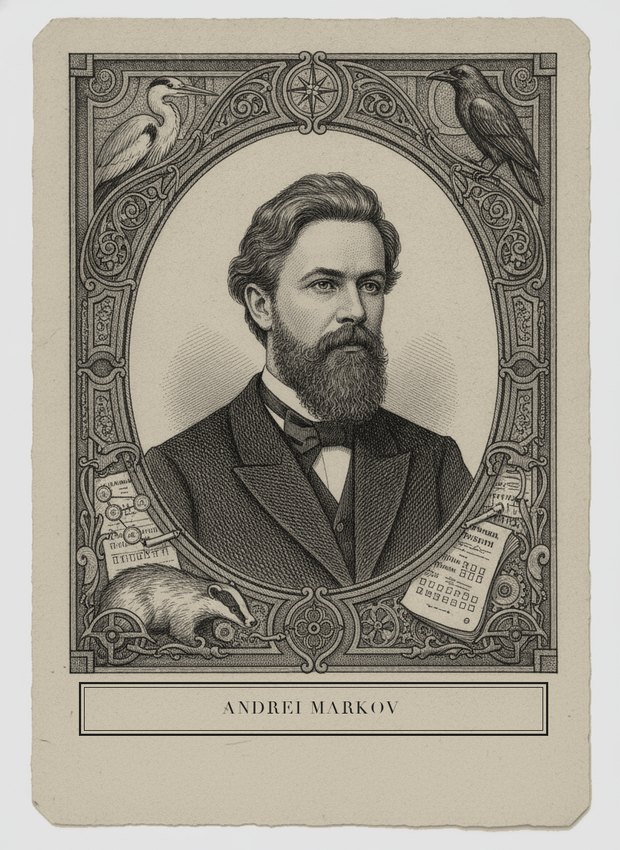
Markov's 1906 chains are the conceptual root of 'memory' in a sequence: a process where the next value depends on recent history rather than being drawn independently, which is exactly the violation this forecaster is ignoring. His work, done to settle a philosophical dispute about independence in probability using Pushkin's Eugene Onegin as a data source, established the mathematics of dependent sequences that autoregressive models formalize a century later. He would immediately diagnose why ordinary least squares standard errors are wrong here — treating dependent draws as independent understates variance. What he lacks is the applied apparatus: differencing for stationarity, moving-average terms, and identification via correlograms are all twentieth-century economic statistics built long after his death, so he supplies the deep principle but none of the forecasting machinery.
Battle #58 · 8/10/2026, 11:34:45 AM · this result is deterministic: the same two personas on this problem always resolve the same way.