experimental-design
The factor you can't keep changing
It is the 1950s in a manufacturing plant, and you must test how both oven temperature and several coating recipes affect a product — but the oven takes half a day to re-set, while a coating can be swapped in minutes. A fully randomized design would demand the oven be reset for every single run, which the schedule forbids. Design a split-plot experiment that respects the hard-to-change factor: group runs under each temperature and randomize the coatings within, then analyze it honestly, because the two kinds of factor carry different error and naive analysis will misjudge which effects are real. Get it wrong and a temperature effect is tested against the wrong yardstick, and you ship the mistaken conclusion into the process.
Who this problem belongs to
The two figures whose methods fit it best, out of 41 in contention.
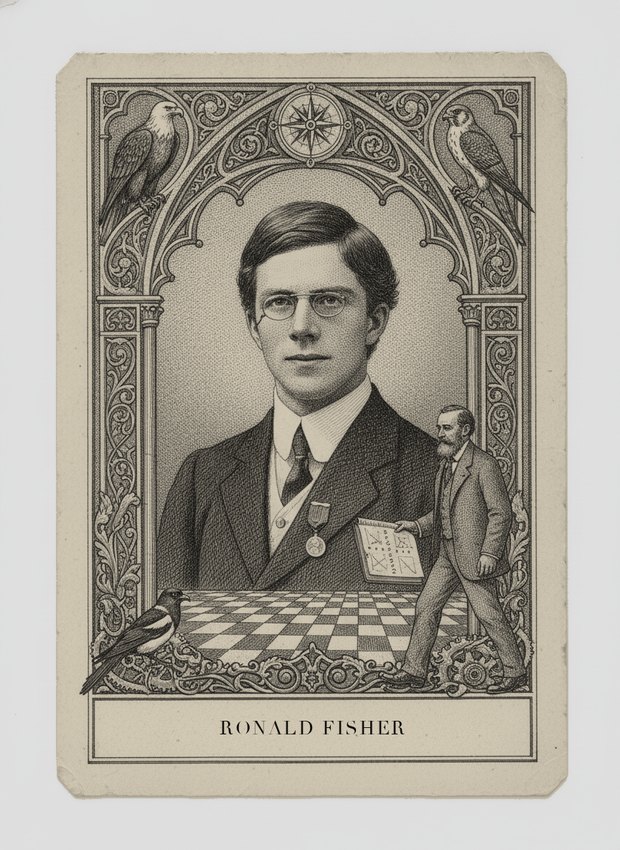
The split-plot design is Fisher's own invention, born of exactly this constraint. At Rothamsted in the 1920s-30s, some agricultural factors -- irrigation method, ploughing regime -- were physically hard to change plot by plot, while others, like fertilizer or variety, could be assigned freely within a plot once it was set; his response was to randomize the hard-to-change factor across large 'whole plots' and the easy-to-change factor within each, then analyze the two strata against different error terms, exactly the discipline this problem demands. His The Design of Experiments (1935) formalizes precisely this structure and precisely this warning: analyze naively and you test the whole-plot factor against the wrong error. The only reason this is not a flat 100 is that the specific manufacturing vocabulary -- ovens, coatings -- is decades and an industry away from his agricultural plots.
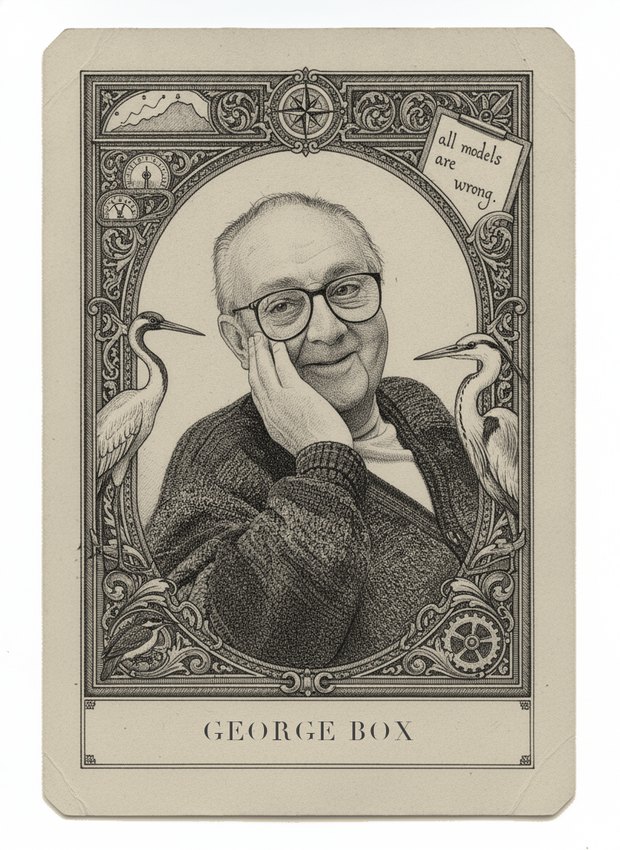
Box inherited Fisher's split-plot logic and, working as an industrial statistician at ICI before his academic career, translated it directly into exactly this factory scenario: a hard-to-reset process variable (temperature, pressure) crossed with cheaply-changed factors (formulations, settings), analyzed with the whole-plot/subplot error structure Fisher had built for agriculture. His and Hunter's later text Statistics for Experimenters explicitly works through manufacturing split-plot examples nearly identical to an oven-and-coating problem, including the warning that naive analysis misjudges the hard-to-change factor's significance. His response-surface and evolutionary-operation work also shows deep comfort with the economic reality that some factors simply cannot be randomized freely on a production schedule. He sits just behind Fisher only because he is the field's great industrial translator of the idea rather than its originator.
In the mind map
The same ideas, as concepts rather than history — in John's ML knowledge map.
41 figures are scored on this problem. Draw it in a battle to see where you land.