small-sample
The recombination fraction from a small cross
It is 1918, and a geneticist has crossed plants and counted the offspring types — but the cross yielded only a few dozen progeny, and from those counts you must estimate how tightly two genes are linked on the chromosome. The estimate is a maximum-likelihood exercise on small integer counts, and the sampling variance at this size is large enough to swallow a real effect or manufacture a false one. Deliver the estimate and its precision, and say honestly whether the two genes are linked at all. Get it wrong and a genetic map is drawn with phantom order, or true linkage is dismissed — and at the dawn of quantitative genetics the map itself is the science.
Who this problem belongs to
The two figures whose methods fit it best, out of 41 in contention.
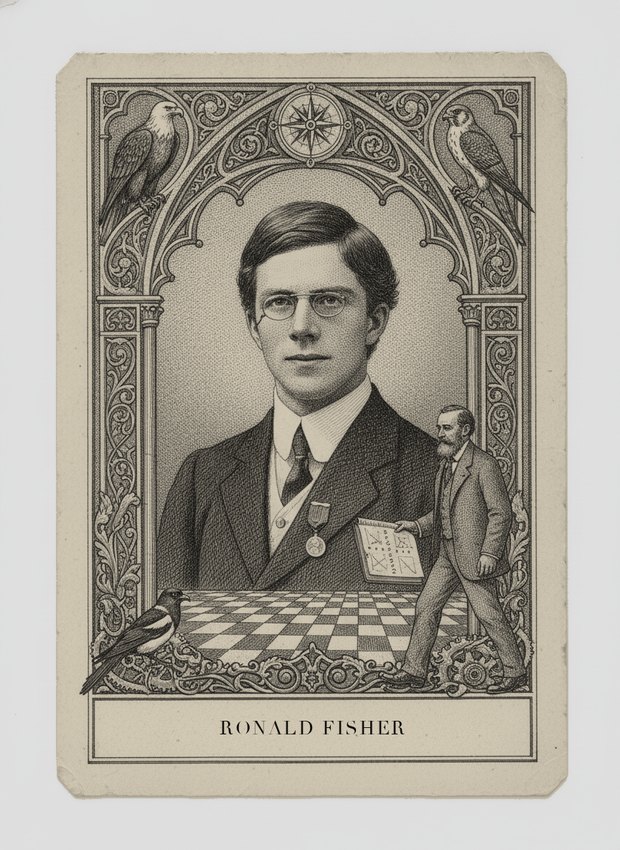
This problem is close to Fisher's own working desk. His 1912 paper 'On an Absolute Criterion for Fitting Frequency Curves' introduced maximum likelihood, and through the 1920s at Rothamsted he developed the method of scoring specifically to estimate recombination fractions from crosses with small, awkward offspring counts, publishing directly on linkage estimation in mice and other organisms during exactly this period. He also built the theoretical apparatus — Fisher information, the variance of the MLE, and later the likelihood-ratio logic underlying significance testing — needed to attach a rigorous precision statement to the point estimate and to judge honestly whether apparent linkage is real. Fisher was simultaneously immersed in the Bateson-Punnett linkage controversies of the 1910s, engaging directly with the biology alongside the statistics. No other figure in this list combines the specific method, era, and application this closely.
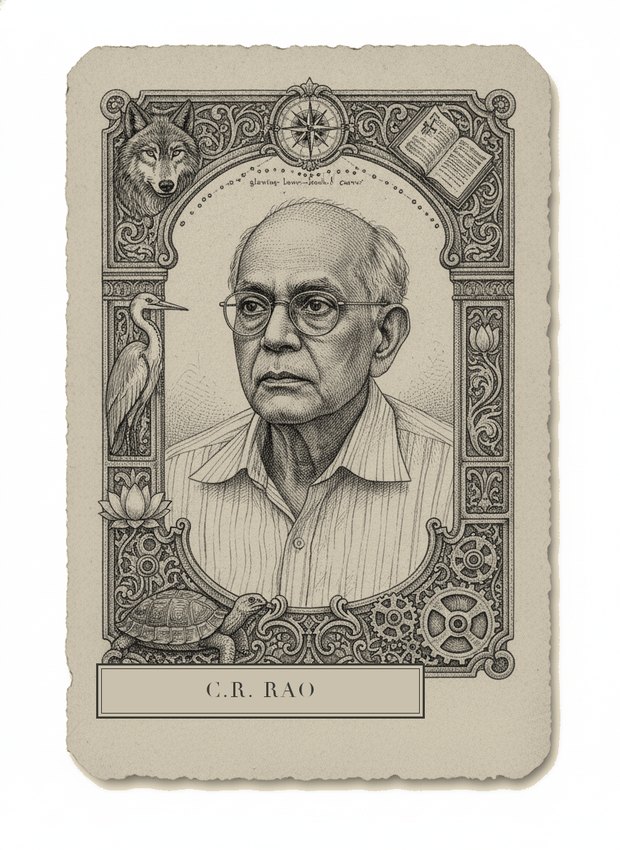
Rao's 1945 Cramer-Rao bound gives the precise theoretical floor on the variance of any unbiased estimator, and his Rao-Blackwell theorem shows how to construct efficient estimators from sufficient statistics — both landmark results in the estimation theory this problem sits squarely inside. For a recombination fraction estimated by maximum likelihood from a small multinomial cross, Rao's framework tells you exactly how much precision is achievable given the sample size, letting you attach a rigorous, non-hand-wavy confidence statement to the point estimate rather than a vague sense of uncertainty. Working at the Indian Statistical Institute from the 1940s onward, Rao built much of the mathematical scaffolding — information geometry, efficiency bounds — that modern quantitative genetics and biometry still cite when justifying MLE-based linkage estimates. His methods arrived after 1918 but map onto this exact estimation problem almost perfectly.
Fought here
In the mind map
The same ideas, as concepts rather than history — in John's ML knowledge map.
41 figures are scored on this problem. Draw it in a battle to see where you land.