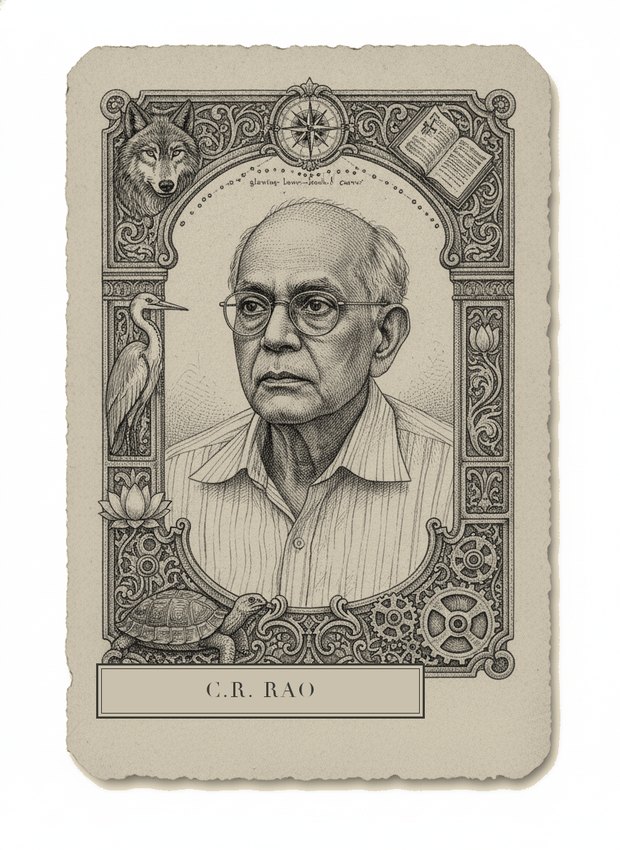
C.R. Rao
Cramer-Rao bound, Rao-Blackwellization, information geometry
Strongest on
In the mind map
The same ideas, as concepts rather than history — in John's ML knowledge map.
Life and career
In 1945, a 24-year-old statistician working in Calcutta published a paper in the *Bulletin of the Calcutta Mathematical Society* with the unassuming title "Information and the accuracy attainable in the estimation of statistical parameters." It contained three separate ideas that would each have made a career: a universal lower bound on the variance of unbiased estimators, a procedure for improving any estimator by conditioning on a sufficient statistic, and the observation that Fisher information defines a Riemannian metric on the space of probability distributions. The author was Calyampudi Radhakrishna Rao, and he would go on to work for nearly eight more decades.
Rao was born in 1920 in Hadagali, in what is now Karnataka, the eighth of ten children in a Telugu family. His father was a police inspector, and the family moved often. He took a master's degree in mathematics at Andhra University and then, after being turned down for a job, found his way to the Indian Statistical Institute in Calcutta, which P. C. Mahalanobis had founded in 1931 and was building into one of the world's great statistical centers. Rao entered the ISI's training program in 1941 and never really left its orbit.
In 1946 the ISI sent him to Cambridge, where he worked at the Museum of Anthropology and Archaeology on the statistical analysis of skeletal measurements from an African expedition — a very Mahalanobis kind of assignment, since Mahalanobis's own distance measure had come out of anthropometry. While there he completed a doctorate under R. A. Fisher, which places Rao in a direct line from the founder of modern mathematical statistics. He returned to India and spent the bulk of his career at the ISI, eventually as its director, training and supervising an extraordinary number of students who populated statistics departments across India and the world.
In 1979, at an age when most academics are contemplating retirement, Rao moved to the United States, holding professorships at the University of Pittsburgh and then at Penn State, where he was for many years associated with the Center for Multivariate Analysis. He kept publishing. He received the U.S. National Medal of Science in 2002, was a Fellow of the Royal Society, and in 2023 — at the age of 102 — was awarded the International Prize in Statistics, the field's closest analogue to a Nobel, cited explicitly for that 1945 paper. He died a few months later, in August 2023.
The arc is worth dwelling on for a graduate audience because it cuts against a common assumption. Rao's foundational work was done young, in a newly independent country's research institute, largely disconnected from the Anglo-American centers of the field, on problems that arrived from agriculture, anthropometry, and genetics. The theory came out of the applications, not the other way around.
Key contributions
**The Cramér–Rao bound.** Given a family of distributions $p(x;\theta)$ and any unbiased estimator $\hat\theta$ of $\theta$, the variance satisfies $\mathrm{Var}(\hat\theta) \ge 1/I(\theta)$, where $I(\theta) = \mathbb{E}[(\partial_\theta \log p)^2]$ is the Fisher information in the sample. In the multiparameter case the covariance matrix dominates the inverse Fisher information matrix in the positive-semidefinite ordering. Harald Cramér arrived at the result independently and slightly later, hence the joint name. What makes this a landmark rather than an inequality is what it *licenses*: it converts estimation from a contest among procedures into a question with a known floor. You can now ask whether a given estimator is *efficient* — whether it attains the bound — and the equality condition tells you exactly when: when the score function is proportional to $\hat\theta - \theta$, which happens precisely in exponential families with the natural sufficient statistic. Everything downstream in asymptotic efficiency theory, from maximum likelihood's asymptotic optimality to the modern information-theoretic minimax lower bounds used in high-dimensional statistics, descends from this move.
**Rao–Blackwellization.** If $T$ is a sufficient statistic and $\delta(X)$ any estimator, then $\mathbb{E}[\delta(X) \mid T]$ is a function of $T$ alone with risk no worse than $\delta$ under any convex loss — strictly better unless $\delta$ was already a function of $T$. Rao and David Blackwell established this independently. It is the most useful theorem in decision theory that a practitioner can actually apply mechanically: it says that conditioning on the sufficient statistic never hurts, and it gives a constructive recipe for improvement. Combined with Lehmann–Scheffé completeness it produces the UMVU estimator. Modern Monte Carlo inherits it wholesale — "Rao-Blackwellized particle filter" is standard vocabulary, and the variance-reduction trick of integrating out analytically tractable components before sampling is exactly this theorem.
**Information geometry.** The 1945 paper's final section noted that the Fisher information matrix, viewed as a bilinear form on the tangent space of a parametric family, is a Riemannian metric, and that the resulting geodesic distance gives a natural notion of distance between distributions. This is now called the Rao distance, and the observation is the seed of information geometry as developed later by Chentsov, Efron, Amari, and others — the field that gives us dual affine connections, the exponential and mixture geometries, and the natural gradient. Anyone who has used natural gradient descent, or wondered why the Fisher matrix keeps showing up as a preconditioner in optimization, is standing on this paragraph.
**Rao's score test.** Also his: the score test (or Lagrange multiplier test) evaluates the gradient of the log-likelihood at the null value and compares it to its expected variability, giving a test statistic that requires fitting only the *restricted* model. It completes the classical trinity alongside the Wald test and the likelihood ratio test, and it is the cheap one — you never have to fit the alternative.
**Multivariate analysis and design.** Rao contributed extensively to multivariate analysis (Rao's U statistic, work on discriminant analysis and the Mahalanobis distance tradition), to the theory of orthogonal arrays and their use in fractional factorial design, and to generalized inverses of matrices, where the Moore–Penrose inverse's role in linear models owes a good deal to his systematic treatment in *Linear Statistical Inference and Its Applications*. That book, and *Generalized Inverse of Matrices and Its Applications* with Mitra, taught the field.
Taken together, Rao is a theorist of *how much information a sample contains* and *what can be squeezed from it*. That is a narrow-sounding description that turns out to cover a very large fraction of classical statistics — and almost none of computer science.
In battle
The matrix carries Rao on 100 problems with a mean of 47 and a median of 46 — respectable, and notably more even than a pure specialist — but the tails tell the real story: ten problems at 80+, fourteen at 20 or below.
His strongest categories are **high-dim** (70.0), **small-sample** (66.0), **information** (59.0), **regression** (58.0), and **testing** (56.9). That cluster is coherent: these are all settings where the binding constraint is *information content*, not computation. Small samples are where efficiency bounds bite hardest, and Rao is the person who wrote down the bound.
His signature win is **P174 — The floor no estimator beats** at 99, which is simply his own theorem being asked back to him; the matrix's explanation notes that the one-point deduction is nominal. **P106 — Squeeze the estimator dry** (98) is Rao–Blackwellization stated as a puzzle. **P115 — Where to place the measurements** (95) is optimal design, where the Fisher information matrix *is* the design criterion — D-optimality, A-optimality, and the rest are functionals of the very object Rao introduced. **P105 — The recombination fraction from a small cross** (90) and **P103 — Count the fish you cannot see** (86) are classical small-sample likelihood estimation in genetics and capture–recapture, exactly the applied genre the ISI cut its teeth on. **P003 — Estimate the tank total** (85) — the German tank problem — is a UMVU exercise and a direct application of sufficiency plus Rao–Blackwell. **P128 — Does the extra parameter earn its keep?** (89) is model selection framed as testing, where his score test and the likelihood-ratio machinery apply cleanly. **P114 — Eleven factors, twelve runs** (85) draws on his orthogonal-array work.
The failures are almost comically uniform: **systems** (6.5), **games** (6.5), **computability** (10.0), **search** (12.0), **nlp** (11.5). He bottoms out on **P200 — Beat the world champion** (5), **P249 — The shopping cart that must not vanish** (5, Dynamo-style availability under partition), **P199 — Prune the game tree, provably** (8, alpha-beta), **P088 — Attention replaces recurrence** (8), and **P082 — Ship it to a hundred contributors** (8). The pattern is that Rao's entire framework presumes a parametric probability model, an i.i.d. sample, and a loss function — and says nothing about algorithms, adversaries, distributed state, or representation learning. His bounds are about *what the data can support*; problems whose difficulty lives in computation, engineering, or search have no Fisher information to compute.
The most instructive middle case is **causality** at 37.7 across 18 problems — soft for a statistician of his stature. Rao's world is estimation within a specified model; the game's causality problems mostly turn on *identification* under confounding, which is a modeling-assumptions question that classical efficiency theory does not touch. Similarly **fairness** (26.0) asks about normative criteria his framework has no vocabulary for.
Play Rao when the question is "how well can this possibly be estimated, and does my estimator get there." Do not play him when the question is "how do I compute it."