information
The floor no estimator beats
It is the 1940s, and estimation theory needs to know its own limits: for a given amount of data, how precisely can any unbiased method possibly pin down a parameter? Derive the bound — that the variance of any such estimator cannot fall below the reciprocal of the information the data carries about the parameter — and show that this "information" is a precise, computable quantity, the curvature of the likelihood. Then identify when an estimator actually achieves the floor. The result reframes information as a geometric property of a statistical model. Get it wrong and you either chase impossible precision, or accept a sloppy method not knowing a sharper one exists — this bound is where information theory and statistics first fuse.
Who this problem belongs to
The two figures whose methods fit it best, out of 35 in contention.
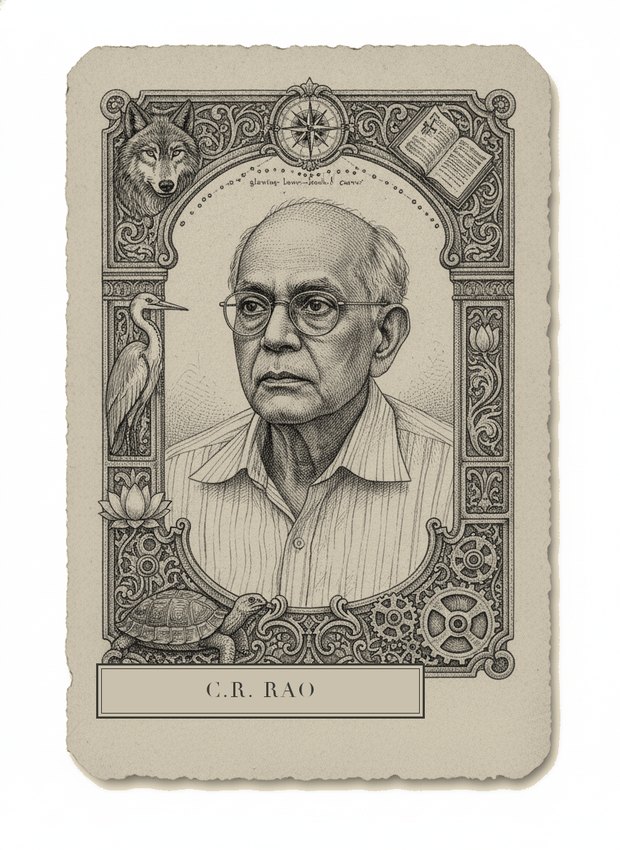
This is Rao's own theorem: his 1945 paper, written as a young statistician in Calcutta, derives what became known as the Cramer-Rao bound, proving that the variance of any unbiased estimator cannot fall below the reciprocal of the Fisher information the data carries about the parameter. His subsequent work on Rao-Blackwellization shows precisely how to construct estimators that approach or achieve this floor by conditioning on sufficient statistics, directly answering the problem's demand to identify when the bound is met. His broader contributions to information geometry, treating the Fisher information matrix as a Riemannian metric on the space of distributions, anticipate the problem's closing reframing of information as geometric curvature. He is the theorem's own author; the deduction from perfect marks is nominal.
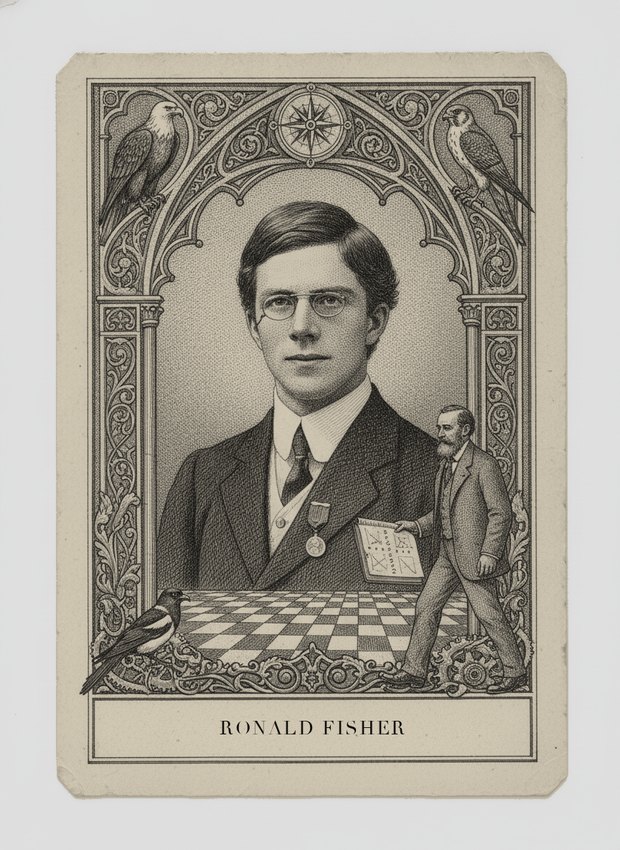
Fisher's development of maximum likelihood estimation and his precise 1920s definition of Fisher information as the expected curvature of the log-likelihood function supply the exact quantity this problem asks to be shown as 'a precise, computable quantity, the curvature of the likelihood.' His theory of estimation, including the property of asymptotic efficiency for maximum likelihood estimators, essentially predicts and motivates the bound that Rao and Cramer would later prove rigorously, since Fisher understood that the information in a sample sets a natural limit on estimation precision even before the exact inequality was formalized. Working entirely by hand at Rothamsted in the 1920s, he built the conceptual and computational apparatus the bound is stated in. He precedes the formal 1945 proof, keeping him just below Rao.
In the mind map
The same ideas, as concepts rather than history — in John's ML knowledge map.
35 figures are scored on this problem. Draw it in a battle to see where you land.