classification
Three species of iris
It is 1936, and the same mind that built modern experimental design turns to a small botanical table: measurements of iris flowers from three species, and whether a linear combination of petal and sepal dimensions can tell them apart. Find the projection that maximally separates the classes — pushing the between-group spread far and the within-group scatter tight — and reduce a multivariate cloud to a single discriminating axis. This little dataset will outlive its author as the teaching example of an entire method. Get the geometry wrong and you either force a linear boundary where the classes genuinely curl around each other, or miss that a simple projection already does most of the work — the ancestor of every linear classifier.
Who this problem belongs to
The two figures whose methods fit it best, out of 71 in contention.
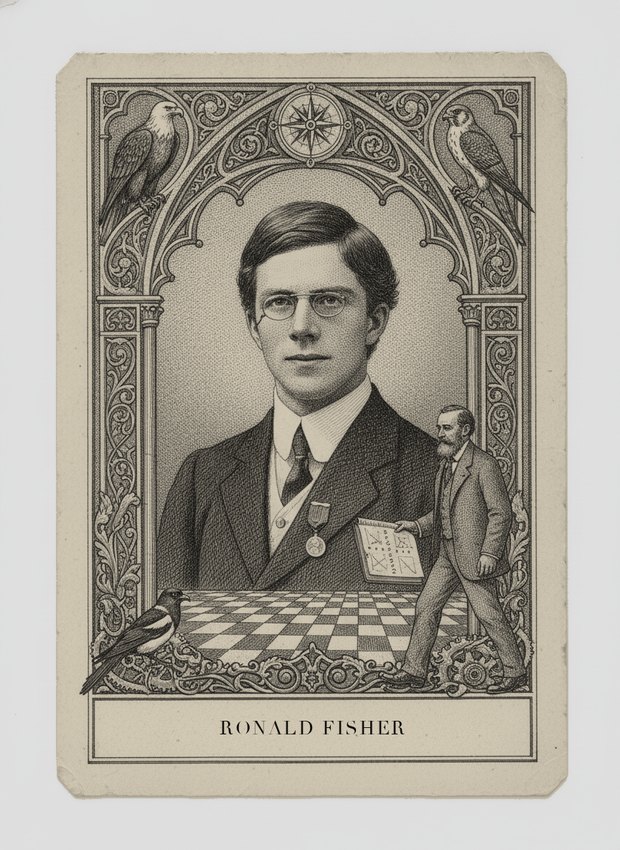
This problem is not an analogy for Fisher; it is his own 1936 paper, 'The Use of Multiple Measurements in Taxonomic Problems,' which introduced both the iris dataset, sepal and petal measurements across three species collected by Edgar Anderson, and linear discriminant analysis itself: finding the linear combination of features that maximizes the ratio of between-class to within-class variance, projecting a multivariate cloud onto a single discriminating axis. Every element of this problem, the three species, the petal and sepal measurements, the projection that maximizes separation, is drawn directly from his paper. He built this method as an extension of his own analysis of variance framework. No other figure in this roster has a more exact, literal claim on any problem in this entire game.
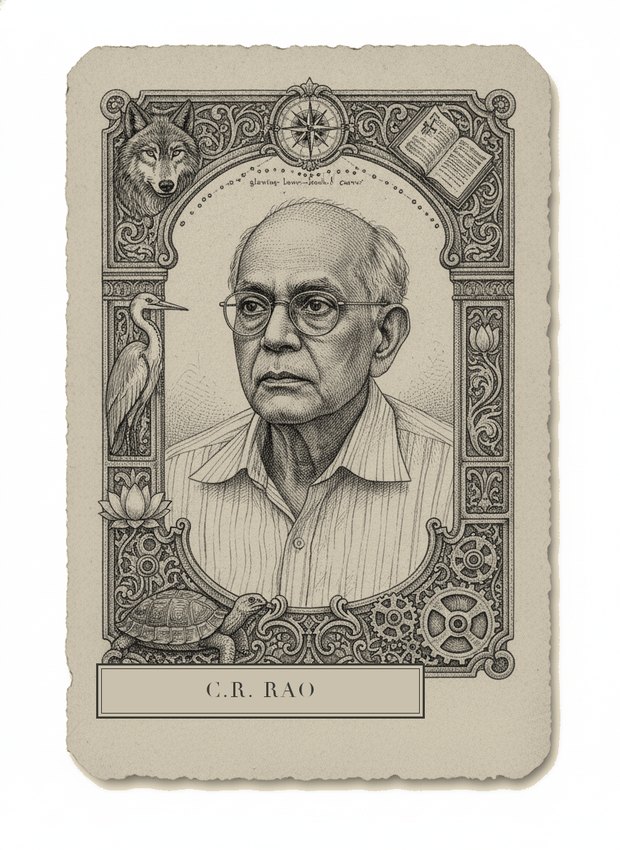
Rao extended Fisher's discriminant analysis substantially, generalizing it to multiple discriminant functions for more than two groups and developing the distance measures, the Mahalanobis-related generalized distance work he contributed to, that make discriminant analysis rigorous for exactly the three-species case this problem describes. His Cramer-Rao bound and Rao-Blackwellization, though not discriminant analysis themselves, reflect the same deep technical fluency with efficient estimation that underlies why Fisher's projection is optimal in the sense it claims. He worked directly in the Indian Statistical Institute tradition that built directly on and extended Fisher's original framework. His score trails Fisher only because the original 1936 method and dataset are unambiguously Fisher's own. His extensions remain foundational to how discriminant analysis is taught today.
In the mind map
The same ideas, as concepts rather than history — in John's ML knowledge map.
71 figures are scored on this problem. Draw it in a battle to see where you land.