small-sample
The eight field plots
It is 1921 at the Rothamsted agricultural station, and England needs to know which fertilizer regimen actually raises yield — but a season is a year, land is finite, and you have exactly eight plots of barley. Two treatments, four plots each; the harvest numbers differ, but the plots differ too: drainage, soil, sun. Decide whether treatment B genuinely outperforms A, and attach an honest statement of uncertainty computed by hand — because the wrong call becomes national agricultural policy and a decade of wasted seasons. The tools that solve this do not exist yet, unless you invent them. n=8 is not an inconvenience; it is the whole problem.
Who this problem belongs to
The two figures whose methods fit it best, out of 46 in contention.
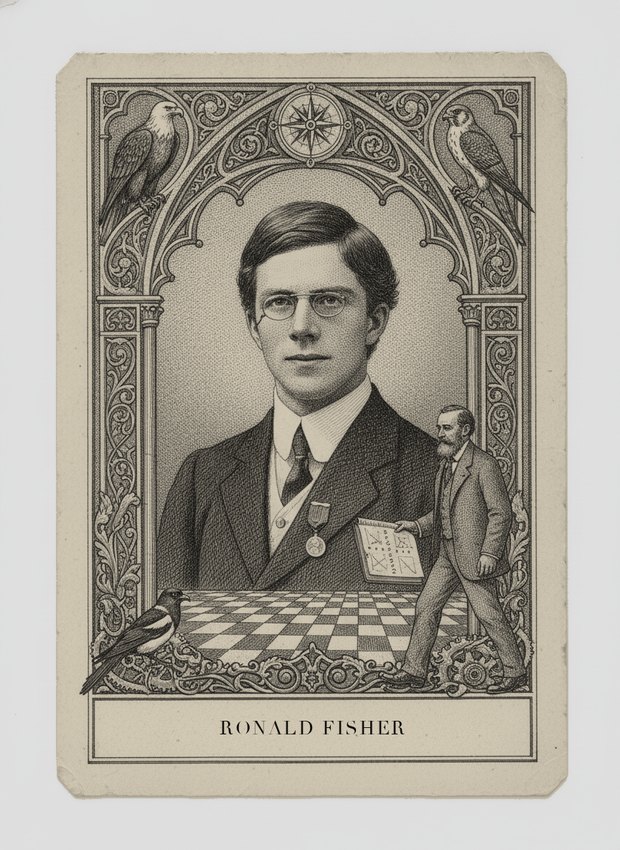
This is not a hypothetical for Fisher; it is his actual desk. He arrived at Rothamsted in 1919 and spent the early 1920s confronting exactly this: small agricultural experiments confounded by soil, drainage, and drift. His response invented the modern field — randomization as the physical basis of valid inference, blocking to absorb known heterogeneity, and analysis of variance to partition yield into treatment and error. His 1921 'Studies in Crop Variation' papers come straight from these plots, and Statistical Methods for Research Workers (1925) codified small-sample exact distributions precisely because agronomists could not wait for large n. Everything runs by hand, as he did it. The only reason the score is not 100 is that in 1921 some of this apparatus was still half-built; he built it here.
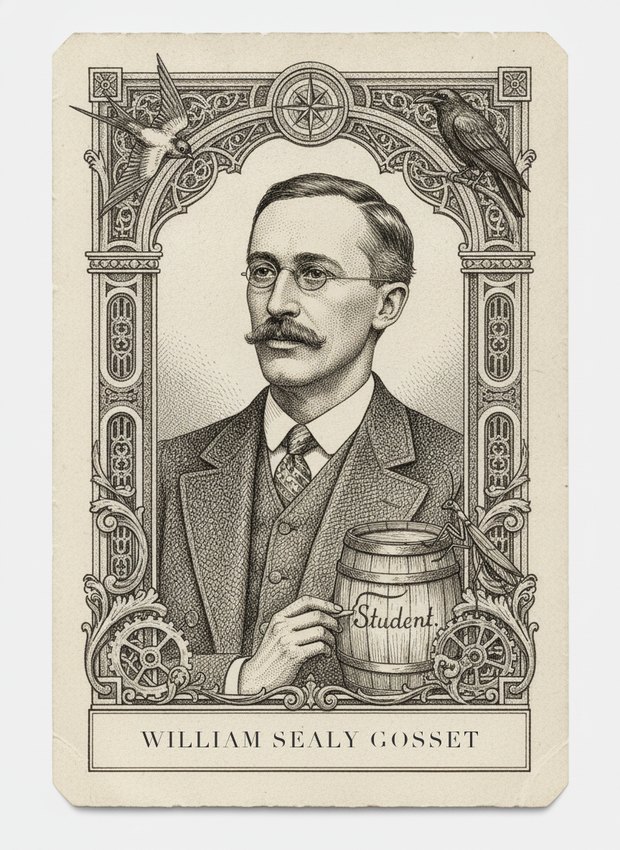
Gosset faced the n-tiny regime a decade before anyone else took it seriously. As Guinness's brewer-statistician he had to compare barley varieties and brewing treatments from handfuls of observations, and his 1908 paper 'The Probable Error of a Mean' — published as 'Student' — derived the t-distribution specifically so that small-sample means could carry honest uncertainty instead of large-sample lies. He ran and analyzed real barley field trials with Irish farms, computed everything by hand, and corresponded extensively with Fisher about exactly these problems. A two-sample comparison of four plots against four is squarely his instrument. He sits just below Fisher because formal randomization and blocking — the design half of the answer, which tames the drainage and sun confounds — were Fisher's contribution, not his.
Fought here
In the mind map
The same ideas, as concepts rather than history — in John's ML knowledge map.
46 figures are scored on this problem. Draw it in a battle to see where you land.