It is 1921 at the Rothamsted agricultural station, and England needs to know which fertilizer regimen actually raises yield — but a season is a year, land is finite, and you have exactly eight plots of barley. Two treatments, four plots each; the harvest numbers differ, but the plots differ too: drainage, soil, sun. Decide whether treatment B genuinely outperforms A, and attach an honest statement of uncertainty computed by hand — because the wrong call becomes national agricultural policy and a decade of wasted seasons. The tools that solve this do not exist yet, unless you invent them. n=8 is not an inconvenience; it is the whole problem.
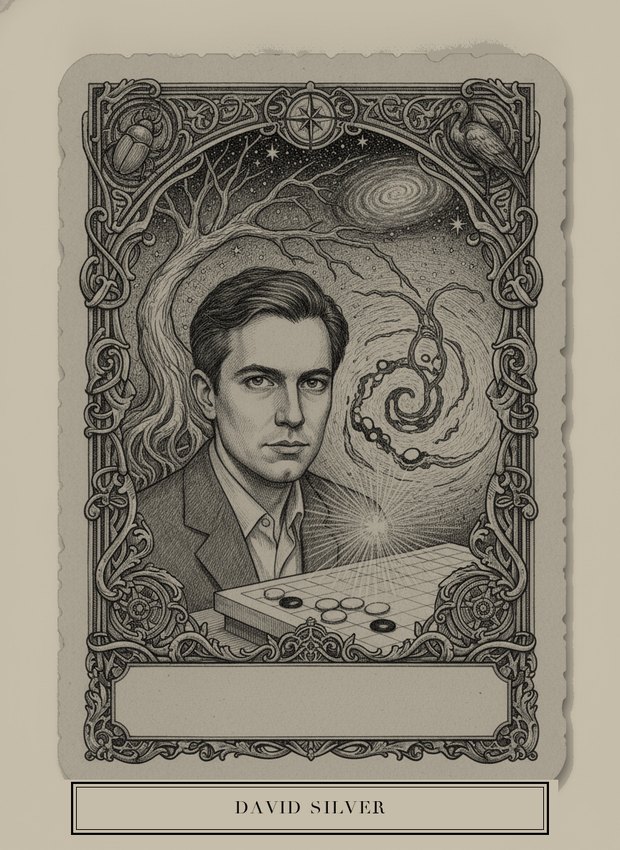
Silver's triumphs are the purest expression of learning from abundance. AlphaGo and AlphaZero work because a perfect simulator supplies unlimited experience — millions of self-play games — and because massive computation turns that experience into policy. Every load-bearing element is absent here: there is no simulator of Rothamsted soil, a 'trial' costs one year of real time, the total dataset is eight numbers, and the problem demands a calibrated uncertainty statement, an artifact reinforcement learning does not natively produce. One could romanticize the multi-season fertilizer program as a bandit problem, but bandit regret bounds at eight pulls are vacuous, and the sequential-design insight belongs properly to Wald and later Robbins. Silver's methods define one frontier of the field; this problem sits at the exact opposite frontier, where data are irreplaceable and honesty is the deliverable.
The professor's method for this problem is characteristically modern: he would open a notebook, type import scipy.stats, and confidently call a t-test — the one Gosset derived by hand in 1908 while actually growing the barley. Asked to justify the p-value, he would cite Fisher; asked to design the blocking, he would cite Fisher; asked to compute anything without electricity, he would cite a coffee shop with better Wi-Fi. This is the fate of the generalist who teaches the survey course: he knows exactly enough about the eight field plots to explain, with genuine eloquence, why Fisher, Gosset, and Neyman each beat him on their home turf — a lecture he has in fact given. The specialists invented the tools; the professor invented the slide deck. Score: zero, by design and, frankly, by merit.
Battle #145 · 8/10/2026, 11:40:16 AM · this result is deterministic: the same two personas on this problem always resolve the same way.