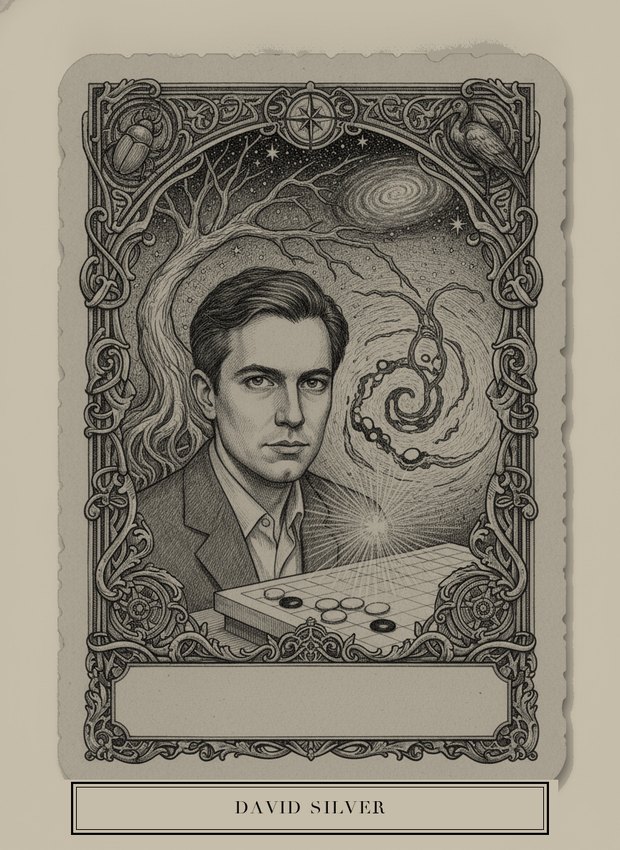
David Silver
AlphaGo and AlphaZero
Played by Greg Predhomme
Strongest on
Battles
The eight field plots W Rina Foygel Barber
Schedule the moonshot W Rina Foygel Barber
Act on what you cannot see L David Blei
The candidate you cannot recall L David Blei
The web of symptoms L Rina Foygel Barber
The web of symptoms
In the mind map
The same ideas, as concepts rather than history — in John's ML knowledge map.
Life and career
David Silver's route into research went through the video game industry, which turns out to be exactly the right preparation for a career spent teaching machines to play. He studied computer science at Cambridge, where he was a contemporary of Demis Hassabis, and after graduating the two of them co-founded a games studio. Silver spent several years there as a lead programmer on ambitious strategy titles — the kind of work where you build AI that has to be interesting to play against on consumer hardware, under a ship date. That is a very different discipline from academic AI, and its imprint on his later work is visible: an emphasis on systems that actually run, evaluated by whether they win.
He left the industry to do a doctorate at the University of Alberta with Richard Sutton, arriving at what was then the world's strongest reinforcement-learning group and choosing the hardest available target. His thesis applied reinforcement learning and simulation-based search to computer Go, in precisely the period when Monte Carlo tree search and the UCT algorithm were transforming the field — programs like MoGo and Crazy Stone had just jumped from weak to strong amateur play by replacing hand-built evaluation functions with statistics over random rollouts. Silver's contribution was to combine learned value functions with that search, which is the idea he would spend the next decade scaling.
He took a lectureship at University College London, where he taught a reinforcement learning course whose recorded lectures became, for years, how most of the world learned the subject. In 2013 he joined DeepMind, and the run that followed is the most publicly visible sequence of results in modern AI. He was part of the team behind DQN, which learned to play Atari games from raw pixels with a single architecture and no game-specific engineering. He then led AlphaGo, which defeated the European champion in 2015 and Lee Sedol four games to one in Seoul in March 2016 — a match watched by hundreds of millions of people, and one in which the program's thirty-seventh move in the second game became famous as an instance of machine play that professionals initially judged a mistake and later judged beautiful. AlphaGo Zero followed, dispensing with human game records entirely; then AlphaZero, the same algorithm mastering chess and shogi as well as Go from nothing but the rules; then MuZero, which dropped the requirement to know the rules at all. He has received the ACM Prize in Computing for this body of work.
Silver is also, with Sutton, Singh and Precup, a co-author of the "reward is enough" hypothesis: the argument that maximizing a suitably general reward signal in a suitably rich environment may be sufficient to produce the full range of abilities we associate with intelligence. Like Sutton's bitter lesson, it is a deliberately strong claim offered for argument, and it is contested.
Key contributions
**AlphaGo: learned evaluation plus search.** Go had resisted the techniques that solved chess because its branching factor is enormous and, more fundamentally, because no one could write down a good position evaluation function. AlphaGo's architecture attacked both. A policy network, initialized by supervised learning on human professional games and then refined by policy-gradient self-play, provided a prior over moves that pruned the search to a narrow, plausible beam. A value network, trained by regression on the outcomes of self-play games, provided a position evaluation that could replace or supplement full rollouts. Monte Carlo tree search then used both: the policy network to bias node expansion, the value network and rollouts to evaluate leaves, with statistics propagated up the tree. The key insight is the *complementarity* — search corrects the network's local errors, and the network makes search tractable by concentrating it where it matters. Neither alone was sufficient.
**AlphaGo Zero and AlphaZero: self-play as the entire curriculum.** The successors removed human data and, with it, most of the special-casing. A single network with policy and value heads is trained purely on games it plays against itself; MCTS acts as a *policy improvement operator*, producing a search-refined move distribution stronger than the raw network's, and the network is trained to match that distribution and predict the eventual outcome. Iterate, and you get a closed loop in which the player and its training data improve together. AlphaZero showed the same algorithm and hyperparameter regime mastering chess, shogi and Go, defeating the strongest handcrafted engines — an argument for generality that would have been unpersuasive without all three.
**MuZero: planning without the rules.** MuZero's advance is subtle and important. Instead of planning in the real environment, it learns a latent dynamics model trained *only* to make the quantities that matter for planning — value, policy, and reward — come out right, with no requirement that the latent state reconstruct anything about the observation. This makes model-based planning possible in domains where the transition rules are unknown or unrepresentable, and it demonstrated the point by matching AlphaZero on board games while also performing strongly on Atari.
**Deterministic policy gradients.** A more technical but widely used contribution: Silver and collaborators derived the deterministic policy gradient theorem, showing that for deterministic policies in continuous action spaces the gradient takes a simpler form, an expectation of the gradient of the action-value with respect to the action, chained with the policy Jacobian. This avoids integrating over the action space and, combined with deep networks and replay, became DDPG, one of the standard algorithms for continuous control.
**Deep Q-networks.** As part of the DQN team, Silver contributed to the demonstration that Watkins's Q-learning could be stabilized with function approximation using experience replay and a slowly updated target network — the result that started the deep-RL era.
In battle
Silver has the strongest sheet of the RL carriers: mean 36.0, median 26, seven problems above 80 and fourteen above 70, with thirty-six weak. RL at 62.9 and games at 53.3, each across a deep bench of sixteen to eighteen problems, make him the most reliable pick in any game-playing or sequential-control matchup.
"The grandmaster's intuition" (99) is, as the game's own explanation puts it, his biography with the serial numbers left on: learned evaluation plus search plus massive compute, applied to the game everyone said would resist it, at the exact historical moment. Nothing on the roster contests it. "Sixty actions a second, no full view" (96) is real-time partially observed control at high action rates — the regime beyond board games, where DeepMind's later game work lived, and where his combination of learned policies and learned models is the right toolkit. "The room with no reward" (84) is hard exploration, where MuZero-style learned models and search-based planning give him a real answer where pure model-free methods stall. "The bluff is the mathematics" (81) is imperfect-information game play — poker's territory, technically owned by the counterfactual-regret line rather than by him, which is why he places high but not first. "Cool the datacenter" (82) is applied control of an expensive real system, a problem DeepMind actually took on. "Ride the winds, stay on station" (80) is stratospheric balloon navigation, another real-world RL deployment. "The robot learns to grasp" (85) rewards deep RL for continuous control, where DDPG is his own contribution. "Best answer before the buzzer" (78) is anytime decision-making under a time budget, which is what MCTS is — you can stop it whenever and take the best move so far.
The losses are a clean statement of what self-play cannot do. "The therapy the trial reversed" (4) is confounding by indication in observational epidemiology; "Twenty thousand tests at once" (5) is multiple-testing correction; "The paradox in the admissions data" (5) is Simpson's paradox; "What happened first?" (5) is causal ordering; "Who wrote the disputed papers?" (5) is Bayesian authorship attribution; "The eigenvalues are lying" (6) is random-matrix correction of sample covariance. His testing average is 5.5, regression 7.0, high-dimensional 9.0, causality 15.2 across ten problems. Every one of these problems shares a feature that Silver's entire method presupposes away: you cannot rerun the world. Self-play works because the environment is simulatable, resettable, and cheap to sample millions of times. Epidemiology, econometrics and observational inference offer one dataset, no resets, and a confounding structure you must argue about rather than sample around.
The second, related weakness is reward specification. AlphaZero's environment provides a perfect, unambiguous, terminal reward — you won or you lost. Field Silver against a problem where the objective is contested, the environment is not simulatable, or the rules are unwritten, and the machinery has nothing to grip. His fairness average of 11.0 and systems average of 9.5 are the sharpest reminders that the most spectacular results in modern AI came from the narrowest and cleanest possible problem setting.