games
The grandmaster's intuition
It is 2015 in a DeepMind office in London, and Go has stood for twenty years as the game computers cannot play: a branching factor near 250, positions beyond astronomical, and professional intuition that no handcrafted evaluation function has ever approximated. Beat professional humans at this game. Exhaustive search is mathematically dead on arrival; learned evaluation must replace brute force — networks trained on human games and then on self-play, married to tree search that samples rather than enumerates. A public match against a world-class professional is scheduled; hundreds of millions will watch. Lose, and deep reinforcement learning remains a laboratory curiosity. Win badly — through a bug, at a critical move — and the field's credibility goes with it.
Who this problem belongs to
The two figures whose methods fit it best, out of 48 in contention.
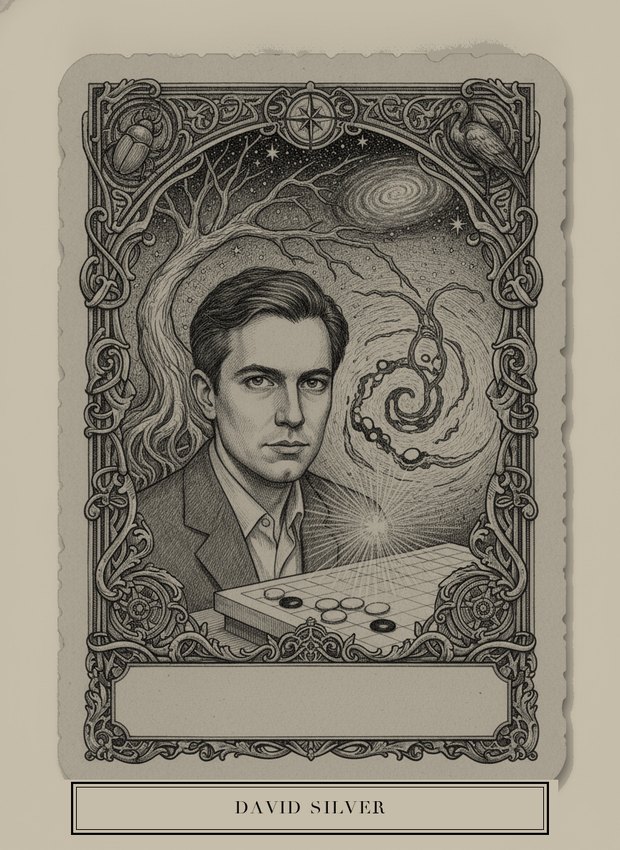
This problem is Silver's biography with the serial numbers left on. His PhD at Alberta under Sutton was reinforcement learning applied to Go, in the era when UCT and Monte Carlo rollouts (MoGo, Crazy Stone) first cracked strong amateur play; he then led the AlphaGo team at DeepMind, where the published method — a policy network trained on human professional games, refined by self-play, a value network regressed on self-play outcomes, both steering Monte Carlo tree search — is his design, and the March 2016 match against Lee Sedol ended 4-1 with a professional-level exhibition of exactly the learned intuition the problem demands. Every axis listed — deep RL plus search, massive compute — names his actual toolkit at its actual moment of application. No other carrier in the roster is the literal historical answer to a problem statement.
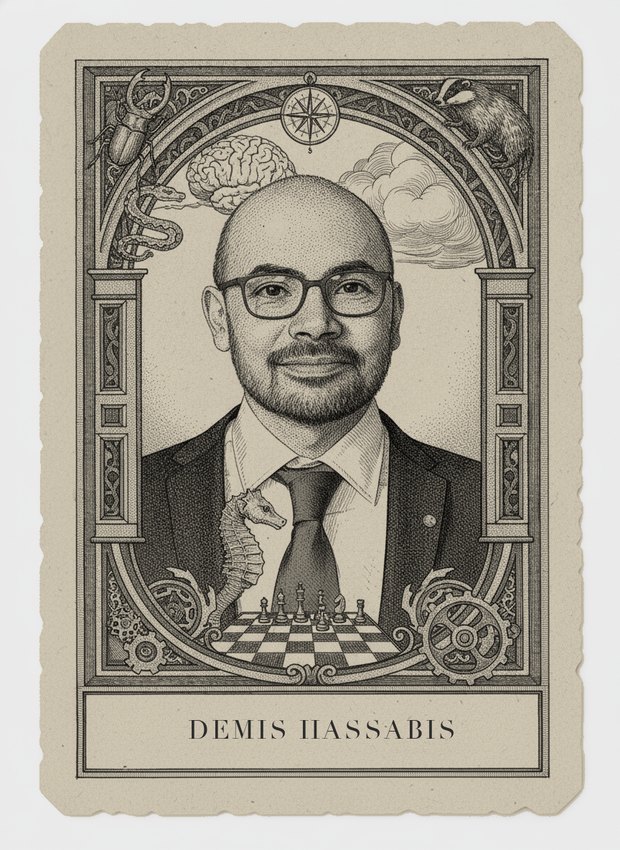
Hassabis supplies everything around the algorithm that the problem's framing makes explicit: the DeepMind office, the institutional bet, and the public match. A chess prodigy who reached master strength as a child, he understands board-game intuition from the inside; his neuroscience PhD (UCL, memory and imagination) shaped DeepMind's founding thesis that learning plus simulation is the road to general intelligence. He assembled the team, secured Google-scale compute, chose Go as the demonstration, and staged the Lee Sedol match with its hundreds of millions of viewers — the stakes paragraph of this problem is his strategic design. The honest gap: the algorithmic contributions are Silver's and the team's more than his, and he was not writing the training code. But 'beat professional humans at Go, publicly, without losing the field's credibility' was executed under his direction, successfully.
In the mind map
The same ideas, as concepts rather than history — in John's ML knowledge map.
48 figures are scored on this problem. Draw it in a battle to see where you land.