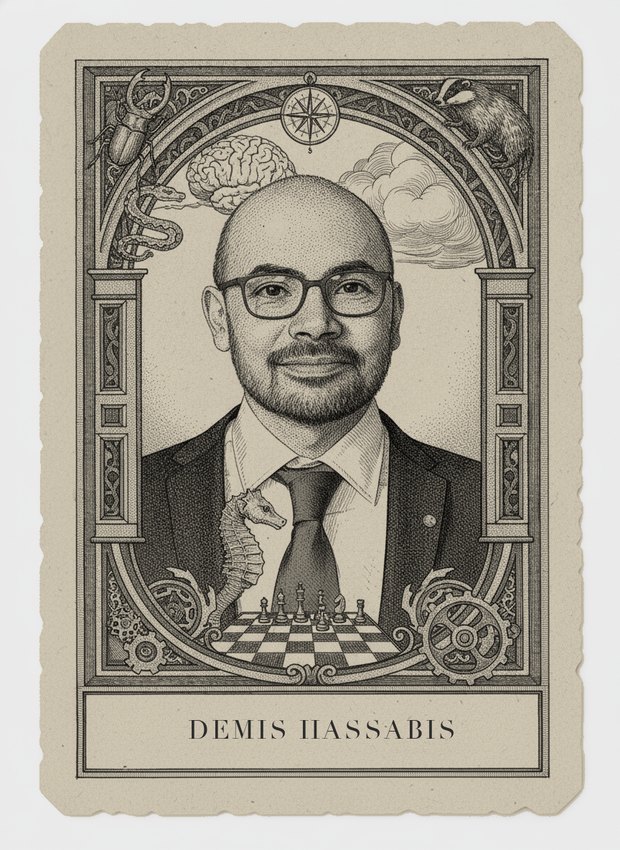
Demis Hassabis
DeepMind; AlphaFold; Nobel 2024
Strongest on
In the mind map
The same ideas, as concepts rather than history — in John's ML knowledge map.
Life and career
Demis Hassabis has had at least four careers, and the interesting thing is how tightly they connect.
Born in London in 1976, he was a chess prodigy — reaching master strength as a child and captaining England junior teams. Chess mattered to him less as a sport than as an object of curiosity: he has spoken often about being fascinated by the question of what his own brain was doing when it produced a good move without conscious calculation. That question, essentially, is the thread through everything that follows.
His second career was in video games. At seventeen he joined Bullfrog Productions, working with Peter Molyneux, and was a co-designer and lead programmer on *Theme Park*, a simulation game that sold in the millions. He then read computer science at Cambridge, graduating in 1997, and afterward founded his own studio, Elixir Studios, which produced ambitious simulation games through the early 2000s. Games gave him something academic AI at that time largely lacked: hands-on experience building systems where agents act in rich simulated worlds and the whole point is emergent behavior.
His third career was neuroscience. Concluding that AI would not progress without a better understanding of how brains actually do it, he closed the studio and took a doctorate in cognitive neuroscience at University College London, working in the memory group there. His best-known scientific result from this period concerns patients with hippocampal damage who cannot form new memories: Hassabis and colleagues showed that these patients are also impaired at *imagining* novel future experiences, providing striking evidence that episodic memory and constructive imagination share neural machinery. The work was widely recognized as a major result. Its conceptual content — that intelligence involves simulating experiences you have not had — became a founding premise of what came next.
In 2010 he co-founded DeepMind with Shane Legg and Mustafa Suleyman. The company's stated mission, unusually explicit for a startup, was to solve intelligence and then use it to solve everything else. Google acquired it in 2014. Under Hassabis's direction DeepMind produced the deep Q-network that learned Atari games from raw pixels, AlphaGo and its successors, and eventually AlphaFold. He was knighted for services to artificial intelligence, and in 2024 he shared the Nobel Prize in Chemistry with John Jumper and David Baker for computational protein structure prediction and design. He now leads Google DeepMind following the 2023 merger of Google's AI research organizations, and separately founded a company applying the same methods to drug discovery.
It is worth being precise about what Hassabis's contribution is, because it is unusual. He is not primarily the author of the algorithms his organization is famous for — those belong to David Silver, John Jumper, Volodymyr Mnih, and a large cast of researchers. His contribution is *direction*: choosing which problems constitute a decisive demonstration, assembling teams around them, securing the compute, and holding the institutional line through years when the bet was not obviously working.
Key contributions
**Deep reinforcement learning from raw perception.** DeepMind's deep Q-network combined Q-learning with convolutional networks, learning to play dozens of Atari games from pixels and score alone, using the same architecture and hyperparameters throughout. Two engineering ideas made it stable: **experience replay**, which stores transitions and samples them randomly to break the temporal correlation that destroys i.i.d. assumptions in online updating, and a **target network** whose parameters are frozen for intervals so that the bootstrapped regression target does not chase the estimator. That combination turned a known-divergent algorithm into a working one, and it opened the deep RL era.
**AlphaGo and the search–learning synthesis.** Go had resisted the tree-search methods that solved chess because its branching factor is enormous and its positions resist hand-written evaluation. AlphaGo combined Monte Carlo tree search with two learned convolutional networks — a policy network to focus the search on plausible moves, and a value network to evaluate positions without rolling out to the end — trained first from human games and then improved by self-play. AlphaGo Zero removed human data entirely, learning from self-play alone with a single network producing both policy and value, and AlphaZero generalized the same recipe to chess and shogi. The 2016 match against Lee Sedol, played before an audience of hundreds of millions, was a deliberately staged public demonstration; Hassabis's choice of Go as the target and his handling of the stakes are as much a part of that achievement as the algorithm.
**AlphaFold.** Predicting a protein's three-dimensional structure from its amino acid sequence had been an open problem for half a century, benchmarked biennially by the CASP competition. AlphaFold2 reached accuracy comparable to experimental methods for a large fraction of targets. The architecture couples an attention-based module operating on multiple sequence alignments — extracting co-evolutionary signal, where residues that mutate together are likely in contact — with a structure module that reasons directly in 3D over residue frames, all trained end to end with recycling of intermediate predictions. DeepMind then released predicted structures for essentially the entire known protein universe. This is the work that produced the Nobel.
**Applied optimization at scale.** A smaller but instructive result: DeepMind applied learned models to the control of Google's data center cooling systems, producing large reductions in the energy used for cooling — a demonstration that the same learning-plus-control machinery pays off on unglamorous industrial problems.
**Imperfect-information and real-time domains.** AlphaStar extended the program to StarCraft II, a domain requiring hundreds of actions per minute under partial observability with no turn structure, using league-based self-play to avoid the strategy cycles that plague naive self-play in non-transitive games.
In battle
Hassabis's card is a pure specialist's: 100 problems, mean 27.2, median 20, with 51 problems at or below 20 — but five dominant cards and a peak of 95. His `rl` category averages 71.7 and `games` 44.5 across sixteen problems, and essentially all of his value lives there.
**P054, "The grandmaster's intuition"** (95) is AlphaGo, and the scoring is unusually candid about *why* he wins it. The problem is framed institutionally — the office, the bet, the public match — and Hassabis supplies all of that: a former chess prodigy who understands board-game intuition from the inside, a neuroscience doctorate that shaped the founding thesis, the team assembly, the compute, and the decision to stage the demonstration in public without embarrassing the field. The stated gap is honest: the algorithmic contributions belong more to Silver and the team than to him. **P207, "Sixty actions a second, no full view"** (92) is AlphaStar, real-time and partially observed. **P229, "The room with no reward"** (80) is exploration under sparse or absent reward, a problem DeepMind pushed hard on.
**P227, "Cool the datacenter"** (95) is the data center energy result — a card players often overlook because it does not fit the AlphaGo narrative, and one of his most reliable wins. **P272, "Learning on the molecule graph"** (85) reflects AlphaFold and the graph-network line of work on molecular systems; note he sits below the equivariance theorists here, because the problem asks for the mathematical formulation rather than the deployment.
The mid-band shows what happens when he is near but not on the target. **P202, "The bluff is the mathematics"** (76) is poker — genuinely adjacent, but the landmark superhuman poker systems came from Carnegie Mellon, not DeepMind. **P196, "Best answer before the buzzer"** (70) is the Jeopardy-style question answering problem, which belongs to IBM. **P029, "The tilted scan"** (74) picks up his organization's medical imaging work.
The losses are the sharpest illustration in the game of the gap between modern scale and classical statistics. **P151, "Three species of iris"** (3) is his floor: Fisher's linear discriminant on 150 flowers, closed-form, small-sample. Nothing in Hassabis's program has ever engaged classical discriminant analysis, and his toolkit is comic overkill for a dataset this size. **P145, "Just look at the neighbors"** (4) and **P217, "How high must the dike be?"** (4) tell the same story, and his `small-sample` average of 9.5 and `experimental-design` average of 7.0 are among the lowest figures on any card.
He is also weak on causal reasoning despite a broad `causality` bucket of eighteen problems averaging just 17.2. **P214, "The paradox in the admissions data"** (5) — Simpson's paradox — and **P215, "The therapy the trial reversed"** (5) are pure confounding problems, and reinforcement learning's causal machinery is not the same machinery. **P248, "The machine that overdosed"** (5) is safety-critical software engineering, and his `systems` average of 6.5 is his outright floor.
Play Hassabis on games, agents, exploration, and moonshot scientific targets. Bench him the moment a problem has fewer than a thousand data points or requires deciding whether an association is causal.