games
The bluff is the mathematics
It is 2017 in Pittsburgh, and heads-up no-limit poker has replaced chess as the honest benchmark, because poker has what chess never did: hidden cards. Beat top human professionals in a game of imperfect information, where the opponent's hand is unknown, bluffing is optimal play rather than psychology, and the strategy must be a probability distribution — von Neumann's original insight, finally at scale. Solving it means compressing a game with more situations than atoms into an abstraction, computing near-equilibrium strategies, and re-solving subgames in real time. Get it wrong and the machine's tells are found and farmed by professionals within a day; get it right and equilibrium computation graduates from a theorem about parlor games to a tool for any adversarial negotiation.
Who this problem belongs to
The two figures whose methods fit it best, out of 58 in contention.
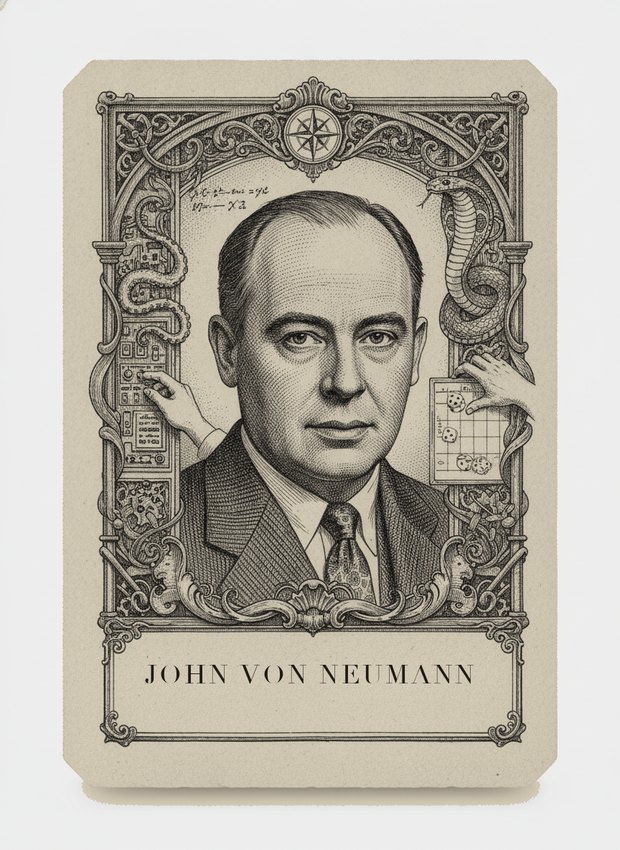
This is his problem before it was anyone else's. Von Neumann proved the minimax theorem in 1928 and, with Oskar Morgenstern, wrote Theory of Games and Economic Behavior (1944), which explicitly uses simplified poker to show that bluffing is not psychology but the rational output of a mixed strategy under hidden information -- exactly the insight the 2017 Pittsburgh match vindicates at scale. He understood that in a zero-sum game with private information, optimal play is a probability distribution over actions, not a single best move, and that an opponent who can be predicted can be exploited. The only reason this is not a perfect 100 is that he had no path to computing equilibria over a state space this vast; the theorem is entirely his, the computation is 2017's.
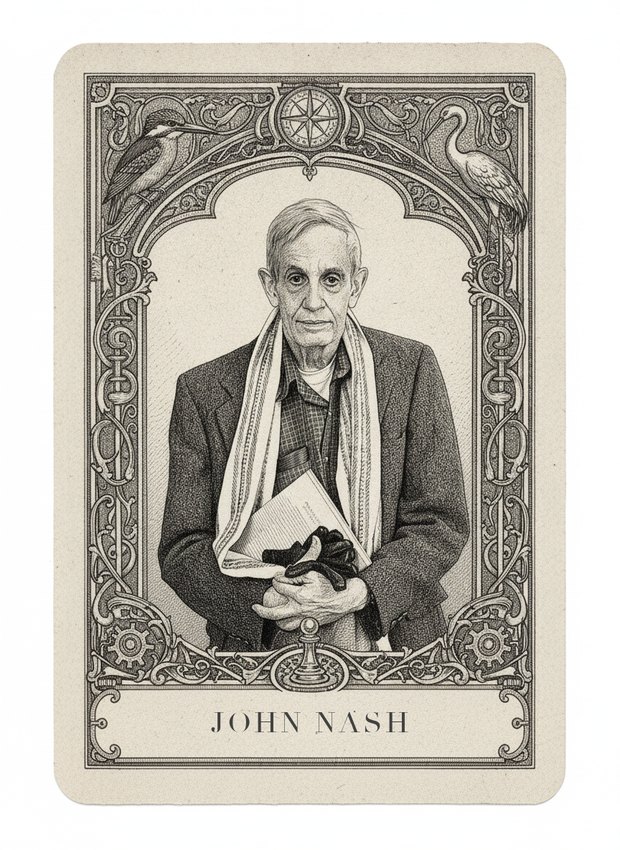
Nash's 1950 and 1951 papers generalized von Neumann's zero-sum minimax into equilibrium concepts for any finite game, proving existence via fixed-point methods -- the mathematical object that 'near-equilibrium strategy' in poker actually names. Heads-up no-limit hold'em is two-player and effectively zero-sum, so the game sits closer to von Neumann's original terrain than to Nash's general non-cooperative setting, but the modern engineering of solving huge extensive-form games by approximating a Nash equilibrium borrows his vocabulary and existence guarantees directly. Nash worked with pencil, paper, and small matrix games at Princeton; he never confronted a game tree with more situations than atoms, and had no computational machinery for approximate equilibria at that scale. He supplied the concept the engineers approximate, not the algorithm that finds it.
In the mind map
The same ideas, as concepts rather than history — in John's ML knowledge map.
58 figures are scored on this problem. Draw it in a battle to see where you land.