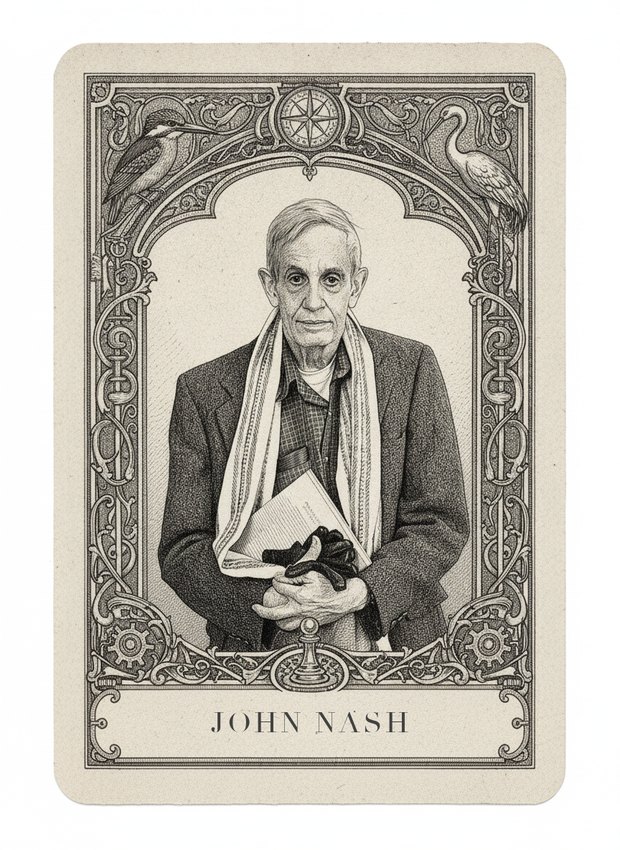
John Nash
Equilibrium in non-cooperative games
Strongest on
In the mind map
The same ideas, as concepts rather than history — in John's ML knowledge map.
Life and career
The letter of recommendation that sent John Forbes Nash Jr. to graduate school at Princeton is said to have consisted of a single line: "This man is a genius." He arrived in 1948 from Carnegie Tech, where he had gone on a full scholarship intending to become an electrical engineer like his father, drifted into chemistry, and then been told by the mathematics faculty that he was a mathematician whether he liked it or not. He was nineteen. Within two years he had written a doctoral thesis of twenty-seven pages that would, four decades later, win a Nobel Prize.
Nash was born in Bluefield, West Virginia, in 1928. Princeton in the late 1940s was arguably the densest concentration of mathematical talent ever assembled — von Neumann, Einstein, Gödel, Lefschetz, with Tucker, Minsky, McCarthy, and Shapley among the students — and Nash was competitive in it to the point of abrasiveness. He did not attend classes much, preferring to derive things himself. He is reported to have shown his equilibrium result to von Neumann, who dismissed it as a trivial fixed-point argument; von Neumann's own theory of games, with Morgenstern, concerned zero-sum and cooperative settings, and he did not see what Nash's extension bought.
After Princeton, Nash worked at RAND during the summers and joined MIT's mathematics faculty in 1951. The work he did there is what pure mathematicians consider his real achievement: the embedding theorems for Riemannian manifolds, and, with Ennio De Giorgi arriving at the same result independently, the regularity theory for solutions of elliptic and parabolic partial differential equations. He married Alicia Lardé, a physics student from El Salvador, in 1957.
In 1959, at thirty, Nash began to experience the symptoms of paranoid schizophrenia. The illness was severe and prolonged. He lost his MIT position, spent periods in psychiatric hospitals, traveled in Europe attempting to renounce his American citizenship, and for roughly three decades was largely unable to work. Alicia divorced him in 1963 but continued to care for him, taking him into her home; they remarried in 2001. Through the 1970s and 1980s he was a quiet presence around Princeton's mathematics building, a figure students knew about before they knew who he was. He described the eventual improvement not as a cure but as a gradual, partly deliberate refusal to follow delusional thinking — a rationality he had to reassert rather than recover.
The 1994 Nobel Memorial Prize in Economic Sciences, shared with John Harsanyi and Reinhard Selten, was awarded amid genuine institutional anxiety about his health. He was well enough. In 2015 he received the Abel Prize, mathematics' highest honor, for the PDE work — making him the only person to hold both. Days after returning from the Abel ceremony in Oslo, he and Alicia were killed in a taxi accident on the New Jersey Turnpike. Sylvia Nasar's biography *A Beautiful Mind* and the film adapted from it made him, improbably, the most famous mathematician of his generation.
Key contributions
**Nash equilibrium.** The 1950 PNAS note "Equilibrium Points in N-Person Games" and the 1951 *Annals of Mathematics* paper "Non-Cooperative Games" establish that every finite game — any number of players, any payoffs, not necessarily zero-sum — has at least one equilibrium in mixed strategies. The definition is the one you know: a profile of strategies such that no player can improve their payoff by unilaterally deviating. The proof is a fixed-point argument. Define the best-response correspondence mapping each strategy profile to the set of profiles in which every player plays optimally against the others; show it is upper hemicontinuous with convex, nonempty values; apply Kakutani's fixed-point theorem (the 1951 version uses Brouwer with a clever direct construction). A fixed point of best response *is* an equilibrium.
The importance is not the technique but the scope. Von Neumann's minimax theorem covers two-player zero-sum games; that is a small and rather special corner of strategic life. Nash's theorem covers everything finite, including the interesting cases where interests are partly aligned and partly opposed. This is why the result reorganized economics — oligopoly, bargaining, auctions, contracts, industrial organization, and eventually political science and evolutionary biology, where the evolutionarily stable strategy is a refinement of Nash equilibrium. Nash's thesis also contained a "mass action" interpretation, reading equilibrium as the resting point of a population of agents adjusting through repeated play, which anticipates evolutionary game theory and much of multi-agent learning.
Two honest caveats belong in any graduate treatment. Existence is not uniqueness: many games have multiple equilibria, so the concept underdetermines prediction, which is why the subsequent literature is largely about refinements (subgame perfection, trembling-hand perfection — Selten's contributions). And *computing* an equilibrium is hard: Daskalakis, Goldberg, and Papadimitriou showed in 2006 that finding a Nash equilibrium is PPAD-complete, a complexity-theoretic obstruction entirely invisible in 1950.
**The Nash bargaining solution** (1950, and "Two-Person Cooperative Games," 1953) approaches the cooperative side axiomatically: state four properties any reasonable bargaining outcome should satisfy — Pareto efficiency, symmetry, invariance to affine rescaling of utilities, and independence of irrelevant alternatives — and show that exactly one solution satisfies all four, namely the point maximizing the product of the players' gains over their disagreement points. This axiomatic style, deriving a unique mechanism from stated desiderata, is now standard across mechanism design and fair division, and is the ancestor of a great deal of work in algorithmic fairness.
**The mathematics.** The Nash embedding theorems (1954, 1956) show that any Riemannian manifold can be isometrically embedded in some Euclidean space — a result whose proof introduced techniques (an iteration with a smoothing operator, later formalized by Moser as the Nash–Moser inverse function theorem) that became a standard tool in nonlinear analysis. The **De Giorgi–Nash–Moser theorem** establishes Hölder continuity of solutions to certain second-order elliptic and parabolic PDEs with merely measurable coefficients, resolving a version of Hilbert's nineteenth problem. Mathematicians generally consider this the deeper work; Nash himself is reported to have been more proud of it than of the equilibrium result.
In battle
Nash carries a hundred problems at a mean of 28.7 with seven dominant scores — one of the sharpest peak-and-plain profiles in the game. His `games` category mean of 55.1 across sixteen problems is the highest of anyone whose primary work is not computational, and `fairness` at 48.0 reflects the bargaining axioms rather than the equilibrium theorem.
The peak is **When everyone acts selfishly** (P052) at 98, essentially the ceiling. The problem is his 1950 note in the strict historical sense — the phrase about no firm regretting its choice given the others' choices is his definition restated, Cournot's 1838 oligopoly is the special case his theorem subsumes, and the thesis's mass-action interpretation even anticipates the question of whether repeated play converges there. What keeps him off 100 is exactly the two caveats above: multiple equilibria make prediction ambiguous, and PPAD-completeness means the object he proved to exist may be intractable to find.
The rest of his dominant band is strategic interaction under different institutional clothing. **Design the auction** (P055) at 93 and **Auction the airwaves** (P205) at 92 sit on mechanism design, where his axiomatic bargaining work is the methodological ancestor even though the specific auction theory belongs to Vickrey, Myerson, and the spectrum-auction designers. **The zero-sum room** (P051) at 92 is von Neumann's territory that Nash generalized. **The tournament of strategies** (P203) at 90 — Axelrod's iterated prisoner's dilemma — is his equilibrium concept meeting repeated play. **The bluff is the mathematics** (P202) at 84 is poker, where mixed strategies are not a mathematical convenience but the actual content of the game. **The ad the algorithm never showed you** (P297) at 80 and **The exchange with no prices** (P206) at 70 extend the same reasoning into ad auctions and matching markets.
His floor is unusually revealing about the shape of his mind. He scores 8 on **Fill in the hidden variables** (P184) — the EM algorithm — 8 on **The paradox in the admissions data** (P214), 8 on **The sentence in a single vector** (P260), 8 on **Let the images choose the basis** (P288) — eigenfaces and PCA — and 6 on **Name what you've never trained on** (P243), zero-shot learning. His absolute floor is 3 on **The language for the job** (P079), programming language design, where he has literally nothing: no documented engagement with computing infrastructure at any point in his life.
The pattern is that Nash reasons about *agents with objectives*, not about *data with noise*. Give him rational actors, payoffs, and a solution concept and he is unmatched. Give him a sample, a latent variable, or a likelihood and his tools go silent — his classification mean is 12.5, causality 10.0, perception 8.0, nlp 9.0. He is also, worth noting, weaker than one might expect on optimization (30.4 over sixteen problems) despite the fixed-point machinery, because most optimization problems in the game are numerical rather than strategic.
The strategic lesson for a player: Nash is a specialist weapon. In any room with multiple decision-makers and conflicting incentives he is the best card on the board. Everywhere else, he is a mathematician of extraordinary depth working entirely outside the question.