games
Auction the airwaves
It is 1994 in Washington, and Congress has ordered the FCC to sell the radio spectrum by auction — billions of dollars of licenses whose values interlock, because a license in one city is worth more to a bidder who also wins the neighboring one. Design the auction: simultaneous ascending bids across all licenses, activity rules that force serious bidding, and safeguards against the tacit collusion that bidders will attempt through the bids themselves — signaling with trailing digits, dividing markets without a word spoken. Game theorists are designing against game theorists. Get it wrong and the licenses fetch a fraction of their worth, or assemble into inefficient patchworks that hobble the wireless industry for decades; get it right and mechanism design becomes national policy.
Who this problem belongs to
The two figures whose methods fit it best, out of 47 in contention.
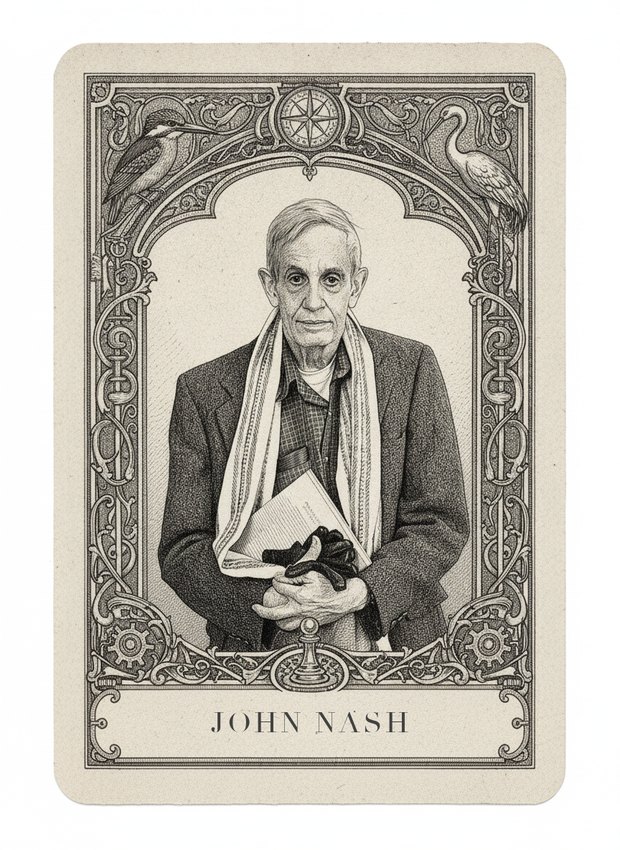
Nash's equilibrium concept, generalizing strategic reasoning to any finite game of rational self-interested players, is the theoretical bedrock the 1994 FCC spectrum auction design actually had to reckon with: bidders signaling with trailing digits or tacitly dividing markets are choosing equilibrium strategies against each other, and any well-designed auction mechanism must be robust to exactly that kind of strategic behavior. Paul Milgrom and Robert Wilson, who designed the simultaneous ascending auction, worked directly in the Nash equilibrium tradition, reasoning about what activity rules and bidding structures would make honest, competitive bidding the equilibrium outcome rather than collusion. Nash himself did not design auctions or work on interdependent-value mechanism design specifically, which is why this stops short of a perfect score, but the game is played entirely on his conceptual terrain.
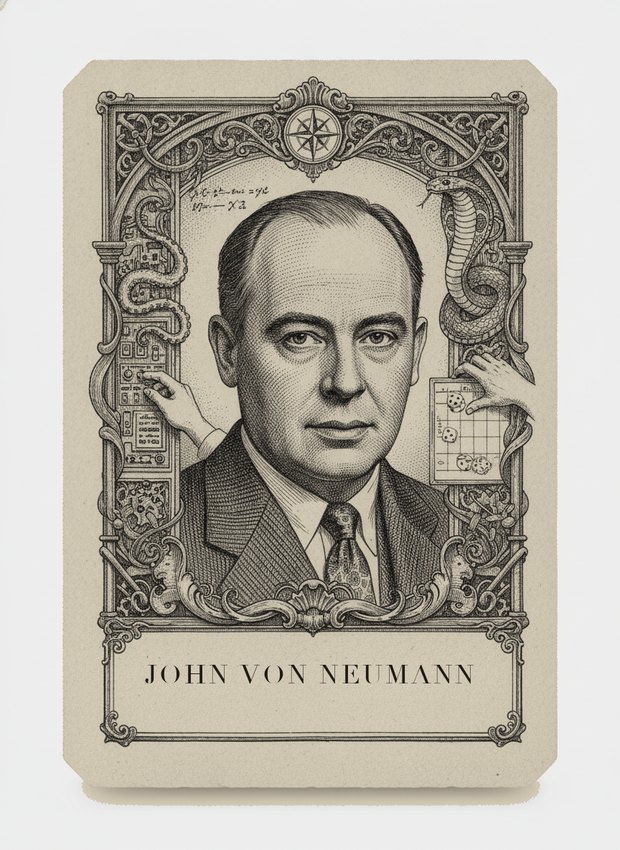
Von Neumann founded modern game theory with his 1928 minimax theorem and, with Morgenstern, the 1944 Theory of Games and Economic Behavior, establishing the formal apparatus -- strategic reasoning among rational self-interested agents -- that underlies all subsequent auction and mechanism design, including the FCC's 1994 spectrum sale. His work on cooperative game theory and coalition formation is also relevant background for understanding how bidders might tacitly collude to divide markets, exactly the behavior the auction's safeguards had to defend against. Von Neumann did not work on auction design or interdependent-value mechanisms specifically, and mechanism design as a distinct subfield emerged decades after his death, but the game-theoretic vocabulary the FCC's economists used to reason about the auction is his.
In the mind map
The same ideas, as concepts rather than history — in John's ML knowledge map.
47 figures are scored on this problem. Draw it in a battle to see where you land.