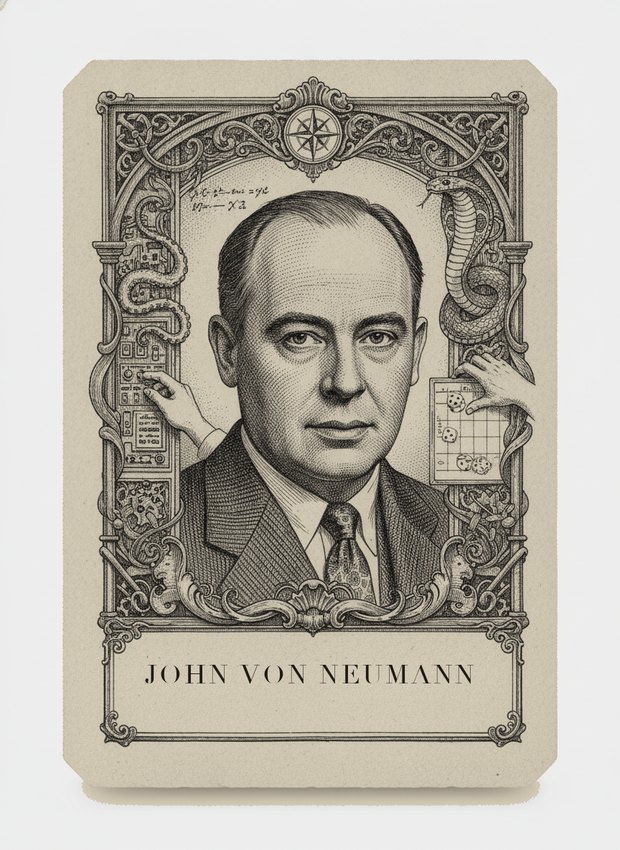
John von Neumann
Stored-program computer, game theory, Monte Carlo methods
Strongest on
In the mind map
The same ideas, as concepts rather than history — in John's ML knowledge map.
Life and career
The stories about von Neumann's speed are so numerous, and told by so many people who were themselves formidable, that they have to be taken seriously as data. Colleagues at Los Alamos and Princeton described a man who could listen to a problem, work it in his head, and give the answer before anyone had found a pencil. Eugene Wigner, a Nobel laureate who had known him since school in Budapest, is often reported as saying that only von Neumann was fully awake. What matters more than the anecdotes is the range: in roughly thirty years of work he founded or transformed the mathematical foundations of quantum mechanics, game theory, computer architecture, numerical analysis, and the theory of self-reproducing automata.
János Neumann was born in Budapest in 1903 into a prosperous Jewish banking family — his father was ennobled, hence the *von*. He was part of the extraordinary cohort of Hungarian scientists (Wigner, Szilard, Teller, Erdős slightly later) that emerged from Budapest's gymnasium system in the early twentieth century. He took a chemical engineering degree in Zurich to satisfy his father and a mathematics doctorate in Budapest, essentially simultaneously, finishing at 22 with a thesis on axiomatic set theory.
He spent the late 1920s in Göttingen and Berlin, in the middle of the quantum revolution, and produced *Mathematische Grundlagen der Quantenmechanik* (1932), which gave quantum mechanics its Hilbert-space formulation and along the way founded the theory of operator algebras. In 1933 he became one of the original faculty of the Institute for Advanced Study in Princeton — one of six, alongside Einstein — and remained there for the rest of his life.
The war changed the direction of his work permanently. He became a consultant to the Manhattan Project, where his contribution to the implosion design of the plutonium weapon was substantial, and where the sheer computational demand of hydrodynamics calculations pushed him toward computing. He was a consultant to the ENIAC project at the Moore School in Philadelphia, and in 1945 wrote the *First Draft of a Report on the EDVAC* — a document circulated with only his name on it, which caused lasting friction with Eckert and Mauchly, who had contributed centrally to the ideas, and which arguably placed the design in the public domain. Whatever the credit dispute, the report is the founding text of the stored-program computer, and "von Neumann architecture" is now simply what a computer is.
After the war he built the IAS machine at Princeton, whose design was deliberately published and widely copied, and he became one of the most powerful scientific advisors in the United States government — on the Atomic Energy Commission, on ballistic missile strategy, closely involved with RAND. His Cold War politics were hawkish and are part of the honest record; he advocated hard deterrence and, in the late 1940s, was associated with arguments for confronting the Soviet Union early.
He was diagnosed with cancer in 1955, probably related to radiation exposure at the test sites. He continued working from a wheelchair and then a hospital bed at Walter Reed, under military guard because of what he knew. His final, unfinished manuscript, published as *The Computer and the Brain*, is a comparative analysis of neural and digital computation — noting that neurons are slow but massively parallel and that the brain's arithmetic must be low-precision and statistical, arguments that read remarkably well today. He died in 1957, aged 53.
Key contributions
**The minimax theorem and game theory.** In "Zur Theorie der Gesellschaftsspiele" (1928), von Neumann proved that every finite two-person zero-sum game has a value: with mixed strategies allowed, $\max_p \min_q p^\top A q = \min_q \max_p p^\top A q$. This is the statement that rational play in strict competition has a determinate solution and that randomization is what makes it so. The original proof used a fixed-point-flavored argument; the streamlined convexity/separating-hyperplane proof came later. With Oskar Morgenstern he wrote *Theory of Games and Economic Behavior* (1944), which extended the framework to $n$-person and cooperative games and established the axiomatic derivation of expected utility from preference axioms — the foundation of decision theory. The duality between the minimax theorem and linear programming duality was recognized in conversation with Dantzig and is one of the load-bearing connections in optimization.
**The stored-program architecture.** The EDVAC report describes a machine with a single addressable memory holding both instructions and data, a control unit that fetches and decodes sequentially, an arithmetic-logic unit, and I/O. Storing programs in the same memory as data is what makes a computer programmable rather than rewireable, and it is what makes compilers, interpreters, and self-modifying code possible. The "von Neumann bottleneck" — the bandwidth limit between memory and processing — is the price, and it is the constraint that GPU and dataflow architectures have spent decades trying to route around.
**Monte Carlo methods.** With Stanislaw Ulam at Los Alamos, von Neumann turned random sampling into a computational method for problems that resist analytic solution — neutron diffusion first, then integration, then everything. He also contributed the practical machinery: the middle-square method (which he knew was bad, and said so), rejection sampling, and the *von Neumann extractor*, an elegant trick for turning a biased coin into a fair one by observing pairs and discarding ties. His remark that anyone who considers arithmetical methods of producing random digits is in a state of sin is one of the few quotations of his that is well documented and worth repeating.
**Numerical analysis.** With Herman Goldstine he analyzed the accumulation of rounding error in the numerical inversion of large matrices, essentially founding the rigorous study of floating-point error propagation and conditioning. He is also credited with early work on stability analysis of finite-difference schemes.
**Cellular automata and self-reproduction.** Von Neumann asked whether a machine could build a copy of itself and answered it constructively: a universal constructor operating on a cellular automaton lattice, carrying a description tape that is both interpreted (to build) and copied (to pass on). He worked this out before the structure of DNA was known, and the logical architecture he identified — a description used in two distinct modes — is precisely what DNA does.
**Operator algebras, ergodic theory, and more.** Von Neumann algebras, the mean ergodic theorem, contributions to lattice theory and continuous geometry. Even setting the computing aside, he would be a major twentieth-century mathematician.
In battle
Von Neumann is the roster's great generalist, and the profile reflects it: 100 problems, mean 47.5, seventeen dominant cells and twenty-two at 70 or above — the widest strong band of any mid-century figure — with only fifteen problems at 20 or below.
His categories are led by **networks** (78.5), **causality** (77.5), **optimization** (76.6 across 7 problems), **games** (67.6 across 12), and **computability** (56.9 across 16). That is an unusual shape: most figures are strong in one or two categories, and von Neumann is strong in five that have little to do with each other.
His signature cell is **P051 — The zero-sum room** at 99, which is his own 1928 theorem, and the matrix notes there is no era gap at all — the problem's RAND-and-nuclear-strategy framing is literally his biography. **P202 — The bluff is the mathematics** (97) is poker under the minimax framework, the example he and Morgenstern used to show that mixed strategies are not a mathematical convenience but the actual content of skilled play. **P211 — Roll the dice at Los Alamos** (97) is Monte Carlo, invented in the room he was standing in. **P251 — The arithmetic that drifts** (95) is floating-point error accumulation — the Goldstine collaboration. **P194 — Prune the adversary's replies** (95) is alpha-beta, a direct descendant of minimax backup. **P177 — The certificate of optimality** (93) is LP duality, and **P040 — Feed the army for pennies** (92) is the diet problem — Dantzig's simplex territory, where von Neumann's duality insight is the theoretical half. **P154 — The truth it cannot prove** (92) is Gödel incompleteness, and von Neumann's claim there is genuine: he attended Gödel's announcement, immediately grasped the consequence, and independently derived the second incompleteness theorem before learning Gödel had it.
The weaknesses are of a single kind and they are all about *engineering at scale after 1960*. His floor cells are **P081 — Train across a thousand GPUs** (15), **P082 — Ship it to a hundred contributors** (15, distributed open-source development), **P249 — The shopping cart that must not vanish** (15, availability under network partition), and **P248 — The machine that overdosed** (12, the Therac-25 race conditions). Every computer in those problems is a von Neumann machine, and that is exactly the point: he specified the machine model, not the practice of building large concurrent fault-tolerant systems on top of it. His **systems** average of 27.8 across 18 problems is the numeric summary of that gap.
The other soft spot is statistical. **Regression** at 15.0, **classification** at 20.5, **high-dim** at 21.5, and floor cells at **P143 — The coefficient that flips sign** (12, multicollinearity/suppression) and **P144 — The spam in the inbox** (13). Von Neumann was a probabilist of great power but not a statistician: he did not do inference from samples, model selection, or supervised learning from data. Problems whose difficulty is estimation rather than structure find him surprisingly empty-handed.
The play, then: bring von Neumann anywhere adversaries, randomness, optimality certificates, machine architecture, or numerical precision are involved, and he is near the top of the board. Bring him to a problem about fitting a model to noisy observations, or to any question about operating a thousand machines, and a much lesser figure will beat him.